
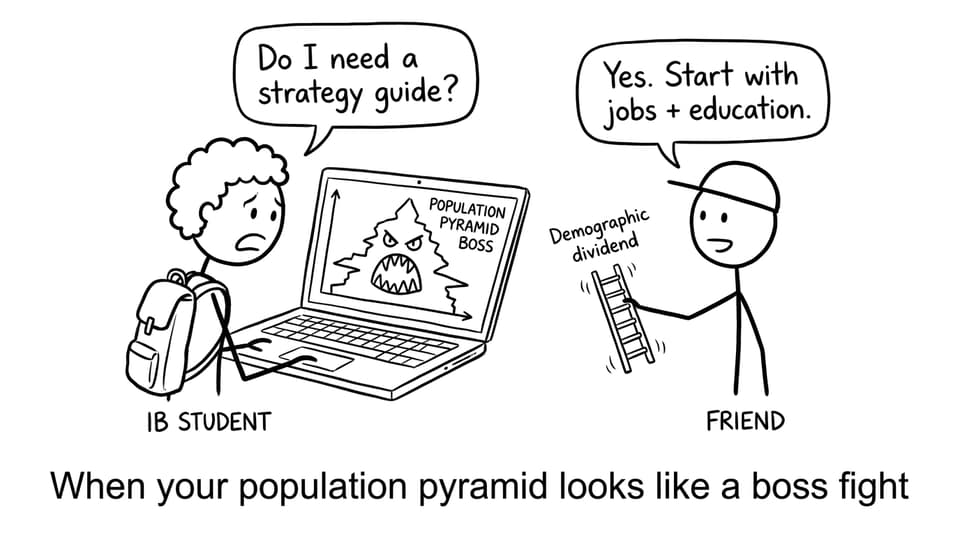
Youth bulges can look scary on a population pyramid. Wide base, steep dependency ratio, and a future that seems to arrive all at once. But in IB Geography, that same shape can also be a plot twist: a country with a youthful population structure is holding potential energy. Whether it becomes progress or pressure depends on decisions made now.
This matters for exams because questions rarely ask you to describe a youthful structure. They ask you to evaluate what it means. So let’s turn the topic into clear opportunities you can use in essays, data responses, and case-study paragraphs in IB Geography.
Quick checklist: opportunities to look for in IB Geography
When a country has a large proportion of people under 15, scan for these opportunity pathways:
-
Potential demographic dividend (more workers compared to dependants)
-
Faster human capital gains (education, skills, productivity)
-
Entrepreneurship and tech adoption (youth-led innovation)
-
Urban growth that can deepen markets and infrastructure
-
Social change (gender equality, civic participation, cultural dynamism)
If you want to practise turning these into exam chains, start with the IB Geography Topic 1.2 Questionbank and aim to write each point as: condition to process to outcome.
The demographic dividend: when the dependency ratio flips
The biggest headline opportunity is the demographic dividend: as today’s children age into the workforce, the working-age population can grow faster than the dependent population. In IB Geography, you should link this to falling dependency ratios and rising tax bases.
But the dividend is not automatic. It’s conditional on jobs, productivity, and health. A strong exam paragraph adds those conditions explicitly: investment in education, basic healthcare, and labour-market absorption.
To anchor this in syllabus thinking, revise age structure and transition patterns through 1.2.1 Demographic Transition and Population Change and pair it with the explainer How the Demographic Transition Model explains population change.
Innovation and entrepreneurship: the advantage of adaptability
Youthful populations can be an engine for entrepreneurship because younger cohorts are often more mobile, more willing to take risks, and quicker to adopt new technologies. In IB Geography, you can connect this to economic diversification: new firms, informal-to-formal transitions, and growth in digital services.
A high-scoring evaluation line acknowledges that innovation still needs enabling factors: electricity, internet access, education quality, and access to finance. Without these, the same youthful energy can remain underused.

Urban development: growth that can build markets (or strain them)
Youthful populations often intensify rural to urban migration as people move for education and employment. That can expand labour pools, consumer markets, and infrastructure investment. In IB Geography, you can frame this as an opportunity for agglomeration effects: bigger cities can mean more specialization and efficiency.
Your evaluation needs the planning angle: housing, transport, schools, and sanitation must scale at pace. For a useful supporting lens, see IB Geography: How migration reshapes urban populations.

Social opportunities: faster change through education and participation
A youthful population structure can accelerate social development when governments expand education access (especially for girls) and improve healthcare. Over time, this can support lower fertility, higher female labour-force participation, and stronger civic engagement.
In IB Geography essays, this is where you connect demography to development: changing norms, shifting household decisions, and political participation. If you need development framing, the notes on Economic Development and Population Patterns can help you link population trends to LIC/MIC/HIC pathways.
How to turn this into exam-grade evaluation
A simple structure that consistently scores well in IB Geography:
-
Identify the opportunity (e.g., demographic dividend)
-
Explain the mechanism (dependency ratio falls as cohorts enter working age)
-
Add conditions (education, jobs, governance)
-
Add a counter-risk (youth unemployment, informal work, pressure on services)
-
Conclude with a judgement (opportunities are high if investment is sustained)
To drill this, build short answers with RevisionDojo’s IB Geography resources hub and track weak spots using Questionbank feedback.
Conclusion: make the pyramid do work for you
A youthful population structure is not just a challenge paragraph. It’s also a set of opportunities: a demographic dividend, a surge of innovation, smarter urban growth, and faster social change. In IB Geography, your edge comes from explaining the conditions that unlock those gains and the risks when they’re ignored.
If you want to turn these ideas into exam-ready evaluation, use RevisionDojo’s Study Notes, Flashcards, and Questionbank for targeted practice, then test your judgement with AI Chat and grading tools. The goal is simple: when a youthful population pyramid shows up in your exam, you already know how to turn it into a clear, balanced argument in IB Geography.