

The first time you meet the MYP, it can feel like you walked into the same school building and found a different set of rules.
You do the homework. You understand the topic. And then the feedback arrives, and it’s… not about the topic. It’s about how you communicated, how you thought, how you used evidence, how you reflected. For students used to traditional curricula, the MYP can feel like being graded on invisible ink.
But the ink isn’t invisible. It’s just written in criteria.
Quick checklist: how the MYP differs (in one screen)
If you’re preparing for exams, keep this high-level map in your head:
-
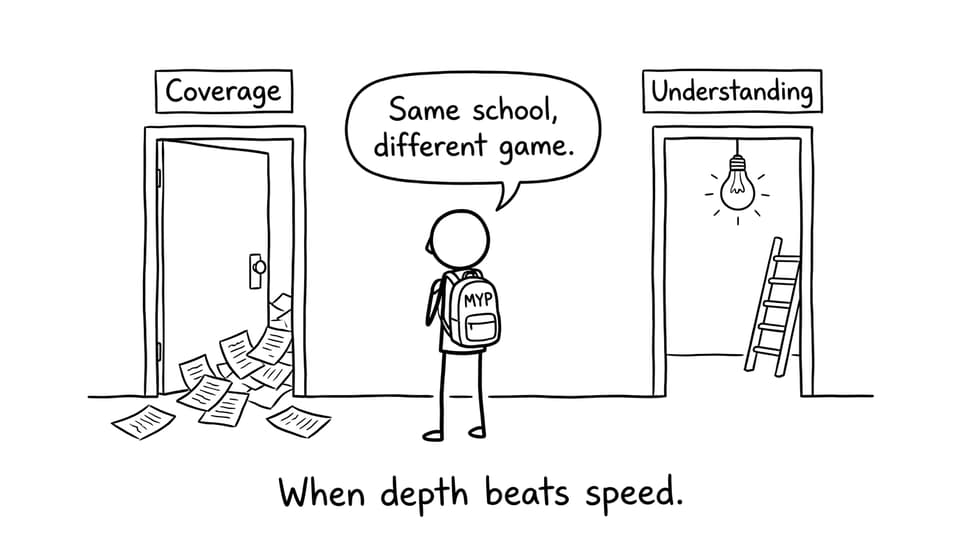
Traditional curricula often prioritize coverage (finish the syllabus, then test recall)
-
The MYP prioritizes transfer (use what you know in unfamiliar contexts)
-
Traditional grades are often percentage-based
-
MYP grades are criterion-based (you’re scored against descriptors)
-
Traditional classrooms can reward speed and correctness
-
The MYP rewards clear reasoning, process, communication, and improvement
For a broader overview of how the programme is structured, start with the Middle Years Program (MYP) hub.
Traditional curricula prioritize coverage; the MYP prioritizes understanding
A traditional curriculum often asks one central question: How much can you get through by the end of the year?
The MYP asks something quieter and harder: What can you do with what you know?
That single shift changes the feeling of learning.
In many traditional systems, topics are the destination. You “finish” a unit, take a test, and move on. In the MYP, topics are more like vehicles: they carry the real goal, which is skill development. That’s why assignments can feel open-ended at first. The programme is trying to train you to think, not just to remember.
If you want to see how that plays out in real tasks, browse Sample MYP Assessment Tasks for Every Subject Group.
MYP assessment is criterion-based (and that’s the whole point)
Traditional grading usually feels straightforward: you get marks, those marks become a percentage, and the percentage becomes a grade.
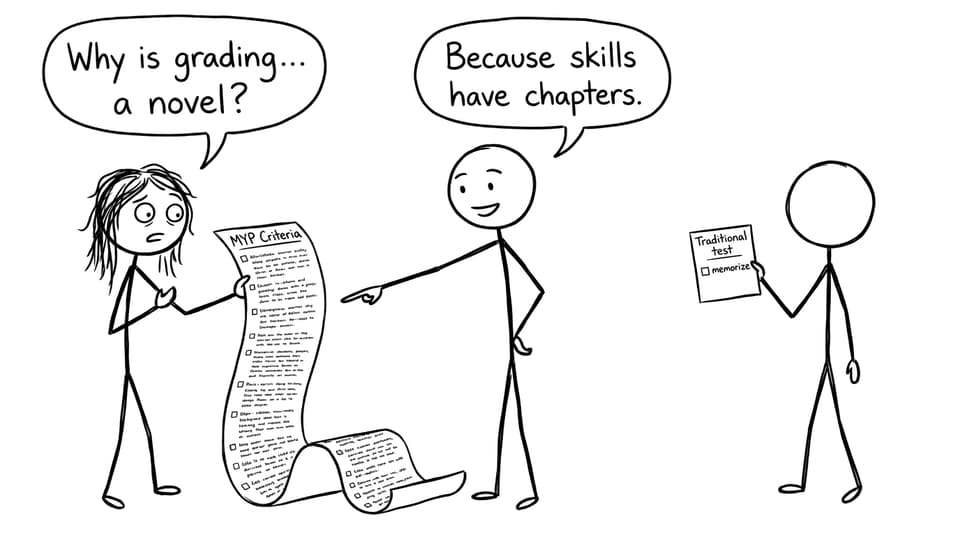
The MYP runs on a different engine: criterion-based assessment. You’re assessed against published descriptors, not against other students. That means your score is meant to describe mastery, not rank.
This is also why “I got most of it right” doesn’t always translate into a high level. A response can be accurate but still miss what the criterion rewards: analysis, justification, organization, reflection, or application.
To make this system feel less mysterious, read How Are MYP Students Graded? Criteria Explained and Evaluation and Reporting in the MYP: Best Practices.
The teacher’s role shifts, so your role has to shift too
In traditional classrooms, the teacher is often the main source of knowledge and the main driver of pace: lecture, practice, test.
In the MYP, teachers are more like designers of learning experiences. They set up tasks that force you to make choices, show thinking, and improve using feedback. It can feel uncomfortable because it puts responsibility on you earlier than many systems do.
This is one reason independence in the MYP isn’t an “extra.” It’s built in. You’re expected to interpret the task, connect it to criteria, use feedback, and reflect on what changed.
If this independence feels like a struggle in a specific subject, targeted breakdowns help. For example, Why Students Struggle With MYP Math (And How to Fix It) shows exactly how criteria can change what “good” looks like.
Memorisation alone stops working in the MYP
Memorisation is still useful in the MYP. It’s just not enough.
What the programme rewards is what happens after you remember: can you explain, justify, evaluate, apply, and communicate in a new situation? That’s why passive methods (rereading, rewriting notes, copying definitions) often feel like they “should” work, and then don’t.
A better approach is active practice with feedback loops: do a task, check it against criteria, improve one piece, repeat. RevisionDojo is built for that workflow: Study Notes to rebuild clarity quickly, Flashcards for daily recall, a Questionbank for exam-style practice, and AI Chat plus Grading tools when you want fast, criteria-aligned feedback.
You can explore the platform overview at RevisionDojo | IB & MYP Resources and the Questionbank feature and Flashcards feature.

How to revise for MYP exams without guessing
Here’s a simple routine that matches how MYP tasks are actually assessed:
-
Pick one upcoming topic and identify the likely criteria
-
Use short Study Notes to patch understanding (don’t live there)
-
Do 20-30 minutes of Questionbank practice
-
Review using criterion language: what would move this up one level?
-
Turn recurring errors into a tiny Flashcards deck
-
Once a week, do a timed session to train pacing
If you want a more structured timeline for eAssessments, use MYP eAssessments: 30-Day Study Plan That Works. And if you want general strategy, MYP Revision Guide: Study Tips for Success is a solid starting point.
Closing: the MYP is different because it trains a different kind of student
Traditional curricula often train you to be good at knowing. The MYP trains you to be good at using what you know, under pressure, in unfamiliar situations, with clear communication and reflection.
Once you see that, the programme stops feeling strange and starts feeling strategic.
If you want your revision to match the way the MYP is graded, make RevisionDojo your home base: use the MYP hub, practice with the Questionbank, tighten recall with Flashcards, and use AI Chat, Grading tools, Mock Exams, Predicted Papers, the Coursework Library, and Tutors to turn feedback into marks.