
Sustainability is one of those words that sounds polite until you try to use it in an exam answer. Then it becomes a test: can you define it precisely, apply it to a case study, and still show balance between people, planet, and profit? In IB ESS, that challenge is the point. Sustainability is not a vibe; it’s a decision-making framework.
What is sustainability in IB ESS?
The classic definition you should memorise for IB ESS comes from the Brundtland Report (1987): meeting the needs of the present without compromising the ability of future generations to meet their own needs.
In exam terms, sustainability is about time (long-term), limits (finite resources), and trade-offs (you rarely get a perfect win). You’re expected to connect it to systems thinking: how a change in one part of a system can ripple into environmental, social, and economic impacts.
If you want the syllabus-aligned version with examples and terminology, start with Notes for 1.4 Sustainability.
Quick sustainability checklist for IB ESS revision
-
Learn the Brundtland definition word-for-word.
-
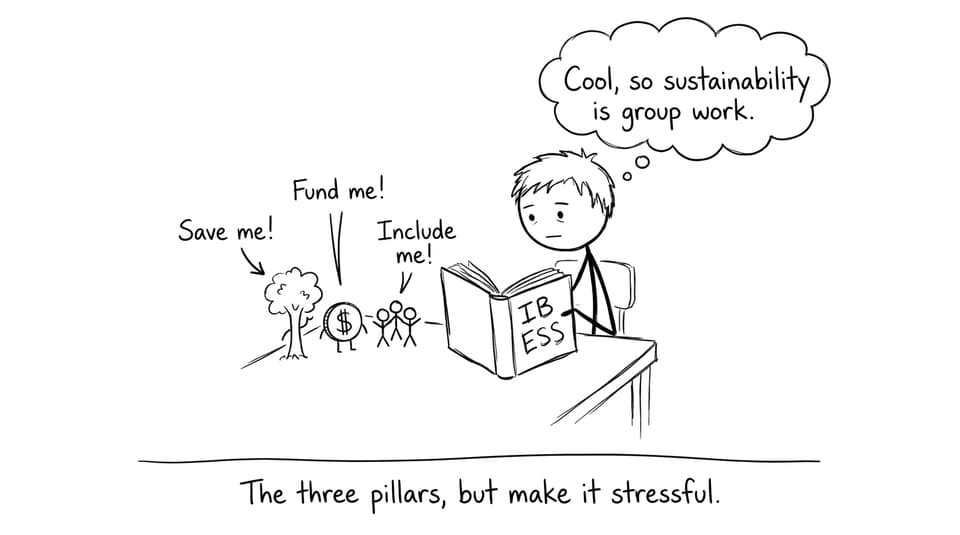
Explain the three pillars (environmental, social, economic).
-
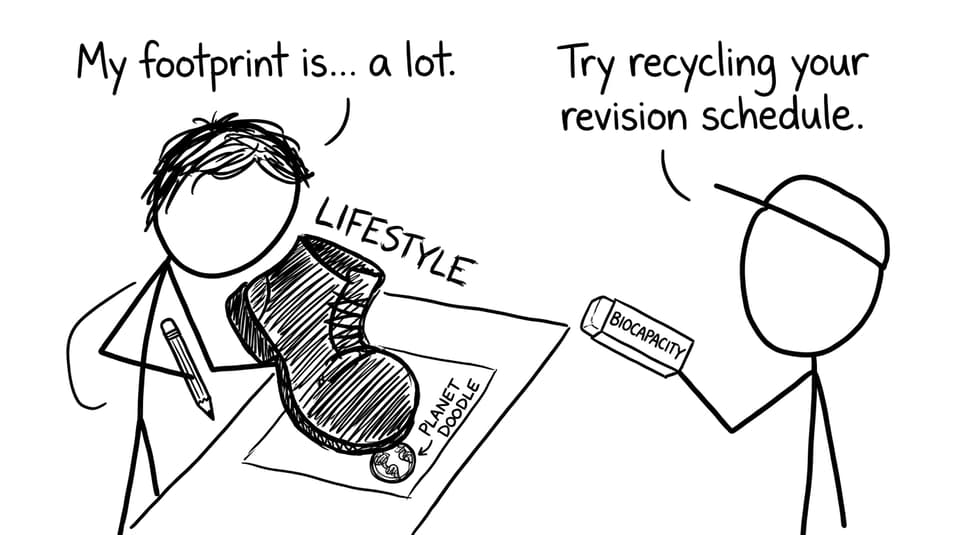
Use at least one indicator (ecological footprint, biocapacity, indices).
-
Add a real example and evaluate trade-offs.
-
Practice writing under time using IB ESS exam-style questions.
For fast coverage across the course, bookmark the IB ESS resources hub and the IB ESS revision notes index.
The three pillars of sustainability (and how examiners want them)
Environmental sustainability
This is the easiest pillar to spot: conserving biodiversity, reducing pollution, managing resources so ecosystems keep functioning. In IB ESS, link this to natural capital, ecosystem services, and resilience.
Social sustainability
This is where many answers get thin. Social sustainability means fairness: access to clean water, health, education, safety, and cultural integrity. A policy that reduces emissions but displaces communities is not automatically “sustainable.”
Economic sustainability
Economic sustainability is about systems that can continue without collapsing their own resource base. A useful IB ESS phrase is: “economic activity should not erode natural capital faster than it can be replenished.”
To strengthen your systems language, review Notes for 1.2 Systems.
Sustainability in practice: exam-ready examples
In IB ESS, examples are not there to impress; they’re there to help you evaluate.
-
Renewable energy: lowers fossil fuel use, but can create land-use conflicts and material supply issues.
-
Sustainable agriculture: crop rotation, reduced pesticide use, and water conservation improve soil and long-term yields.
-
Circular economy: redesigning products for reuse and recycling reduces waste and resource extraction.
-
Urban planning: public transport and green space can cut air pollution while improving quality of life.
For topic-linked examples, explore the IB ESS Topic 4: Water and IB ESS Topic 5: Land pages.
How to score higher on sustainability questions in IB ESS
Most students lose marks by defining sustainability and stopping. High-scoring IB ESS responses usually do three things:
-
They use an indicator (ecological footprint, biocapacity, carbon footprint).
-
They show trade-offs across the pillars.
-
They make a judgement using the command term (evaluate, discuss, suggest).
On RevisionDojo, that becomes a loop: learn with Study Notes, lock it in with Flashcards, then prove it with the Questionbank. If you get stuck mid-explanation, AI Chat can help you rebuild the reasoning, and Grading tools can show you what your wording is missing.
Final thought: sustainability is a skill, not a slogan
In IB ESS, sustainability is how you turn environmental knowledge into an argument you can defend under time pressure. Define it precisely, balance the pillars, and use indicators to justify your judgement.
If you want to make that feel automatic, build your routine on RevisionDojo: Study Notes for clarity, Flashcards for recall, a Questionbank for exam-style repetition, AI Chat when you hit a wall, plus Predicted Papers, Mock Exams, and Grading tools to sharpen performance. Start at the IB ESS resources hub and make sustainability one of the easiest marks you collect.