



War rarely arrives like a clear moral equation. It arrives like a fog: headlines, fear, speeches about necessity, and a rush to pick a side before you even know what “side” means.
In IB Global Politics, the question “Is war ever justified?” matters because it forces you to do something harder than having an opinion. It asks you to build a standard, test it against ethics and international law, and then admit what happens when political reality pushes back.
This is also why the question is so exam-friendly: it rewards calm structure, balanced evaluation, and precise use of concepts (sovereignty, legitimacy, power, security, human rights). If you can learn to answer this one well, you’ll write stronger essays across IB Global Politics.
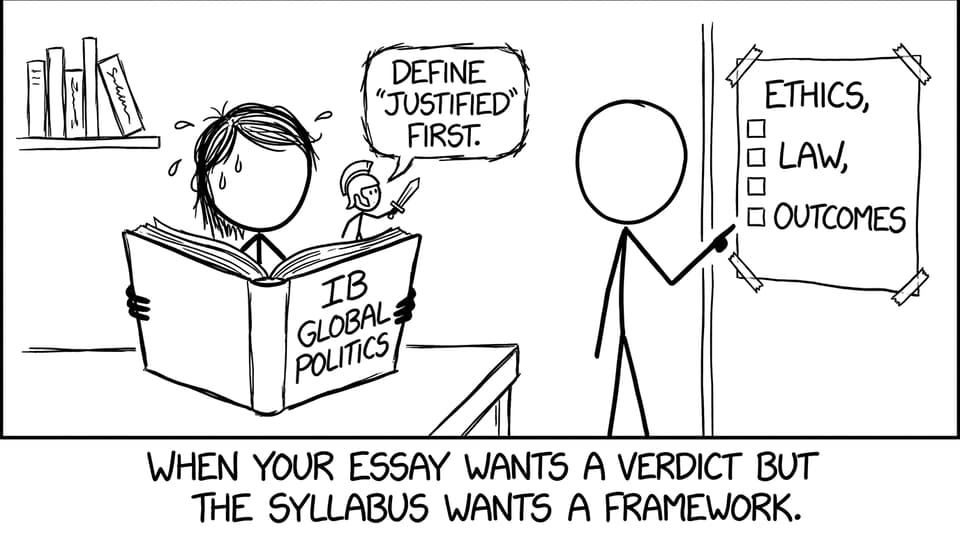
A quick exam checklist for “Is war justified?” (IB Global Politics)
Use this as a fast planning grid before you write:
-
Define “war” and “justified” (ethical justification? legal justification? political legitimacy?)
-
Ethics: self-defence, humanitarian protection, just war thinking (proportionality, necessity, discrimination)
-
International law: UN Charter logic (self-defence, collective security, authorization)
-
Politics: power, interests, information control, and unintended consequences
-
Evaluation: intent vs outcomes, short-term vs long-term, who bears the costs
If you need a syllabus-aligned home base while you revise, start with the IB Global Politics hub on RevisionDojo and the Peace and Conflict topic page, then layer practice using the Questionbank.
The strongest case for war: self-defence (and why IB Global Politics still probes it)
If there is a “cleanest” justification for war, it’s usually framed as self-defence. The ethical intuition is simple: if a community is attacked, resisting is not the same as choosing violence for gain. In IB Global Politics, you can connect this to realism: states prioritize survival, and security threats shape behaviour.
But exam answers rise when you add the pressure-test:
-
Necessity: was war truly the last workable option, or just the fastest?
-
Proportionality: did the response match the threat, or expand beyond it?
-
Imminence and evidence: was the threat immediate and credible, or argued after the fact?
A high-scoring IB Global Politics paragraph doesn’t stop at “self-defence is justified.” It asks how leaders define “threat,” who controls the narrative, and how quickly defensive language can slide into strategic opportunity.
To sharpen your concept vocabulary (which helps you sound precise under time pressure), RevisionDojo’s content on power is useful: see Understanding power and global politics: Power.
Humanitarian intervention: the moral argument that comes with political traps
Another major justification is humanitarian intervention: using force to stop genocide, ethnic cleansing, or mass atrocities when diplomacy fails. On paper, it sounds like the world acting like an adult. In practice, it’s messier.
In IB Global Politics, your analysis should show the tension between:
-
Sovereignty (non-interference, territorial integrity)
-
Human rights (protection of individuals, universal moral claims)
-
Authority (who decides intervention is legitimate?)
This is where students can score well by showing conceptual depth: humanitarian language can reflect genuine protection, but it can also be used to sell a strategic project to domestic audiences. Intent matters, but outcomes matter more.
For stronger theory-to-example links on rights debates, RevisionDojo’s notes on competing perspectives help: Competing global perspectives on human rights.
The best argument against war: civilians pay for decisions they didn’t make
The most consistent objection is not that war never has reasons. It’s that war reliably produces harms that are hard to contain: civilian casualties, displacement, trauma, infrastructure collapse, and cycles of retaliation.
In IB Global Politics, this fits naturally with ethical criticism: even when leaders claim necessity, the foreseeable harm to non-combatants can undermine legitimacy. This is also where you can use just war criteria to evaluate (not just describe):
-
Discrimination: are civilians protected in practice, not just in speeches?
-
Proportionality: are the harms outweighed by the goals?
-
Reasonable chance of success: is the plan realistic, or symbolic?
A thoughtful evaluation acknowledges something uncomfortable: war can begin with a “just” claim and still unfold into unjust outcomes.
International law: when legal permission and moral legitimacy diverge
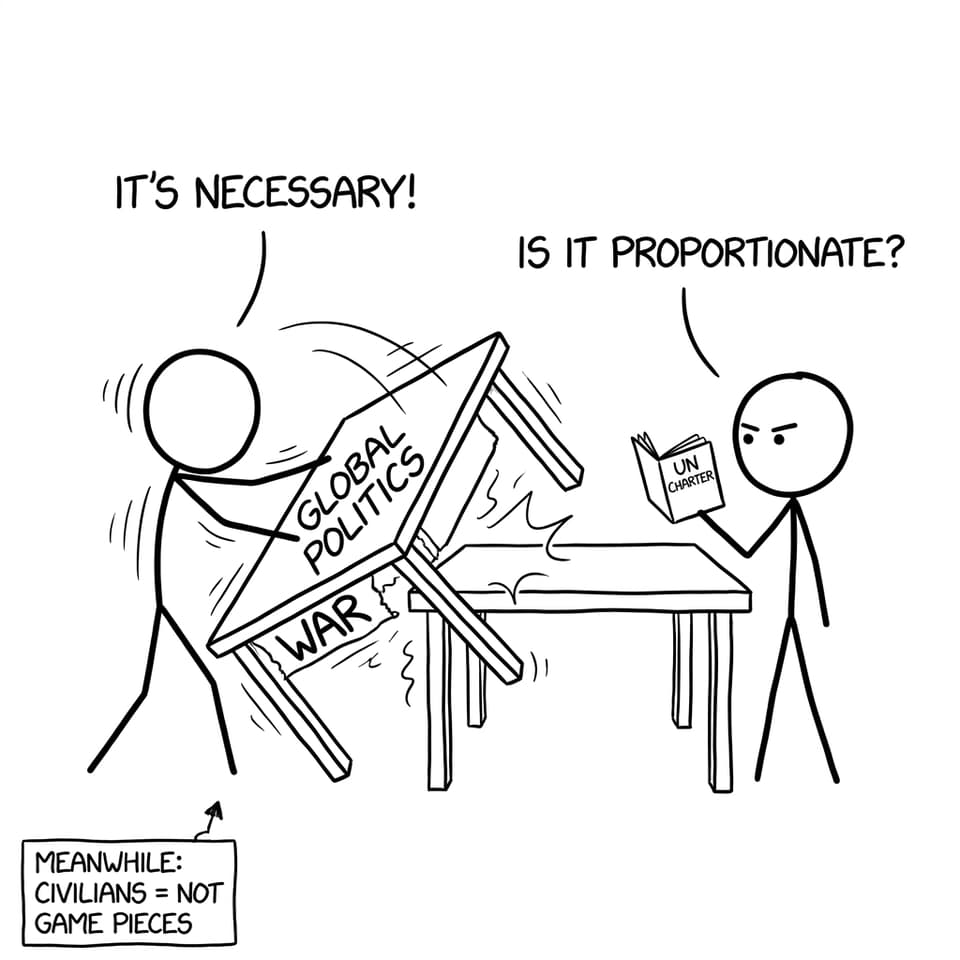
International law tries to narrow the doorway to war. The basic idea: force is not a normal policy tool. It’s an exception.
In most IB Global Politics exam framing, the key legal reference point is the UN system: war is generally restricted, with limited exceptions such as self-defence and collective action through international institutions.
But the higher-level evaluation is this: law does not enforce itself. Powerful states may resist accountability, and enforcement can be selective. That gap between rule and reality is a core analytical move in IB Global Politics: institutions matter, but power still shapes outcomes.
If you want case-study-ready angles for essays, topics like legitimacy connect well here. RevisionDojo’s notes help you link intervention, recognition, and authority: External challenges to state legitimacy.
“War is a failure of politics” (and why that line can earn marks)
There’s a reason many global politics thinkers treat war as a breakdown rather than a solution. War often signals that negotiation, deterrence, mediation, and compromise failed, or were never seriously attempted.
In IB Global Politics, you can use this as an evaluative lens:
-
Even if war is arguably justified, it can still represent limited diplomatic capacity.
-
“Justified” doesn’t mean “wise,” and “legal” doesn’t mean “good.”
-
Prevention (institutions, diplomacy, norms) is often cheaper than repair.
This line of reasoning helps you avoid absolute claims. It also moves your essay from moral debate into political analysis, which is exactly what IB Global Politics rewards.
How to turn this into a top-level IB Global Politics exam answer
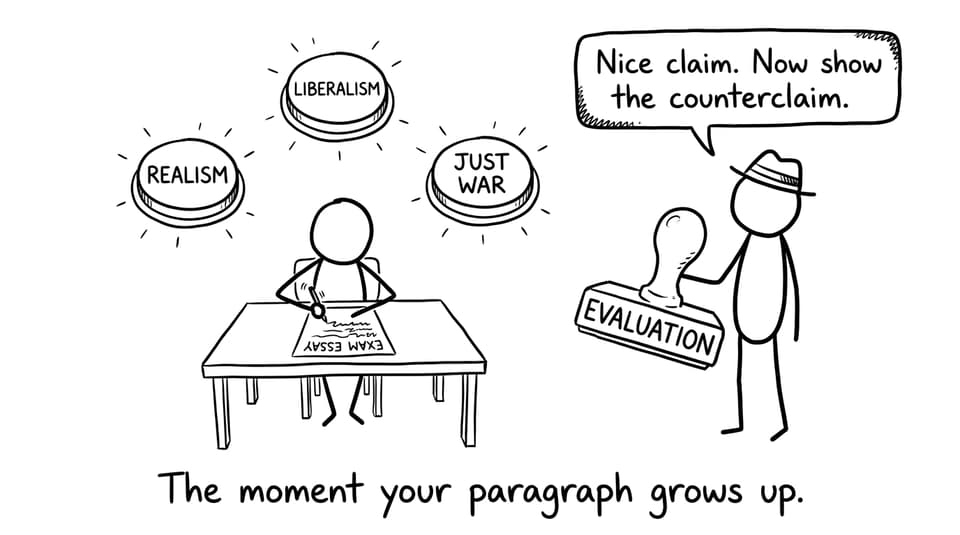
A strong structure is:
-
Thesis: war may be conditionally justified, but only under strict ethical and legal constraints, and legitimacy depends heavily on outcomes.
-
Claim 1: self-defence as the strongest justification (evaluate necessity and proportionality).
-
Claim 2: humanitarian intervention as a contested justification (evaluate sovereignty, authority, and consequences).
-
Counterclaim: civilian harm, escalation, and manipulation of moral narratives.
-
Synthesis: international law provides a framework, but enforcement and power politics complicate it.
-
Judgement: justification is possible in theory, fragile in practice.
To practise this efficiently, RevisionDojo is built around feedback loops: do one timed response, get it graded, then patch the weakness. Use the IB Global Politics Paper 2 guide notes for essay structure, the Paper 1 guide notes for source-driven evaluation skills, and the IB Global Politics Predicted Papers to rehearse exam timing.
Closing: the IB Global Politics takeaway
War might be justified in narrow, extreme conditions, especially under credible self-defence or to stop mass atrocities. But IB Global Politics teaches you to treat every justification as a claim that must survive ethical tests, legal constraints, and political reality.
If you want to revise this topic with less panic and more proof, build a loop: learn the framework with RevisionDojo Study Notes, drill arguments in the Questionbank, lock in definitions with Flashcards, pressure-test ideas with AI Chat, and train judgement under time using Predicted Papers and Mock Exams. When you’re ready for deeper feedback, RevisionDojo’s Grading tools and Tutors help you turn “I think” into “I can justify.”
For more structured revision pathways, explore the Global Politics cheatsheets and the main IB Global Politics resource hub.