A quiet kind of harm you can miss in one glance
A student reads a headline about a war and thinks, that’s violence. Then they look up and see a different kind of damage: a community with no clinic, a school that never opens, a job market that never hires. No one is throwing punches. No bombs are falling. But life still gets smaller.
That’s structural violence, and in IB Global Politics, it’s one of the most exam-useful concepts because it helps you explain how harm can be produced by the “normal” design of society.
What is structural violence (definition for IB Global Politics)?
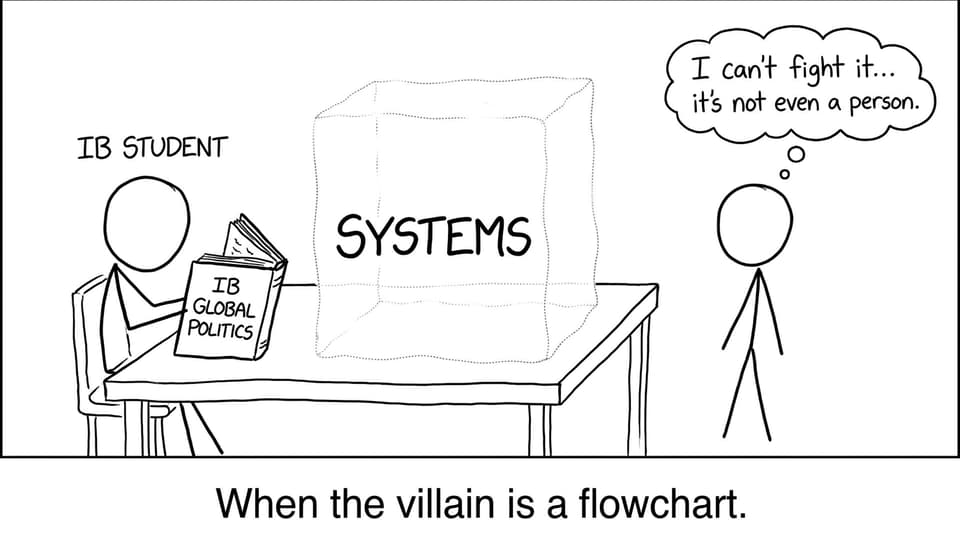
Structural violence is harm caused by social, political, and economic structures that systematically block people from meeting basic needs or achieving life chances. It is typically:
-
Indirect (no clear attacker)
-
Systemic (built into institutions and rules)
-
Normalized (it can look “ordinary”)
-
Long-term (its effects accumulate across years)
A quick way to phrase it in IB Global Politics essays: structural violence is violence embedded in systems, producing avoidable suffering through inequality.
For clean exam phrasing, you can cross-check the term in the IB Global Politics glossary.
Structural violence vs direct violence (the comparison examiners love)
Direct violence is visible: physical force, threats, assault, war. Structural violence is quieter: it appears as policy outcomes, unequal access, and predictable deprivation.
In IB Global Politics, the key comparison is agency:
-
Direct violence has identifiable perpetrators and immediate events.
-
Structural violence results from how society is organized, including laws, markets, borders, and institutions.
To revise the broader peace framework that this concept sits inside, use Understanding Violence and Peace notes.
Why structural violence matters for peace and conflict
Structural violence is a bridge concept: it connects inequality to instability. When groups experience persistent exclusion (political voice, education, healthcare, legal protection), grievances become durable. And durable grievances are a reliable fuel for conflict.
This is why IB Global Politics often pushes you beyond “war ended” toward “conditions changed.” You can deepen that argument with:
A fast exam checklist (Paper 1 or Paper 2)
Before you write, run this mini-plan:
-
Define structural violence in one sentence (systemic, indirect harm).
-
Name one structure (law, economy, institution, social norm).
-
Show who is disadvantaged and how basic needs are restricted.
-
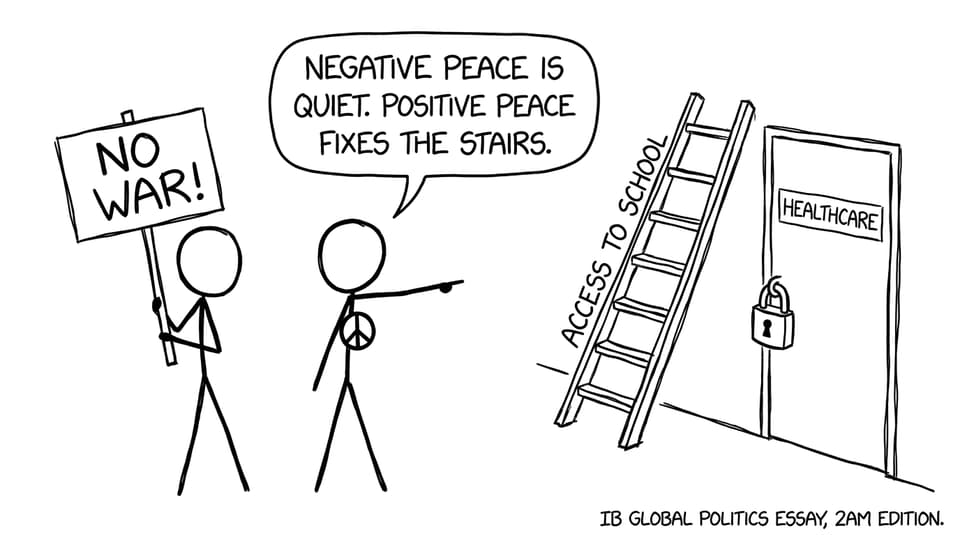
Link to peace: negative vs positive peace.
-
Evaluate: who benefits from the structure, and why change is hard.
If you’re practicing timed responses, RevisionDojo’s Global Politics resources hub helps you move from Study Notes to Flashcards to exam-style questions quickly.
How to use structural violence in IB Global Politics answers (without staying descriptive)
Top-mark responses don’t just list examples like poverty or discrimination. They explain mechanism: how the system produces harm, why it persists, and what that means for legitimacy, human rights, and stability.
A strong way to train this is doing targeted practice in the Peace and Conflict Questionbank or the Interactions of political stakeholders and actors Questionbank, then using RevisionDojo’s AI Chat and Grading tools to tighten your evaluation.
For essay structure support, keep this open while planning: IB Global Politics Paper 2 essay structure.
The takeaway for IB Global Politics revision
Structural violence helps you write like a political analyst, not a news reporter. It lets you explain how inequality becomes harm, and how harm becomes instability, even when nobody is “attacking” anyone.
If you want this concept to show up naturally in your essays, build a small revision loop on RevisionDojo: start with Study Notes, drill Flashcards, then do the Questionbank under time pressure, and finish with AI Chat feedback. That’s how IB Global Politics concepts stop being definitions and start becoming arguments.


