

Intertextuality is that quiet moment when a line in your novel feels like it has lived somewhere else first.
Maybe it’s a character who seems borrowed from myth. Maybe it’s a phrase that sounds like a hymn, a headline, or Shakespeare on a tired day. In IB English, noticing that feeling is not a party trick. It’s a lever. Pull it well, and your analysis gains depth without gaining fluff.
Intertextuality matters because texts don’t arrive in the world alone. They arrive with their ancestors. And once you learn to spot those literary connections, you start writing essays that feel less like summary and more like insight.
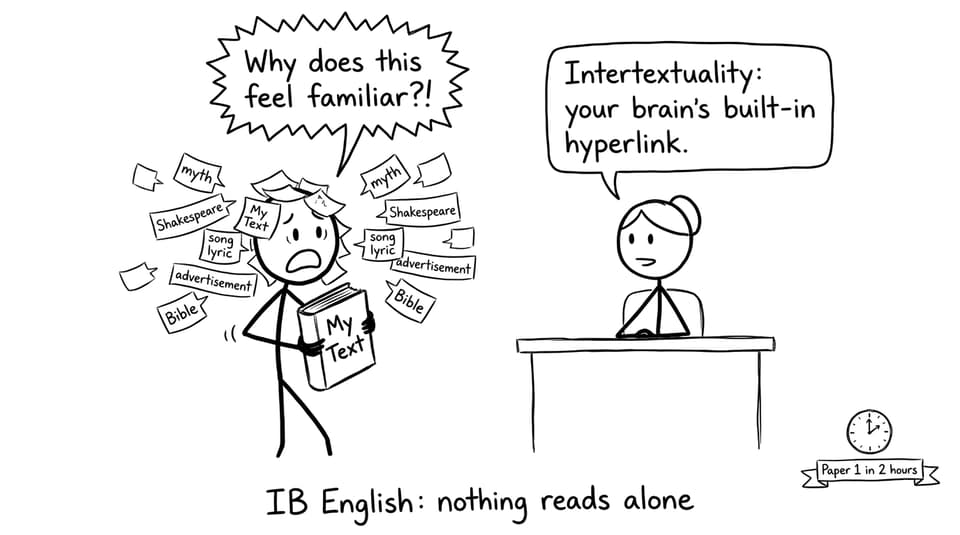
What is intertextuality (in IB English terms)?
In IB English, intertextuality is the relationship between texts: the way one text references, reshapes, challenges, or echoes another. A “text” can be a novel, poem, play, speech, advertisement, film, song, or even a cultural story like a myth.
Julia Kristeva coined the term in the 1960s, building on Mikhail Bakhtin’s idea that language is always in dialogue with what came before it. For you, the practical meaning is simple: a text often creates meaning by pointing outside itself.
If you want a clean exam-ready definition plus examples you can borrow in your writing, keep this guide open: Intertextuality in IB English: Connecting Texts for Top Marks.
A quick intertextuality checklist (before you write)
When you suspect intertextuality in IB English, run this fast checklist:
-
Spot the connection: what earlier text, genre, myth, or cultural script is being echoed?
-
Name the type: quotation, allusion, parody, structural borrowing, thematic echo.
-
Explain the purpose: is the author honoring, critiquing, updating, or mocking the source?
-
Prove it with technique: diction, imagery, structure, characterization, tone.
-
Link it to your thesis: how does this connection strengthen your argument?
That last step is where marks live. Examiners reward meaning, not trivia.
Types of intertextuality you can use in IB English analysis
Intertextuality shows up in many forms, but these are the ones that appear most often in IB English exams and coursework.
Quotation (direct borrowing)
Quotation is the loudest kind of intertextuality: the text openly takes words from another source. In poetry, it can be a mosaic of voices. In prose, it might appear as an epigraph, a prayer, or a repeated line that carries cultural weight.
A classic example is T.S. Eliot, whose work is threaded with references and quotations from religious texts, Shakespeare, and myth. If you’re revising poetry, this is a good companion piece for building sharper commentary: Easy Poems for IB English: A Simplifying Your Poetry Reading List.
IB English move: Don’t just say “this is a quote.” Say what the quote imports into the text (authority, tradition, irony, sacredness, nostalgia) and how that changes meaning.
Allusion (indirect reference)
Allusion is quieter. The text hints rather than declares. It relies on the reader’s recognition, which makes it powerful: if you catch it, you feel like the text is speaking in a second channel.
Allusions can point to myth, religion, historical events, famous speeches, or other literature. They often function like compressed context.
IB English move: Show the tension between the old meaning and the new meaning. Ask: what changes when the author relocates this reference into a different time, place, or voice?
Parody (imitation with attitude)
Parody mimics another text or genre, usually with humor or critique. It can expose the original’s assumptions, or it can soften something serious by making it playful.
Jane Austen’s Northanger Abbey is a well-known example of parodying Gothic conventions. The point isn’t just comedy; it’s commentary.
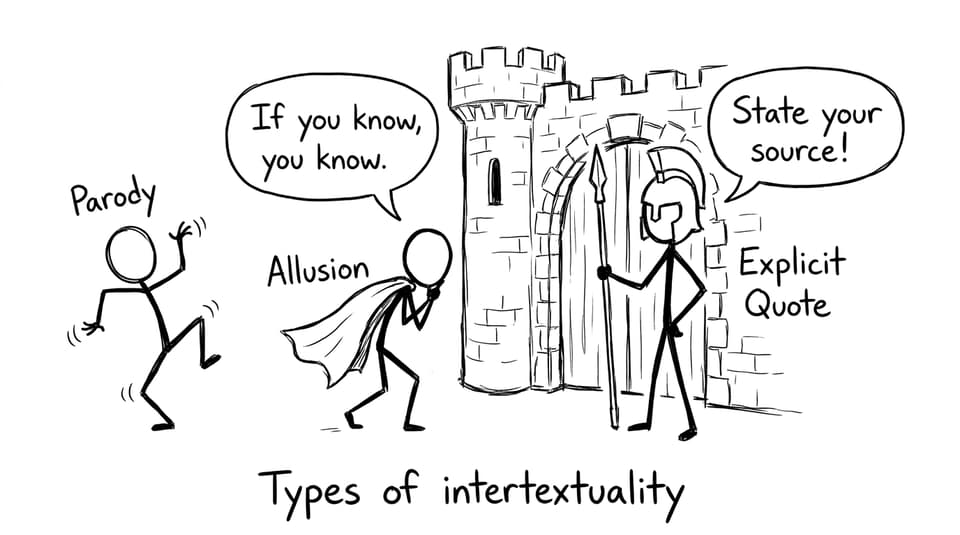
IB English move: Identify what is being imitated (tone, plot shape, character type, diction), then explain what the imitation reveals.
Thematic echoes (shared ideas across texts)
Sometimes texts don’t reference each other directly. They echo the same questions: power, identity, freedom, belonging, justice. That shared territory becomes a conversation across time.
This matters especially for comparative writing. If you’re building Paper 2 muscles, use: Thematic Comparisons Across IB Prescribed Texts and Key Themes in IB English Literature.
IB English move: Comparative paragraphs score higher when they explain why two writers treat the same theme differently, not just that they do.
Why intertextuality boosts your IB English marks
Intertextuality isn’t an “extra.” It’s a way to show control over interpretation.
It deepens your commentary without padding
In Paper 1, you don’t have space to ramble. Intertextuality gives you a shortcut to depth: one reference can unlock context, tone, and authorial purpose fast.
To keep your analysis exam-tight, pair intertextual insights with technique-based explanation. RevisionDojo’s breakdown here helps: Mastering Literary Devices in IB English Exams.
It strengthens arguments in Paper 2 and the HL Essay
In IB English, the strongest essays are built on conversations between texts: agreement, disagreement, revision, rebellion. Intertextuality gives you language for that conversation.
For a structure that stays analytical (not descriptive), this resource is gold: IB English Paper 1 Literary Commentary: A Clear Guide.
It improves your sense of writer’s choices
Intertextuality forces you to ask “why this reference, here?” That question automatically pulls you toward authorial intent, audience, and context.
If you need a practical way to keep that focus, use RevisionDojo’s technique-driven close reading guidance: Close Reading Techniques for Prose and Poetry.
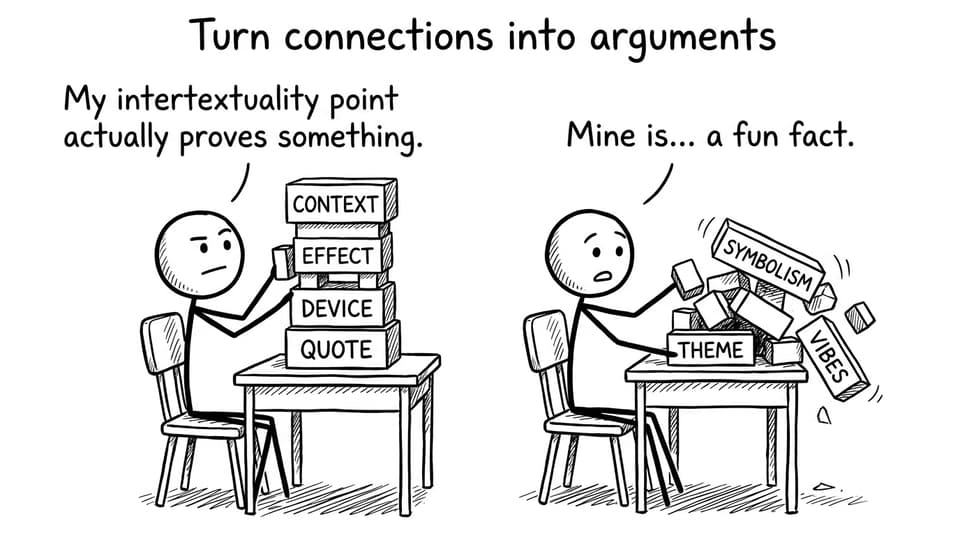
How to write about intertextuality in IB English (a mini formula)
When you spot a connection, try this four-step sentence plan:
-
Name the intertext (what is being referenced).
-
Describe the technique (allusion, quotation, parody, echo).
-
Explain the effect (tone, characterization, theme, reader response).
-
Link to the thesis (how it supports your interpretation).
If you’re revising figurative language at the same time, this pairs well: What Is a Metaphor? IB English Literary Device Guide.
Closing: Build your own web of meaning
Intertextuality is the reminder that literature is not a shelf of isolated objects but a network of voices passing ideas forward. When you learn to hear those echoes, IB English starts to feel less like guessing and more like reading with permission to think.
If you want to train that skill deliberately, RevisionDojo makes it practical: use Study Notes to clarify concepts, Flashcards to keep key terms ready, AI Chat to test interpretations, Grading tools to tighten your paragraphs, and Mock Exams plus Predicted Papers to rehearse under pressure. Add the Coursework Library when you need model standards, and lean on Tutors when you want targeted feedback.
Intertextuality is a web. Revision is too. Build yours with RevisionDojo -- and walk into your next IB English exam seeing connections you used to miss.