



A hook: the myth of “going it alone”
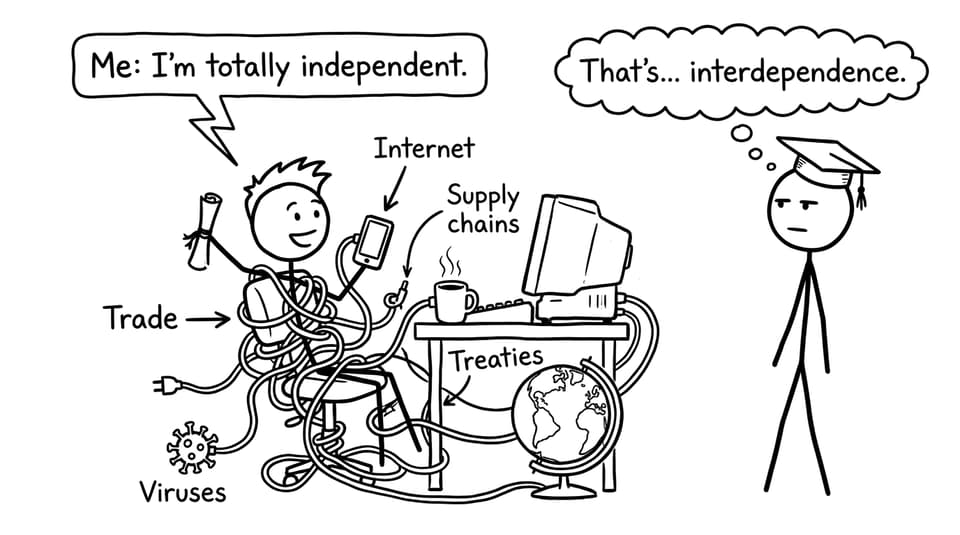
On paper, a country can look like an island: borders, a flag, a government, a “national interest.” But in IB Global Politics, the moment you zoom in, that island is covered in bridges. Fuel arrives from abroad. Data travels through cables. Rules are negotiated in institutions. Crises spill across borders faster than any policy can keep up.
That web is interdependence: a condition where states and other actors are mutually reliant, so decisions in one place create consequences elsewhere. In IB Global Politics, interdependence is not just a definition to memorise. It is a lens for analysing how globalization reshapes cooperation, vulnerability, and power.
Interdependence in IB Global Politics: a quick exam checklist
Use this mini-checklist when interdependence appears in Paper questions or essays:
-
Define interdependence as mutual reliance among actors
-
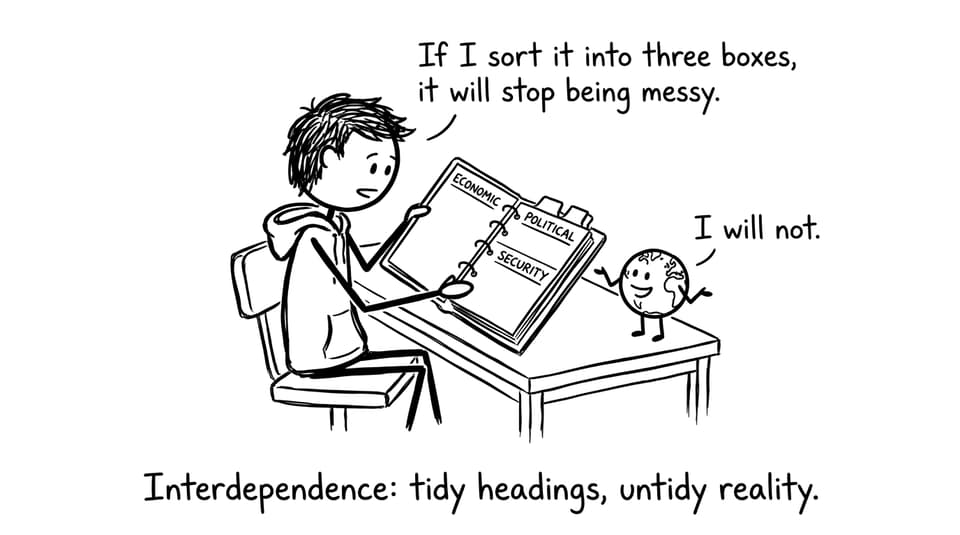
Sort it into economic, political, and security interdependence
-
Explain impact: cooperation becomes useful, unilateral action becomes costly
-
Evaluate asymmetry: who depends more, and what leverage follows?
-
Link to power: interdependence can constrain and empower at the same time
For syllabus-aligned revision, keep IB Global Politics Resources open as your hub.
Economic interdependence (the visible one)
Economic interdependence is the easiest to spot in IB Global Politics because it shows up in trade, investment, supply chains, and finance. A state may rely on imports for essentials or on export markets for growth. That mutual reliance often encourages cooperation because disruption harms multiple actors at once.
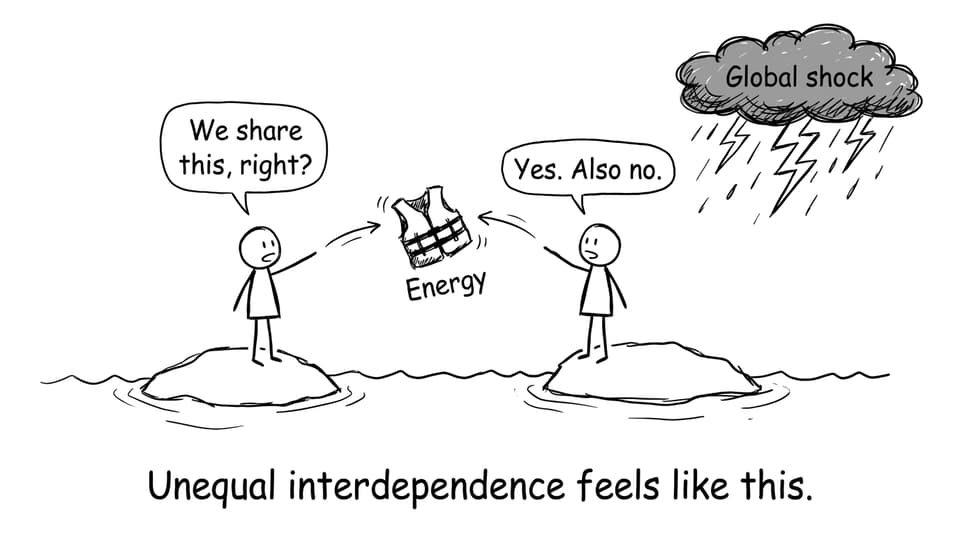
But the highest-scoring analysis adds a second move: interdependence can be unequal. If one country has more alternatives, it can absorb shocks better. If another has fewer, it becomes more vulnerable to pressure.
To practise writing this like an examiner expects, try timed prompts from the Interdependence Questionbank and compare your structure to the Paper 2 Guide notes.
Political interdependence (rules, norms, and shared authority)
Political interdependence describes how states depend on institutions, agreements, and norms to manage shared problems. In IB Global Politics, this helps explain why states sometimes accept constraints: membership in organizations creates expectations of compliance, and collective decisions can shape domestic policy.
A clean example pathway is: institution sets a rule -> states adapt policy -> sovereignty becomes negotiated rather than absolute. If you want a concrete institutions angle, revise The United Nations Notes and Intergovernmental organizations notes.
Security interdependence (shared risks, shared exposure)
Security interdependence is about cross-border threats: terrorism, cyber attacks, pandemics, and environmental disasters. No single state can fully contain these risks, which makes cooperation more than idealism: it becomes a necessity.
In IB Global Politics, this is where interdependence becomes a double-edged concept. Shared vulnerability can motivate coordination, but it can also amplify panic when systems are tightly coupled and shocks cascade.
How interdependence shapes power in IB Global Politics
Interdependence can reduce conflict by raising the cost of confrontation, but it also creates new tools of influence. When reliance is asymmetric, interdependence becomes leverage: market access, technology, resources, or financial pathways can be weaponised or negotiated.
If you want to build evaluative paragraphs quickly, use the structure guidance in IB Global Politics Paper 2 Essay Structure (Fast Guide) and sharpen source analysis with the Paper 1 Guide Notes.
Conclusion: make interdependence usable in exam answers
Interdependence in IB Global Politics is the simple idea that countries are connected, plus the difficult reality that those connections create both cooperation and constraint. If you can define it, classify it (economic, political, security), and evaluate asymmetry, you can turn a vague concept into a high-mark argument.
To make this stick, revise the topic with Interdependence lessons, drill exam-style practice in the Interdependence Questionbank, and consolidate with RevisionDojo’s Study Notes, Flashcards, AI Chat, Grading tools, Predicted Papers, Mock Exams, Coursework Library, and Tutors, all built to help IB Global Politics students turn understanding into marks.