



The hook: the world looks different when you change the lens
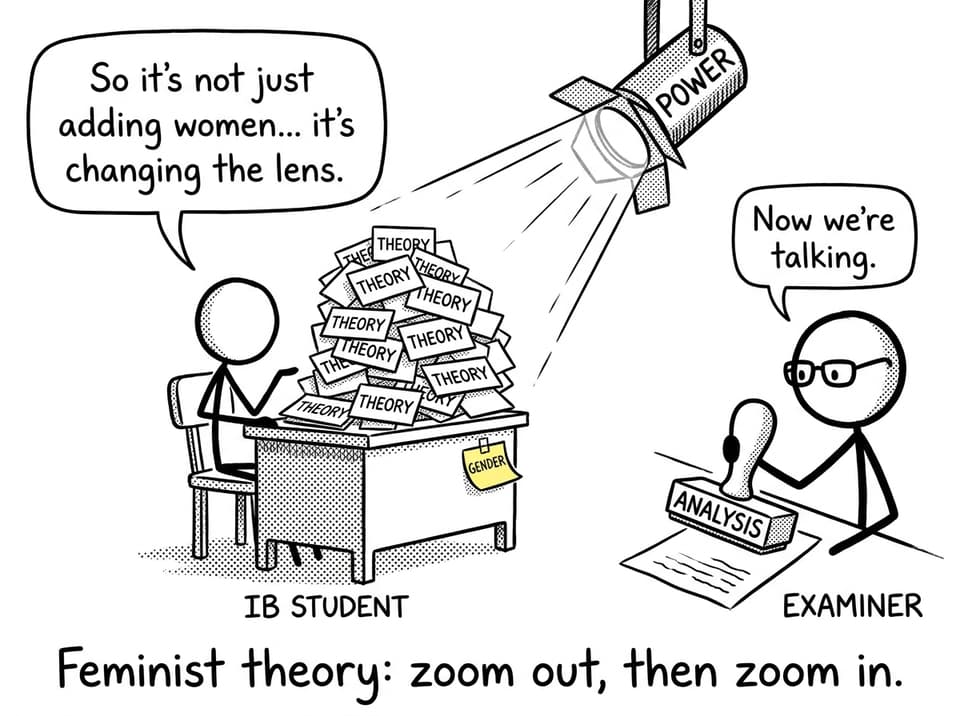
In IB Global Politics, students are trained to look for power: who has it, who claims it, and who pays the price for it. Feminist theory starts with a simple, unsettling thought: if your toolkit was built mainly from male experiences, it will treat some forms of power as “normal” and others as “invisible.” Once you notice that, your case studies stop being just headlines. They become human systems.
Feminist theory in global politics is a critical perspective that examines how gender shapes power, inequality, and political outcomes at local, national, and global levels. It challenges the idea that global politics is only about states, wars, treaties, and leaders. Instead, it asks: whose voices were centered when we decided what counts as “political” in the first place?
Feminist theory in IB Global Politics: a quick checklist
Use this checklist when you see an essay or source question that could reward feminist theory in IB Global Politics:
-
Identify how gender norms shape roles, risks, and opportunities.
-
Ask what the issue looks like in everyday life (health, safety, care work, education, migration).
-
Test the public vs private divide: what’s treated as “personal” but has political effects?
-
Link to core concepts like power, legitimacy, human rights, and justice.
-
Add evaluation: what does feminist theory explain well, and what might it miss?
For topic refreshers that help you connect theory to concepts, the IB Global Politics resources hub is the fastest place to orient yourself.
What feminist theory argues (in exam-friendly terms)
Feminist theory argues that power in global politics is gendered. Traditional approaches often prioritize state behavior, military capability, and formal institutions. Feminist perspectives don’t always reject those topics, but they insist they are incomplete without analyzing how gender shapes who participates, who is protected, and whose suffering is dismissed as background noise.
In IB Global Politics, that matters because many of your highest-mark answers require you to do more than describe events. You need to explain mechanisms and assumptions. Feminist theory gives you a mechanism: gender norms distribute vulnerability and authority unevenly, and institutions often reproduce those patterns.
To strengthen your concept links, pair feminist analysis with the Power topic page and build practice through the Power Questionbank.
The “public vs private” split: the quiet engine of feminist theory
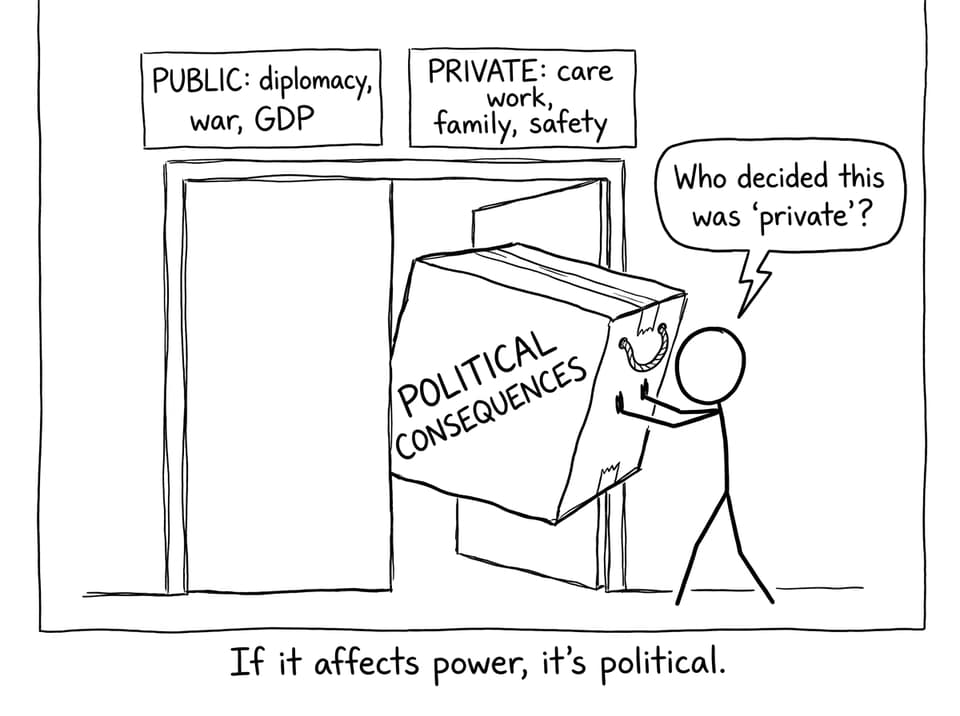
One of the most useful feminist insights is that global politics often treats some issues as public (war, trade, diplomacy) and others as private (family life, care work, domestic violence). Feminist theorists argue this split hides political realities. If an issue shapes life chances, security, and participation, it has political consequences.
This is exam gold in IB Global Politics, because it expands the scope of what you can analyze. Conflict is not only battlefield tactics. It includes displacement, sexual violence, access to healthcare, and the long-term impact on education and livelihoods.
If you want to connect this directly to syllabus themes, the Rights and Justice topic page and the Peace and Conflict topic page are strong starting points.
Strands of feminist theory you can reference quickly
In IB Global Politics, you don’t need a university lecture. You need accurate labels and clear application:
-
Liberal feminism: focuses on equal rights and inclusion within existing institutions (representation, legal equality, access).
-
Radical/critical feminism: argues institutions themselves can be structured in unequal ways, so reform may not be enough.
Different strands share a common goal: reveal hidden power relations and bring marginalized voices into the analysis.
To keep your theory comparisons sharp, review Theoretical Foundations in IB Global Politics and then practise integrating theory into essays using the Paper 2 Guide Notes.
How to use feminist theory in IB Global Politics exam answers
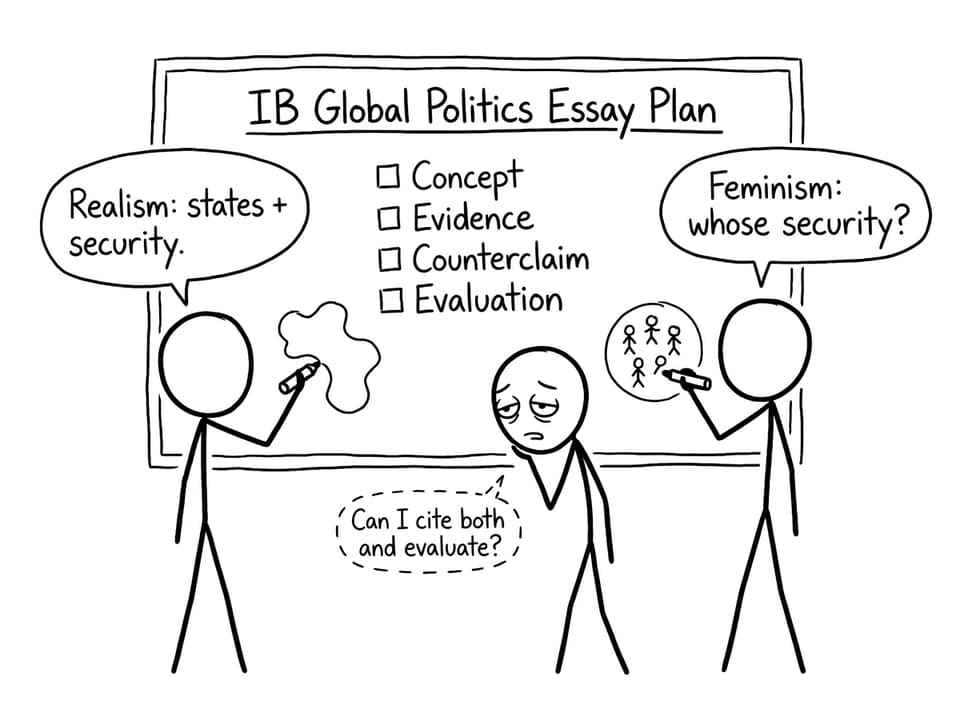
A reliable way to deploy feminist theory is: claim, concept, evidence, evaluation.
Example moves you can make:
-
Reframe “security” by asking whose safety is prioritized and whose insecurity is normalized.
-
Link gender to human rights and legitimacy: who is protected by law, and who is excluded in practice?
-
Evaluate policy outcomes by considering lived experience, not only state intentions.
When you practice, make it timed and specific. Use RevisionDojo’s Study Notes for clarity, Flashcards for fast recall, the Questionbank for exam-style pressure, and AI Chat when your explanation feels fuzzy. Then run Mock Exams and Predicted Papers to turn understanding into performance.
For writing under pressure, keep these open: How to Answer IB Global Politics Paper 1 Questions and Common Mistakes in IB Global Politics Essays.
Conclusion: a stronger lens makes a stronger answer
Feminist theory doesn’t ask you to memorize more content for IB Global Politics. It asks you to notice what your analysis might be leaving out, and to treat those omissions as part of power itself. When you apply it, your essays become less like summaries and more like explanations.
If you want to practice this lens consistently, build a simple loop on RevisionDojo: learn with Study Notes, drill with the Questionbank, lock in definitions with Flashcards, ask AI Chat to refine your wording, and then test yourself with Mock Exams and Predicted Papers. In IB Global Politics, the goal is not to sound clever. It’s to see clearly, and write like you do.