



Development in IB Global Politics: the word that hides an argument
A country’s GDP rises. Headlines cheer. But in the next street, a clinic closes, schools lose funding, and rivers turn the color of industry. That uneasy gap between “growth” and real life is exactly where IB Global Politics places the concept of development.
In IB Global Politics, development is not a single scoreboard. It’s a debate about what progress means, who decides, and who pays the costs. When you treat development as contested and political (not just economic), your essays stop sounding like summaries and start sounding like analysis.
Quick checklist: how to define development in an exam
Use this mini-checklist before you write:
-
Give a broad definition (living standards and well-being, not only wealth)
-
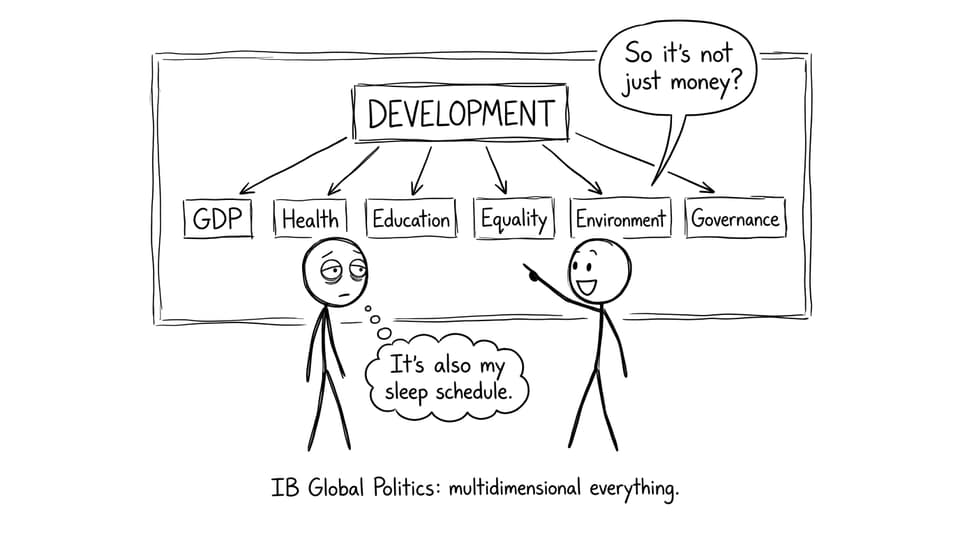
Show multiple dimensions: economic, social, political, environmental
-
Explain trade-offs and winners/losers (inequality, exclusion, power)
-
Link to sustainability (long-term vs short-term gains)
-
Add evaluation (who defines development and why)
If you need a syllabus-aligned anchor, start with RevisionDojo’s IB Global Politics Development and Sustainability topic hub.
The economic view: why “more money” is not enough
Historically, development was often measured through economic indicators: income per person, industrial output, or national production. That logic is simple: if the economy expands, life improves.
IB Global Politics pushes you to question the shortcut. Economic growth can raise average incomes while leaving specific regions, ethnic groups, or social classes behind. It can also create dependence on volatile exports or weaken labor protections. In an essay, the high-scoring move is to acknowledge economic growth as one measure, then show why it’s incomplete.
To build exam confidence fast, practise framing the argument with timed prompts from the IB Global Politics Resources hub.
Human development: progress measured in lived reality
A more modern approach emphasizes human development: health, education, access to opportunity, and dignity. The key shift is subtle but powerful: development becomes about people’s capabilities, not just a country’s output.
In IB Global Politics, this helps you make sharper comparisons. A state may be “wealthy” overall while still underdeveloped for groups who lack basic services, face discrimination, or have no political voice. In essays, that’s your opening for evaluation: development is uneven, and averages can hide harm.
If you’re revising core ideas that connect development to other concepts, RevisionDojo’s Theoretical Foundations in IB Global Politics is a strong companion.
The political dimension: development is about power
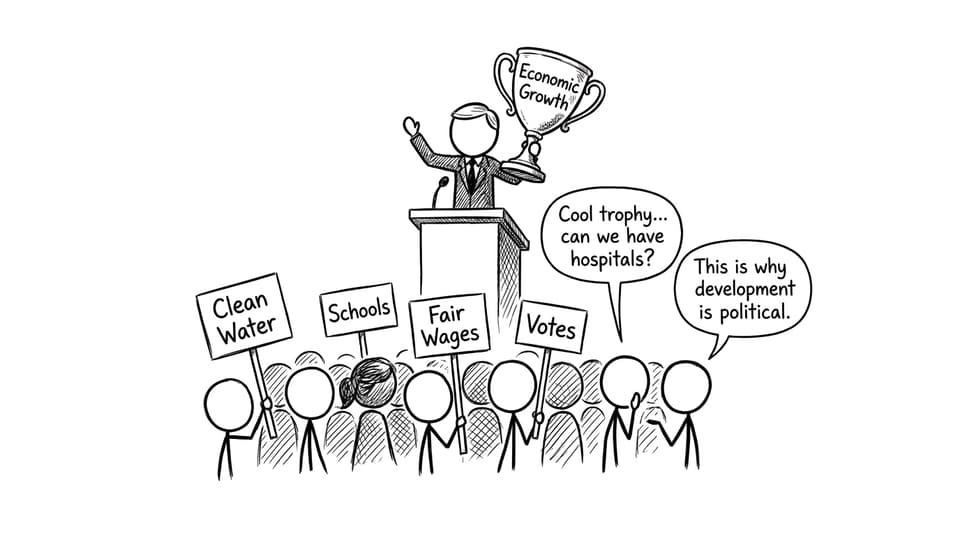
Development policies decide who gets land, water, jobs, housing, and protection. That makes development inherently political.
Institutions matter. Governance, rule of law, accountability, and participation shape whether resources turn into real improvements or disappear into corruption, conflict, or patronage networks. This is where IB Global Politics students should explicitly connect development to legitimacy and justice: when people feel excluded from development, the state’s authority can weaken.
For concept links, read What Is Power in Global Politics? IB Global Politics Guide and then practise planning essays using the IB Global Politics Paper 2 Guide.
Inequality and sustainability: the two questions examiners love
Two themes repeatedly lift answers into the top bands:
Inequality: Development gains can concentrate among elites, cities, or majority groups. Your analysis improves when you specify “development for whom?” and show how global structures (trade, finance, corporate power) can widen gaps.
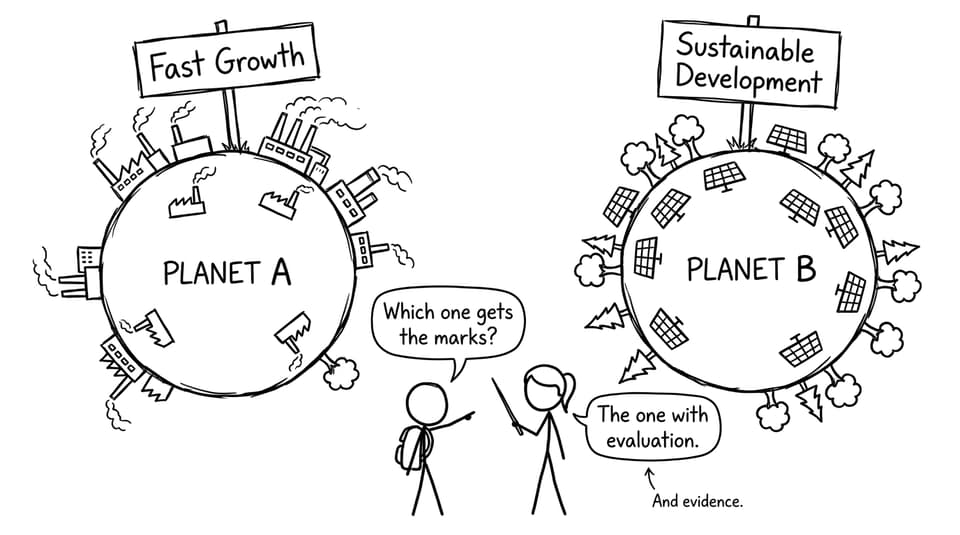
Sustainability: Short-term growth can damage ecosystems and undermine future well-being. Sustainable development asks whether progress today steals capacity from tomorrow.
To strengthen structure and exam technique, use RevisionDojo’s IB Global Politics Paper 2 Guide Notes and keep a bank of adaptable examples with the strategy from How to Use Case Studies in IB Global Politics.
Conclusion: treat development as a debate, not a definition
If you remember one thing, let it be this: in IB Global Politics, development is an argument about people, power, and the future. Define it broadly, show its dimensions, and evaluate who gains and who loses.
When you’re ready to practise under exam conditions, RevisionDojo brings everything into one place: Questionbank prompts, Study Notes, Flashcards for active recall, AI Chat for quick clarification, and Grading tools to tighten your paragraphs. Add Predicted Papers and Mock Exams for timing, use the Coursework Library for research confidence, and lean on Tutors when you want feedback that feels like an examiner. For more topic support, browse All IB Global Politics posts.