



An electric field is a region in which an electric charge experiences a force. At any point, electric field strength is the force per unit positive test charge, expressed as E = F/q. It is a vector: its direction is the direction in which a positive test charge would be pushed, and its SI unit is N C⁻¹.
The strange part is that nothing needs to touch. A source charge changes the space around it, and another charge placed there responds. For an IB Physics student, that invisible interaction becomes manageable once you separate three ideas: the field created by a source, the force on a charge, and the sign that determines the force direction.
Electric field essentials at a glance
Before going deeper, keep this checklist beside you:
- Definition: force per unit positive test charge
- Field equation: E = F/q
- Force equation: F = qE
- Point-charge field: E = k|Q|/r²
- Uniform field between parallel plates: E = V/d
- Unit: N C⁻¹, equivalent to V m⁻¹
- Direction: away from positive source charges and toward negative source charges
- Negative particle: force acts opposite to the field direction
- Field-line density: closer lines represent a stronger field
These relationships are central to the current IB Physics D.2 electric and magnetic fields topic. You can explore them through RevisionDojo's D.2 electric and magnetic fields resources, which combine Study Notes, lessons, Flashcards, and targeted practice.
What is an electric field physically?
Imagine placing a very small positive charge at different points around a charged object. At every point, you record the electric force on that test charge. The collection of force-per-charge measurements forms the electric field.
Mathematically:
E = F/q
Here, E is electric field strength, F is the electric force on the test charge, and q is the test charge. The test charge is imagined to be small enough that it does not significantly disturb the charges producing the field.
This distinction matters. The source charge creates the field. The test charge experiences a force because it is in that field. Changing the test charge changes the force, but it does not change the pre-existing field when the test charge is sufficiently small.
Electric field strength is a vector quantity, so a complete answer may require both magnitude and direction. If the source is positive, the field points radially outward. If the source is negative, it points radially inward.
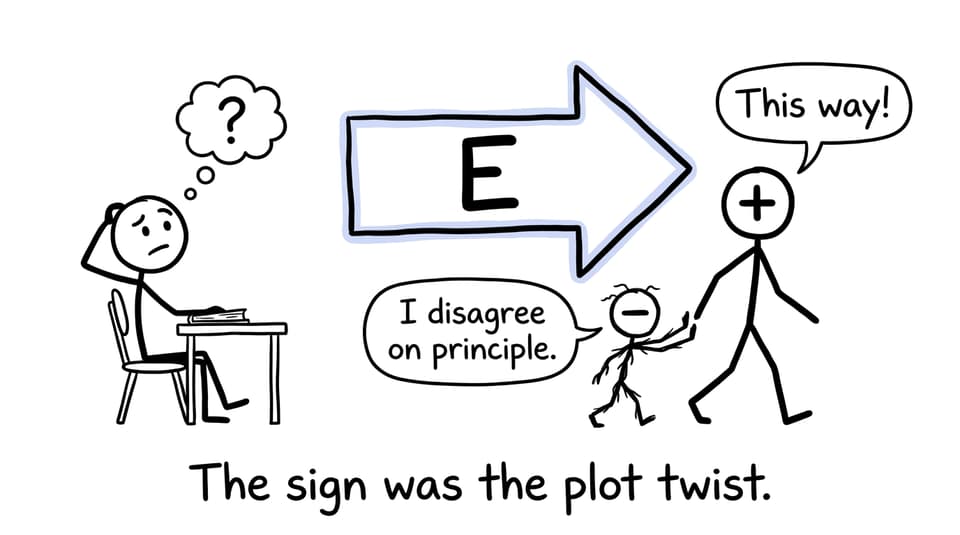
The convention uses a positive test charge. Therefore, a negative particle experiences force in the direction opposite to the electric field:
F = qE
The sign of q carries the directional information. This is one of the smallest details in the topic and one of the easiest places to lose a mark.
Electric fields around point charges
For a point charge, or a spherically symmetric charge observed from outside the sphere, the field magnitude in a vacuum is:
E = k|Q|/r²
where:
- Q is the source charge
- r is the distance from the source charge to the point of interest
- k ≈ 8.99 × 10⁹ N m² C⁻²
This is an inverse-square relationship. If the distance doubles, the field becomes one quarter as strong. If the distance triples, it becomes one ninth as strong.
Notice that the equation contains the source charge Q, not the charge later placed in the field. A useful habit is to ask, “Which charge creates the field?” before substituting numbers. RevisionDojo's electric field properties and laws notes provide a focused review of this distinction alongside Coulomb's law.
When several source charges are present, electric fields obey superposition. Calculate the field produced by each charge at the chosen point, then add the fields as vectors. Fields pointing in opposite directions subtract in magnitude; fields at angles usually require components.
Reading electric field lines
Field lines are a visual model, not physical threads in space. At any point, the tangent to a field line gives the electric field direction. Their relative density indicates field strength.
A valid field-line diagram follows several rules:
- Lines point away from positive charges and toward negative charges.
- Lines never cross because the field cannot have two directions at one point.
- Lines are closer together where the field is stronger.
- Radial fields become less dense with increasing distance.
- Parallel, equally spaced lines represent a uniform field.
Between large, oppositely charged parallel plates, the central field is approximately uniform. Ignoring edge effects:
E = V/d
Here, V is the potential difference and d is the perpendicular plate separation. This equation produces V m⁻¹, which is equivalent to N C⁻¹. Do not apply E = V/d automatically to a radial field; it is the uniform-field relationship.
For a more visual walkthrough, use the D.2 electric and magnetic fields lessons alongside the article rather than trying to memorize diagrams without understanding them.
How electric fields appear in IB exam questions
Electric-field questions often ask you to move between representations. You may receive a field-line diagram and infer direction, calculate E from a source charge, or use F = qE to predict particle motion.
A reliable method is:
- Identify what creates the field.
- Decide whether the field is radial or uniform.
- Calculate the field magnitude.
- State the field direction.
- If a particle is introduced, use F = qE.
- Reverse the force direction if the particle is negative.
- Include the appropriate SI unit.

Worked IB-style example
A positive point charge of 3.0 μC creates an electric field. Determine the field strength 0.20 m from the charge. Then find the force on an electron placed at that point.
First convert the source charge:
Q = 3.0 × 10⁻⁶ C
Calculate the field:
E = k|Q|/r²
E = (8.99 × 10⁹)(3.0 × 10⁻⁶)/(0.20)²
E = 6.7 × 10⁵ N C⁻¹ to two significant figures.
Because the source charge is positive, the field points away from the source.
For an electron, use the magnitude of its charge, 1.60 × 10⁻¹⁹ C, to calculate the force magnitude:
F = |q|E
F = (1.60 × 10⁻¹⁹)(6.7 × 10⁵)
F = 1.1 × 10⁻¹³ N to two significant figures.
The electron is negative, so its force is toward the positive source, opposite to the field direction.
Once this process feels clear, apply it in the D.2 electric and magnetic fields Questionbank. Understanding becomes exam skill only after you retrieve and use it without a model answer beside you.
Common electric-field mistakes
Confusing field with force
An electric field exists at a location even when no test charge is there. Force appears when a charge is placed in the field. Field strength is measured in N C⁻¹; force is measured in N.
Following the motion of an electron when drawing E
Field direction follows a hypothetical positive test charge. An electron accelerates in the opposite direction. Draw E first, then consider the particle's sign.
Using the wrong charge in the point-charge equation
In E = k|Q|/r², Q is the charge creating the field. In F = qE, q is the charge experiencing the force.
Treating electric field as a scalar
Fields from multiple charges must be added as vectors. Two large fields can cancel at a point if they have equal magnitudes and opposite directions.
Forgetting unit conversions
Convert μC to C, cm to m, and kV to V before substitution. Keep extra digits during calculation and round at the end.
Quick-reference formula table
| Situation | Relationship | Exam reminder |
|---|---|---|
| Definition of field strength | E = F/q | Use a positive test-charge convention |
| Force on a charge | F = qE | A negative q reverses the direction |
| Field due to a point charge | **E = k | Q |
| Uniform field between plates | E = V/d | Use perpendicular plate separation |
| Particle acceleration | a = qE/m | Combine electric force with Newton's second law |
Particle motion is developed further in RevisionDojo's charged particle motion notes. For HL students, the IB Physics Fields exam guide also connects field strength to electric potential, potential energy, and potential gradient.
Turn the definition into exam marks
Knowing what is an electric field is the beginning, not the finish. The real test is whether you can identify the source, choose the correct model, preserve vector direction, and explain what happens to a positive or negative particle.
RevisionDojo brings that process together. Review the Study Notes, use Flashcards for definitions, and move into the IB Physics Questionbank for retrieval practice. Then test your timing with IB Physics Predicted Papers and Mock Exams. AI Chat and Grading tools can help diagnose reasoning gaps, while the Coursework Library and Tutors support the wider IB journey.
The field itself is invisible. Your method should not be. Define it, draw the direction, choose the equation, and check the sign.