

A small moment that costs big marks
The most painful kind of exam mistake is the quiet one.
Not the one where you blank completely. The one where you know the content, you write confidently, and you still lose marks because your answer makes an IB examiner work too hard to find what they're looking for. In an IB paper, the difference between a solid 6 and a frustrating 5 is often not knowledge; it's presentation of thinking.
IB examiners don't grade like your friend reading your notes. They grade like someone holding a checklist, moving fast, and looking for evidence that you understood the command term, used relevant material, and built a clear chain of reasoning. Anything that blocks that chain is what they "hate" seeing.
This guide walks through the most common answer-killers in IB exams, why they lose marks, and what to do instead, with a few lighter breaks along the way.
Quick checklist: the IB examiner-friendly answer
Before we get into the common problems, here's the simple checklist most high-scoring IB answers quietly follow:
- You respond to the command term in the first line.
- You stay on the exact question (not the topic).
- You make a claim, then back it with evidence, then explain the link.
- You use subject vocabulary only when it adds precision.
- You show steps (for calculations) and structure (for essays).
- You manage time so every mark is "reachable" on the page.
If you want a consistent routine for this, RevisionDojo's Study Notes and Flashcards make it easier to keep command terms, definitions, and key examples ready under pressure.
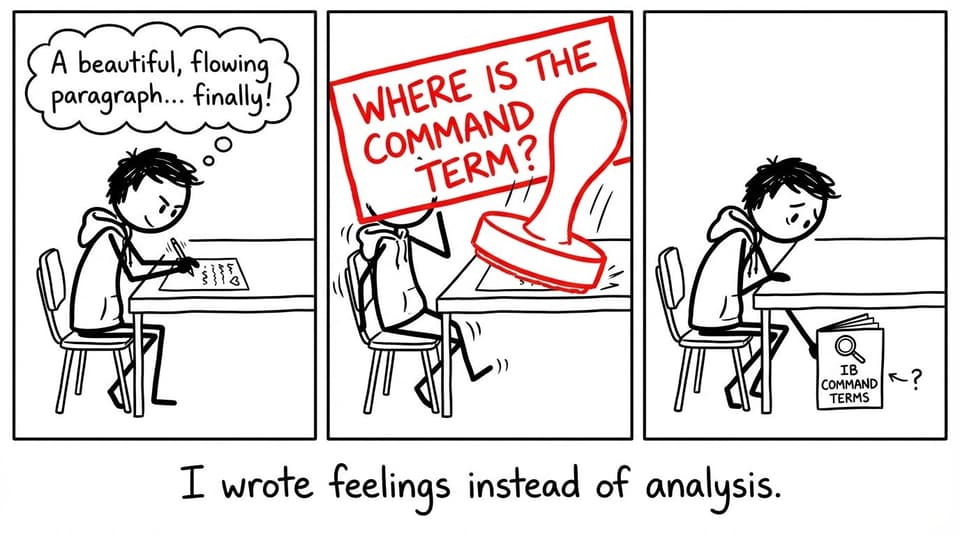
Ignoring the command term (the fastest way to under-answer)
This is the classic IB trap: you answer the topic, not the instruction.
"Describe" is not "explain." "Explain" is not "evaluate." "To what extent" is not "list." The examiner isn't impressed that you know more than asked. They're focused on whether you did what was asked.
What IB examiners hate
- A long paragraph when the question wanted a comparison.
- A definition when the question wanted an implication.
- An evaluation with no criteria.
What to do instead
Start with a one-line command-term translation. Literally write it in your head:
- Explain = cause and effect, "because… therefore…"
- Compare = similarities and differences, using the same categories
- Evaluate = judge using criteria, then conclude
A practical training method: open a set of exam-style prompts in RevisionDojo's Questionbank and, before answering, label the command term and write a 5-word plan. This builds the reflex that the IB rewards.
Vague claims with no evidence (aka "trust me" writing)
IB marking is not vibes-based.
A surprising number of answers sound intelligent but don't land because they never provide a specific example, data point, quotation, named concept, or worked step. Examiners can't award marks for ideas they can't verify.
What IB examiners hate
- "This shows the author's intention." (How? Where?)
- "Globalization has many impacts." (Which? On whom?)
- "The enthalpy increases." (By how much? From what?)
What to do instead
Use a simple three-part rhythm:
Point (your claim), followed by Proof (example/data/quote/calculation step), followed by Explain (why that proof earns the claim).
This works across IB subjects: Literature, Economics, Biology, History, Math. It's less about the content and more about the shape of your thinking.
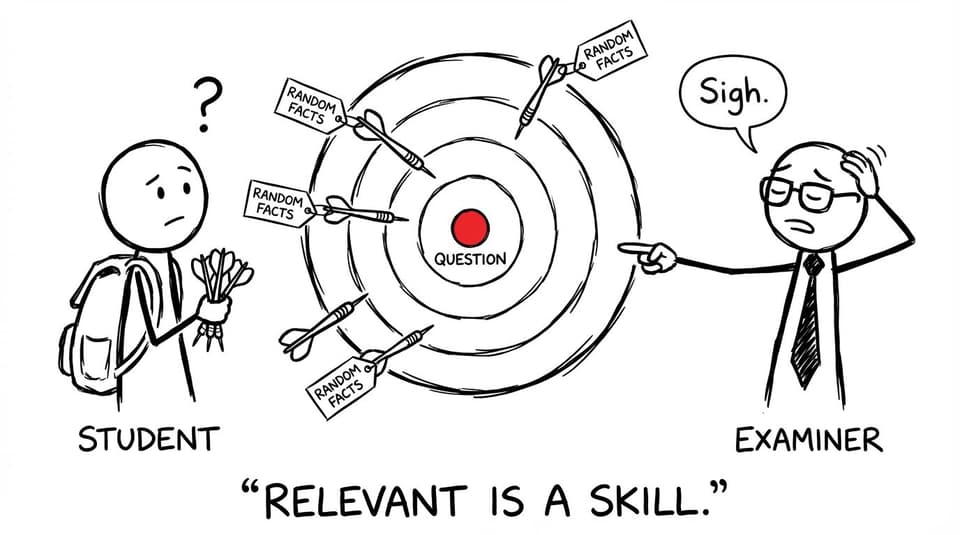
Dumping everything you know (relevance beats volume)
Some students treat IB exams like a storage unit: if they throw enough facts into the box, surely some of it counts.
But examiners don't award marks for being busy. They award marks for being relevant. Extra information can even make your key point harder to find.
What IB examiners hate
- A "topic dump" that never returns to the question.
- A paragraph of context with no argument.
- Multiple unrelated points when the question asked for one developed one.
What to do instead
Ask: "If I delete this sentence, do I lose marks?" If not, it probably doesn't belong.
RevisionDojo's AI Chat can be used like a sparring partner here: paste your answer and ask, "Which sentences are irrelevant to the question?" It's a clean way to train relevance.
Messy structure (when the examiner has to hunt for your logic)
An examiner is not grading your intentions. They're grading what they can find quickly.
Even brilliant analysis can lose marks if it's buried. In an IB exam, structure is a kindness you offer to your future self.
What IB examiners hate
- No paragraphs, no signposting, no direction.
- Arguments that switch mid-sentence.
- A conclusion that introduces new points.
What to do instead
Use lightweight signposting:
- "First…" "However…" "Therefore…"
- "In contrast…" "This suggests…"
- "Based on X criterion…"
For long answers, plan in 20 seconds: 3 bullet points, 1 line each. Then write.
If you want a fast way to practice structure, RevisionDojo's Grading tools (and Mock Exams) help you see what earns marks and what just takes space.
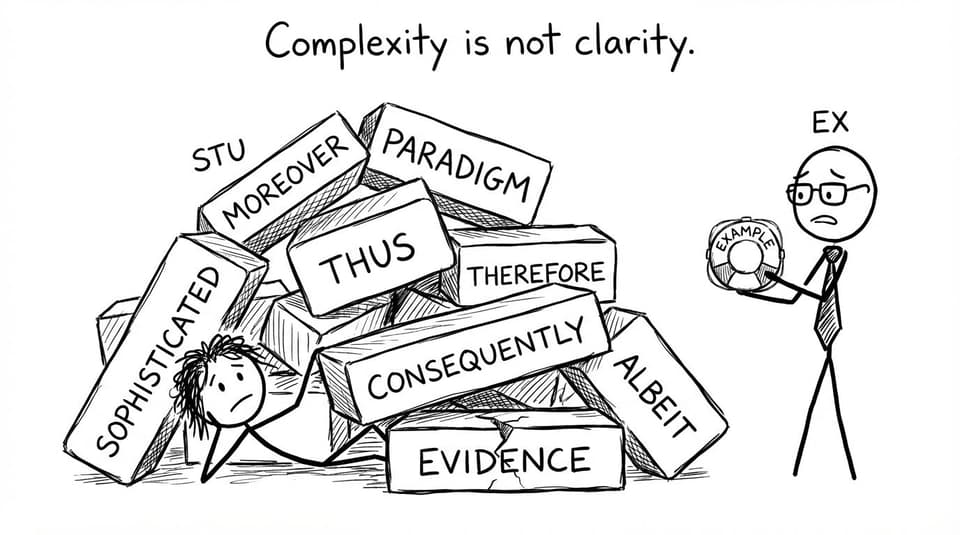
Jargon stacking (complex words without complex thinking)
There's a particular IB-style fear: if your writing sounds simple, it must be low-level.
So students build sentences like ornate staircases that lead nowhere. Examiners don't reward vocabulary for its own sake. They reward precision.
What IB examiners hate
- Fancy connectors hiding missing evidence.
- Technical terms used incorrectly.
- Overgeneral academic tone with no substance.
What to do instead
Prefer clean sentences:
- Define the term once.
- Use it correctly.
- Prove the claim with a specific example.
In many IB essays, a plain sentence with a precise example beats a complicated sentence that only signals effort.
Not showing working (maths, sciences, and any method-based mark)
A harsh truth: sometimes the final answer is worth less than the steps.
IB markschemes often award method marks. If you skip steps, you make it impossible for an examiner to reward partial understanding.
What IB examiners hate
- Answers with no units.
- No substitution shown.
- A correct-looking number with no logic.
What to do instead
Write like you're leaving breadcrumbs:
- Formula
- Substitution
- Calculation
- Units
- Significant figures (when appropriate)
This also protects you under stress. When your brain runs fast, your writing can keep it honest.
Misreading the question (one word can change everything)
IB questions are often engineered to punish autopilot.
Words like "only," "two," "to what extent," "using the data," and "in the context of" are not decoration. They are the rules of the game.
What IB examiners hate
- Answering a similar question you practiced instead of the actual one.
- Ignoring a dataset, extract, or quote provided.
- Giving three points when asked for two (wasting time and clarity).
What to do instead
Underline constraints and rewrite the question in simpler language in the margin.
If you're drilling exam questions, RevisionDojo's Predicted Papers and Mock Exams are useful because they force you to practice careful reading in realistic conditions.
Time mismanagement (unfinished answers are invisible marks)
Examiners can't award marks for what you meant to write.
The IB student who writes slightly simpler but finishes often beats the student who writes beautifully but leaves a whole question blank.
What IB examiners hate
- A perfect first response and a missing last response.
- Spending 25 minutes on a 10-mark section.
- Rewriting instead of moving on.
What to do instead
Use a blunt rule: marks = minutes (roughly). Check the mark allocation, decide the length, and move.
You can practice pacing with timed sets in RevisionDojo's Questionbank, then review patterns with the Grading tools.
A calmer way to train: deliberate repetition
The best IB answers aren't written by people who "try harder" on the day. They're written by people who practiced the right habits.
A simple weekly loop:
- 2 timed questions (from RevisionDojo's Questionbank)
- 1 self-mark using criteria (RevisionDojo Grading tools)
- 10 targeted flashcards (RevisionDojo Flashcards)
- 15 minutes fixing one weakness (with AI Chat)
That routine is boring in the best way. Boring is reliable. Reliable is what the IB rewards.
The final thought: make your thinking easy to reward
IB examiners don't hate students. They hate friction.
They hate when the command term is ignored, when evidence is missing, when relevance is unclear, when structure is messy, and when time runs out. Not because they're harsh, but because the IB system is designed to reward answers that are clear, targeted, and provable.
If you want the simplest advantage, make your answers easy to mark. Practice with RevisionDojo's Questionbank, refine with Study Notes and Flashcards, stress-test with Mock Exams and Predicted Papers, and tighten your response style with AI Chat and Grading tools. That combination turns what examiners "hate" into the habits they can't ignore.