

What IB Examiners Actually Look For (Not What You Think)
A friend once told me they "lost marks because the examiner didn't like their writing style." They said it with the same resignation you hear after a coin lands on tails five times in a row: unfair, random, personal.
But IB marking is rarely personal. It's usually simpler than that. Examiners are trained to find marks, not to play literary critic. They're scanning for specific evidence that you met the criteria, responded to the task, and showed thinking in the way the subject expects. If you understand what an IB examiner actually looks for, you stop trying to impress and start trying to be understood.
This article is a guide to that shift. Not "write smarter." Not "revise more." But: align what you do on exam day with what IB examiners reward.
A quick checklist: what IB examiners reward across subjects
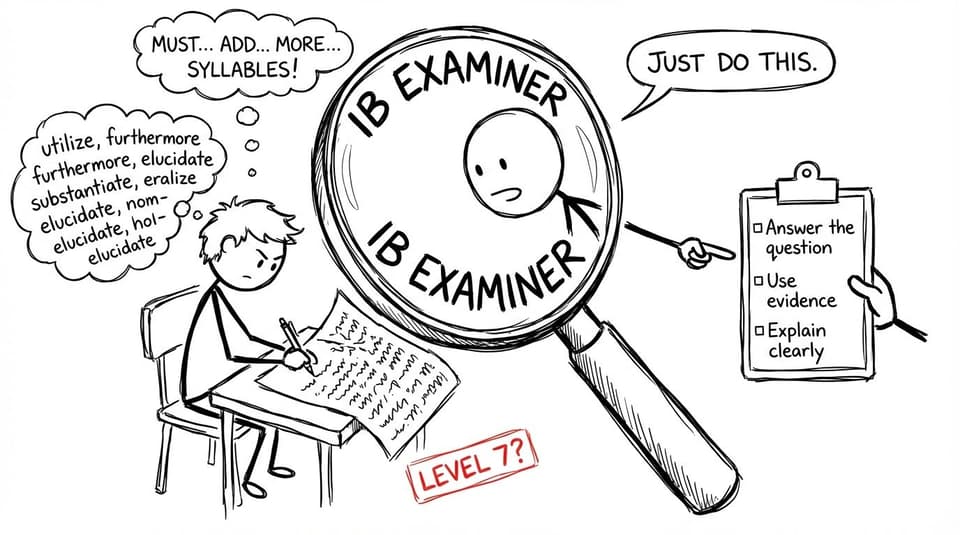
If you remember nothing else, remember this: most IB examiners are doing a structured search for proof.
Here's the cross-subject checklist that shows up everywhere in IB marking:
- You answered the exact question asked (not the one you prepared).
- You used subject-appropriate evidence (data, quotes, working, references to the text, case studies, diagrams).
- You explained your reasoning (not just conclusions).
- You stayed aligned to the criteria (the rubric is the map; examiners follow it).
- You communicated clearly under pressure (structure beats sparkle).
When students lose marks, it's often because they did "hard work" that didn't match those points.
The biggest misconception: IB is marked like "good writing"
Many IB students revise like they're preparing for a performance. They polish paragraphs. They memorise "sophisticated" phrases. They try to sound like the exemplar.
Examiners don't award marks for sophistication by itself.
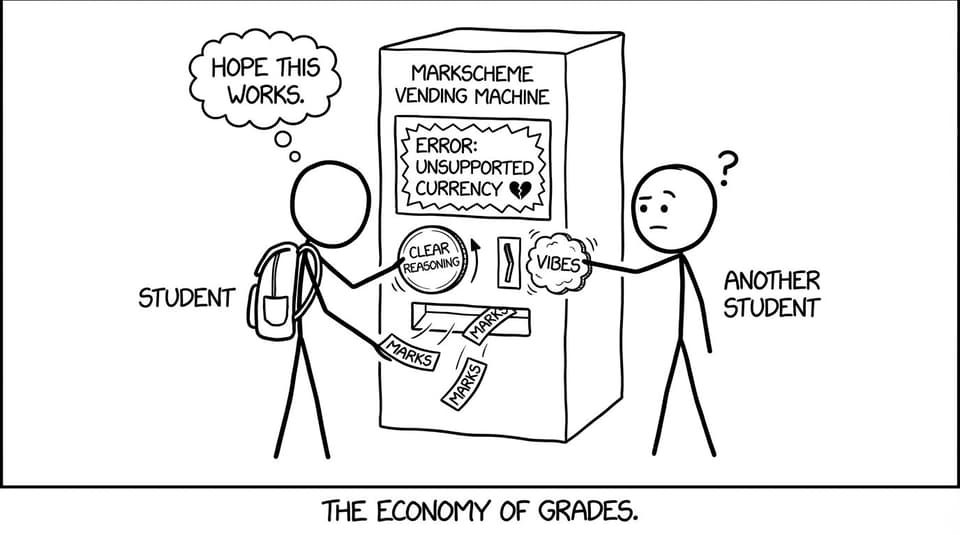
They award marks when sophistication serves something measurable: precision, insight, evaluation, correct method, or appropriate terminology. In other words, IB is not graded by vibes.
That's why the student with clean, plain writing can outscore the student with "beautiful" prose. The examiner is not thinking: Was that elegant? They're thinking: Where is the justified claim? Where is the evidence? Where is the evaluation?
A useful mental model is this: an IB examiner is like a careful accountant. They are checking whether the "mark statements" have been met.
What IB examiners look for in your first 30 seconds
Examiners are human. They form a fast impression. Not of you, but of whether your answer is trackable.
In that first half-minute, IB examiners tend to notice:
- Is the response structured? Clear paragraphs, clear steps, clear headings when appropriate.
- Are you using the language of the subject? Terms that show you're in the right conceptual space.
- Are you responding to the prompt, not circling it? They want commitment.
A practical strategy: write your first 2-3 sentences as if you're giving the examiner a map. For essays, that usually means a direct thesis and a direction of argument. For sciences and maths, it means clear method and correct setup. For humanities, it means framing and focus.
This is where RevisionDojo's AI Chat can help: paste a thesis or first paragraph and ask, "Does this directly answer the question and signal my line of argument?" It's a small habit that prevents big mark leaks.
Criteria alignment: the hidden skill top IB students train
High scorers don't just "know more." They aim better.
They practice with the criteria in mind, so the exam feels like a familiar conversation:
- "This command term wants evaluation, so I need a judgment with justification."
- "This question rewards method, so I must show steps, not just results."
- "This task needs interpretation of data, so I must link values to claims."
The quiet superpower is being able to look at any IB question and immediately think: What would a marker need to see to award top-level marks?
This is exactly what you can drill with RevisionDojo's Grading tools and Mock Exams: you're not just checking if you were "right," you're checking if you were markable.
Evidence beats coverage: why "I revised everything" can still underperform
A lot of IB students take pride in coverage. They finish the syllabus. They read every note. They watch every video. And then they're shocked when the exam exposes a different weakness: turning knowledge into scoring answers.
Examiners reward usable knowledge. Knowledge that is:
- selected (relevant, not random)
- applied (used to answer this specific question)
- explained (linked to reasoning)
- evaluated (limitations, alternatives, implications)
This is why RevisionDojo's Questionbank is so valuable for IB prep: it forces you to practice selection under constraints. You stop revising in endless open space and start revising inside the shape of IB questions.
The "chain of reasoning" is where marks live
Across IB subjects, a typical low-to-mid response looks like this:
- claim
- claim
- claim
A high-level response looks like:
- claim
- evidence
- explanation
- implication
- (sometimes) counterpoint
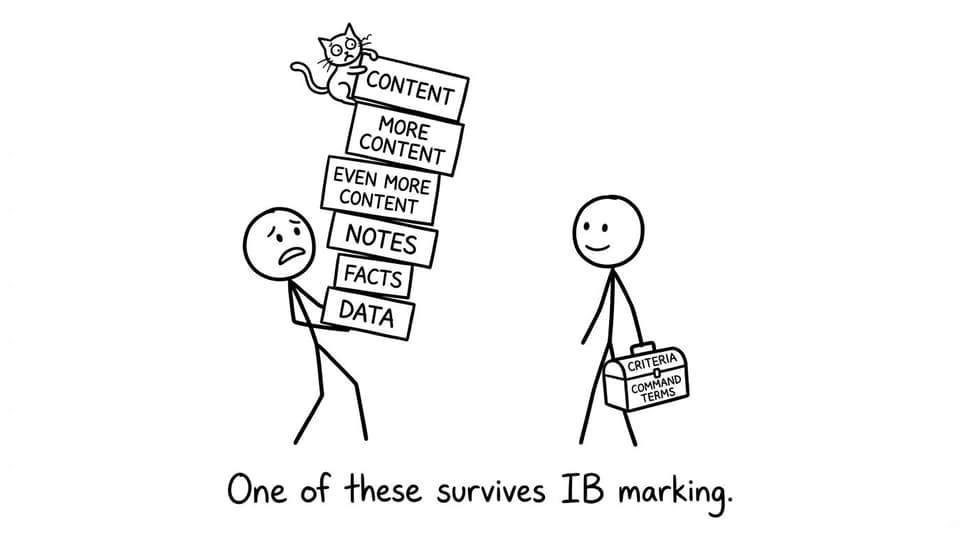
Examiners are trained to reward the chain, not the pile.
If you want a simple rule: never leave your evidence sitting alone. If you quote a line, explain what it proves. If you calculate a value, interpret what it means. If you describe a theory, apply it to the case.
RevisionDojo's Study Notes and Flashcards help here when they're used correctly: don't memorize isolated facts. Turn each card into a mini chain: "term -> meaning -> why it matters -> example." That's IB thinking.
What "evaluation" really means to an IB examiner
Evaluation is one of the most misunderstood ideas in IB.
Students often think evaluation means being negative, or saying "on the other hand" once. Examiners usually want something more concrete: a justified judgment based on criteria.
Examples of what IB evaluation looks like in practice:
- comparing two approaches and choosing one with reasons
- identifying limitations of a method and stating how they affect conclusions
- weighing perspectives and linking them to evidence
- discussing assumptions and how they shape outcomes
You can train evaluation deliberately:
- Add a "So what?" line at the end of each paragraph.
- Add one limitation or alternative explanation after each major claim.
- Use conditional language correctly ("This suggests… provided that…").
RevisionDojo's Predicted Papers (used as timed practice, not as shortcuts) are useful here: they recreate the feeling of having to evaluate quickly, with imperfect time and imperfect certainty, which is exactly the skill the IB rewards.
The examiner's dream: answers that make marking easy
This might sound strange, but the best IB exam answers are kind to the person reading them.
They are:
- easy to follow
- clearly signposted
- consistent in terminology
- careful with definitions
- explicit in steps and reasoning
In most subjects, marks are not taken away because you didn't "know it." They're lost because your thinking stayed inside your head.
A clean structure is not boring. It's generous. It gives the examiner more chances to award marks.
One practical routine:
- Practice with timed Mock Exams.
- Use RevisionDojo's Grading tools to identify which criterion you're missing.
- Target that criterion with Questionbank drills until it becomes automatic.
That cycle is how you build exam-day clarity.
A mini routine for the final weeks of IB exam prep
Here's a calm, repeatable plan that matches how IB examiners actually award marks:
Build mark-ready knowledge
Use RevisionDojo Study Notes to get the core concepts straight, then convert them into Flashcards that include application or explanation, not just definitions.
Practice under constraints
Use the Questionbank daily, with short timed sets. After each set, rewrite one answer to make it more "markable" (clearer chain of reasoning, tighter focus on the prompt).
Simulate the real thing
Do weekly Mock Exams. This is where you learn pacing, endurance, and how your clarity changes under pressure.
Fix one scoring weakness at a time
Use AI Chat to diagnose: "Where did I stop explaining?" or "Which parts are not answering the question?" Then pick a single improvement target.
Get feedback that mirrors the examiner
Use RevisionDojo's Tutors when you need human calibration: not just "is this good," but "what would an examiner credit here, and what is missing?"
Closing: the quiet way to win marks in IB
The most comforting truth about IB marking is also the most challenging: you don't need to be dazzling, you need to be detectable.
Examiners reward answers they can follow, verify, and credit. They look for criteria alignment, clear reasoning, and evidence that is actually used. When you revise with that in mind, studying becomes calmer. You stop chasing the myth of "perfect wording" and start building repeatable scoring habits.
If you want to train the exact skills IB examiners look for, build your routine around RevisionDojo: drill with the Questionbank, tighten knowledge with Study Notes and Flashcards, stress-test yourself with Mock Exams and Predicted Papers, calibrate with Grading tools, and ask AI Chat the questions you're too tired to untangle alone. When you're ready, bring in Tutors for examiner-style feedback.
IB marks aren't hidden. They're just quiet. And once you learn what to listen for, you start hearing them everywhere.