

A microscopic story hiding inside a quiet thermometer
In IB Physics, thermal equilibrium can feel oddly anti-climactic. You put a hot object next to a cold one, wait, and eventually the thermometer stops changing. End of story.
But at the microscopic level, it’s the opposite of calm. Particles keep colliding, trading energy, and ricocheting in every direction. Thermal equilibrium is not “nothing happens.” It’s “everything happens, but it cancels out.” And that distinction is exactly what IB examiners love.
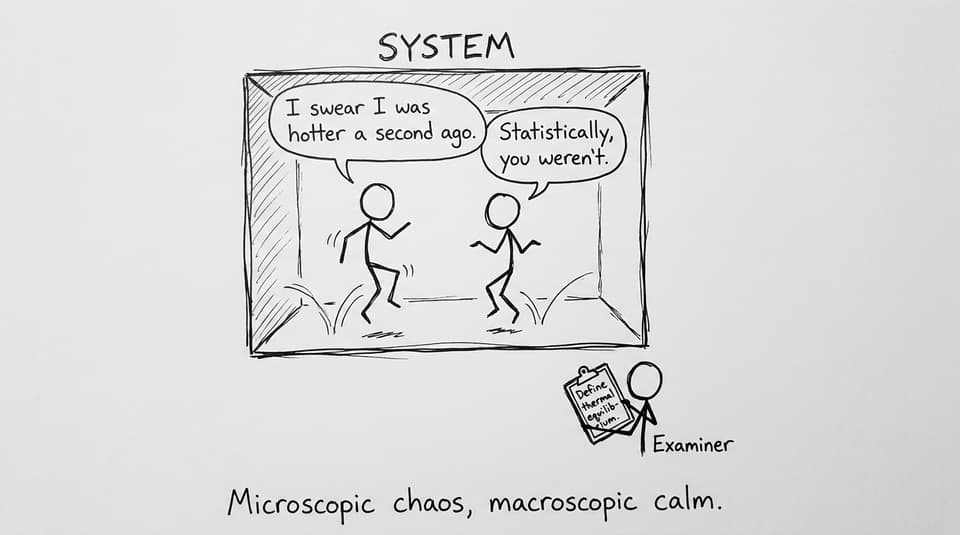
What thermal equilibrium means in IB Physics (quick checklist)
Use this checklist when writing an explanation in IB Physics:
-
Temperature is linked to average kinetic energy of particles.
-
Energy transfers through collisions (and in metals, also via electrons).
-
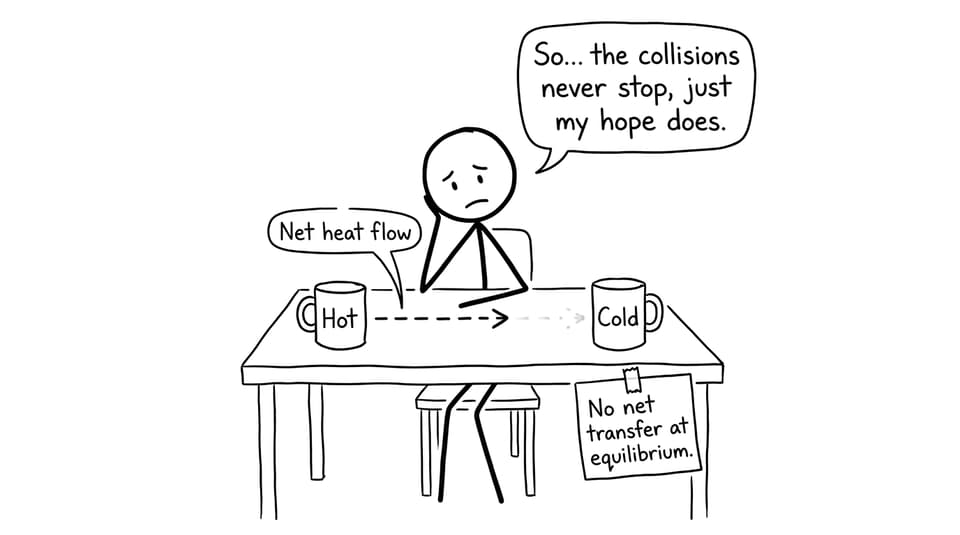
Before equilibrium, there is a net energy transfer from hot to cold.
-
At equilibrium, collisions still exchange energy, but there is no net transfer.
-
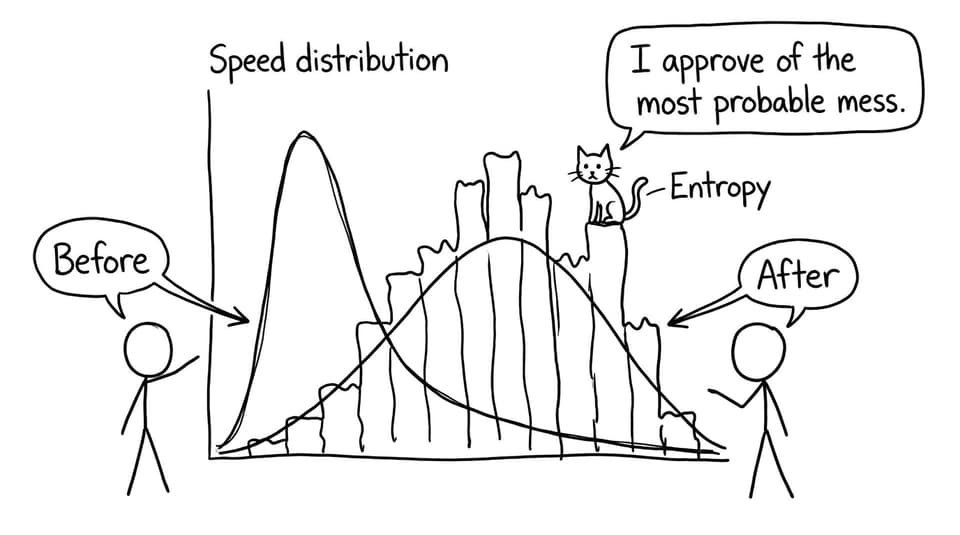
The distribution of particle speeds becomes stable over time.
For the syllabus-aligned foundations, revise temperature, internal energy, and thermal ideas in 3.1 Thermal concepts notes.
Thermal equilibrium at the microscopic level: “no net transfer”
Imagine two regions of the same system: one hotter, one colder. In IB Physics, “hotter” means the particles in that region have a higher average kinetic energy. So, on average, more fast particles are leaving the hot side, and when they collide with slower particles on the cold side, they tend to transfer kinetic energy.
That “tend to” matters. Individual collisions are random: a slow particle can sometimes speed up a fast one. But statistically, the hot region has more high-speed particles available to give energy away.
Thermal equilibrium is the moment that statistical bias disappears. Collisions still occur constantly, but energy transfers become symmetric: the hot side is no longer consistently losing kinetic energy overall, and the cold side is no longer consistently gaining it. Temperature becomes uniform because the average kinetic energy is uniform.
To connect this to transfer mechanisms, see Particle motion and heat transfer methods.
The distribution of speeds becomes stable (not identical)
A common mistake in IB Physics is to imagine equilibrium as “all particles have the same speed.” They don’t.
Even at equilibrium, particles still have a range of kinetic energies. Some are fast, some are slow, and they keep swapping energy. What becomes stable is the overall pattern: the speed (or energy) distribution stops changing with time.
That stability is what your macroscopic instruments detect as a steady temperature. If the distribution shape is steady, then the average kinetic energy is steady, so the temperature is steady.
If you’re revising the bigger chapter context, start from IB Physics revision notes (SL/HL) and then drill into thermal topics.
Why equilibrium links to entropy (in exam-friendly language)
Microscopically, equilibrium is also the most probable arrangement of energies. There are vastly more ways for energy to be “spread out” among many particles than “piled up” in one corner.
So as collisions continue, the system naturally evolves toward the most statistically likely distribution. In IB Physics, you can describe this as the system moving toward maximum entropy given its constraints. The key is to keep it concrete: “more possible microstates correspond to an even spread of energy.”
For HL students extending into thermodynamic thinking, connect this to B.4 Thermodynamics notes or the broader B.2 Thermodynamics notes.
How to practice this for IB Physics exams
Knowing the definition isn’t enough in IB Physics. You need to apply the microscopic story to unfamiliar contexts.
-
Practice explanation-style questions in the B.1 Thermal energy transfers Questionbank.
-
If you’re on the older path, use the Thermal energy transfers Questionbank.
-
Build speed with targeted practice in 3.1 Thermal concepts Questionbank.
RevisionDojo also makes the microscopic language easier to retrieve under time pressure: Study Notes for clarity, Flashcards for quick recall, AI Chat for “why is this wrong?” moments, and Grading tools to tighten your phrasing into examiner-friendly sentences. When you’re ready, Mock Exams and Predicted Papers help you rehearse the same ideas at full exam pace.
Closing: calm is a statistical illusion you can learn to write
Thermal equilibrium at the microscopic level is the moment the universe stops having a preference. Particles still race, collide, and trade energy, but the trades balance out so perfectly that temperature becomes steady and heat flow loses its direction.
If you want this to feel automatic in IB Physics, use RevisionDojo to pair clear Study Notes with Questionbank practice, then refine your explanations with AI Chat and Grading tools. The goal is simple: turn microscopic chaos into marks you can count.