




The hook: when “steady” creates a curve
In IB Physics, students often expect “constant” to mean “straight.” Constant speed gives a straight line on a displacement-time graph, so it feels natural to assume constant acceleration should do something similarly tidy. Then projectile motion arrives and the path curves like it has a personality.
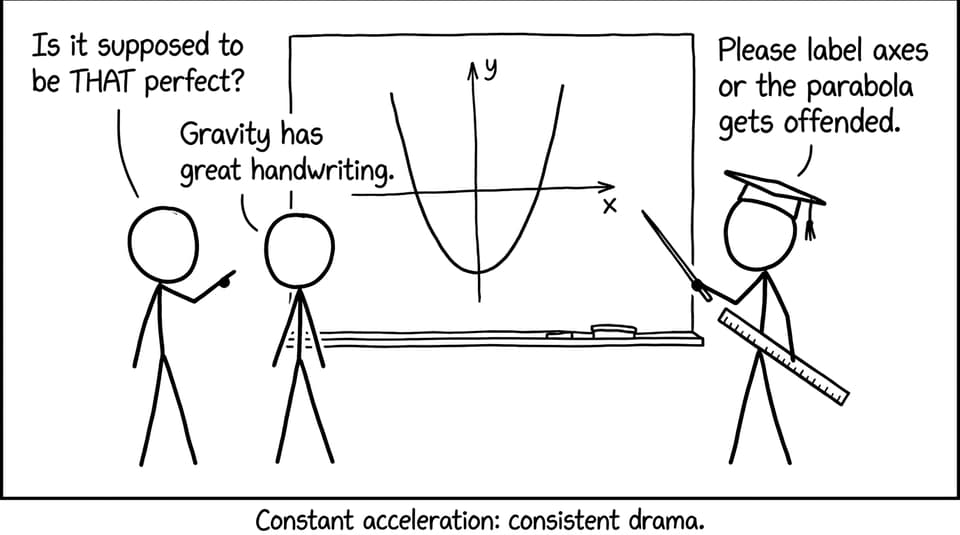
Here’s the quiet surprise: constant acceleration is exactly what creates a parabola. Not because physics wants to be fancy, but because stacking equal changes in velocity over equal times forces displacement to grow in a squared way.
Quick checklist (exam mindset)
-
Constant acceleration means velocity changes linearly with time.
-
Displacement is the accumulation of velocity over time (area under a v-t graph).
-
Linear velocity “adds up” into quadratic displacement.
-
In projectile motion: x is linear in time, y is quadratic in time.
-
Eliminate time and you get y as a quadratic in x: a parabola.
For syllabus-aligned support, start with IB Physics A.1 Kinematics Notes.
Why constant acceleration bends displacement (without magic)
Think of motion in one dimension. In IB Physics, you can frame it two ways:
The graph way
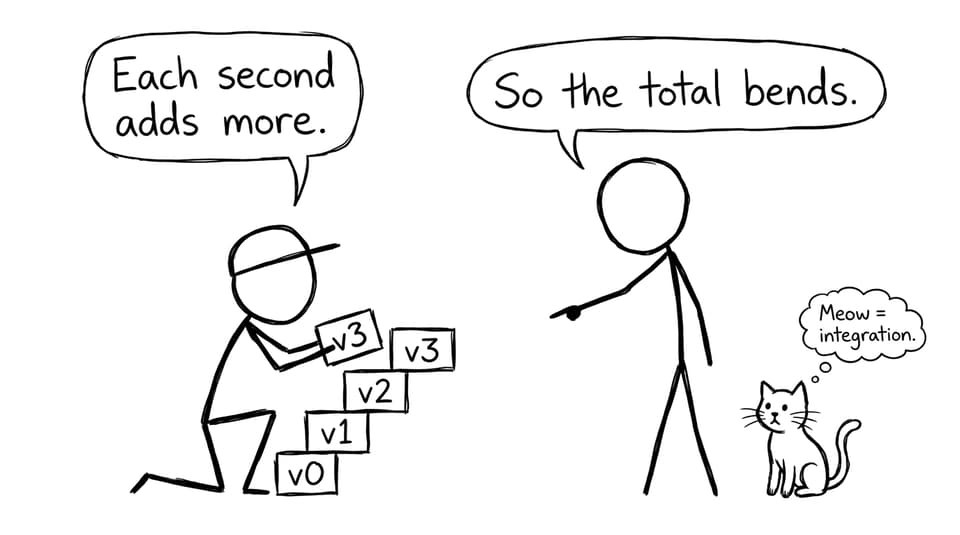
If acceleration is constant, the velocity-time graph is a straight line. Displacement is the area under that straight line, which is a rectangle plus a triangle. A triangle’s area goes like (t^2), so displacement naturally becomes a quadratic function of time.
This is the same idea behind the constant-acceleration equations explained in A.1.2 Equations of motion Notes.
The intuition way
Each second, the object is moving a bit faster than the second before. So each equal time step adds a larger “chunk” of displacement. When the added chunks grow evenly, the total grows in a curve. In IB Physics, that curve is the parabola.
Projectile motion: where the parabola becomes visible
Projectile motion is just two one-dimensional motions happening together:
-
Horizontal: constant velocity (approximately), so (x \propto t)
-
Vertical: constant acceleration (-g), so (y \propto t^2)
So time is the bridge. If (x) is linear in time and (y) is quadratic in time, then eliminating (t) makes (y) quadratic in (x). That’s the parabola you meet in IB Physics.
If you want this in a topic-focused layout, use IB Physics A.1.3 Projectile Motion Notes and then drill the same patterns in the A.1.3 Projectile motion Questionbank.
The “constant acceleration” trap examiners set
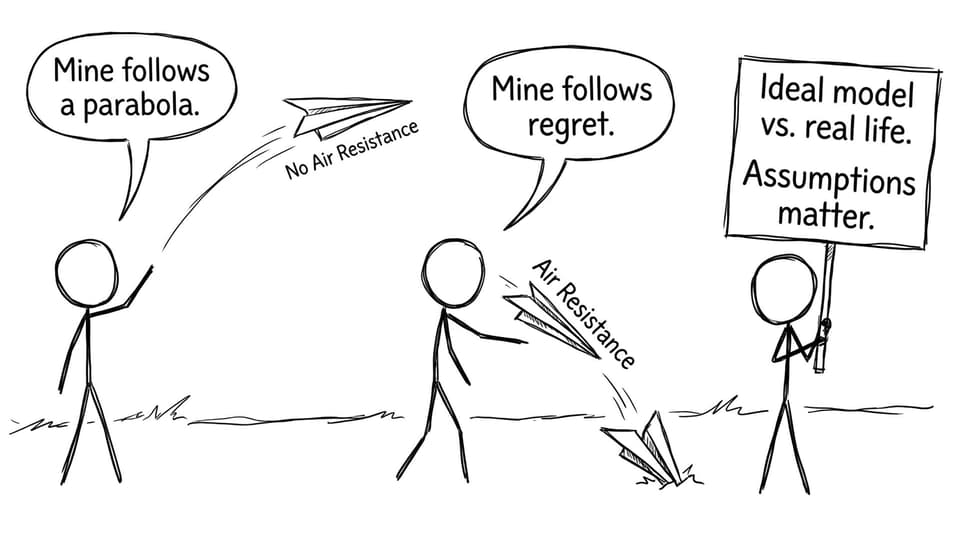
In IB Physics, parabolic motion is a signal that the model is ideal:
-
acceleration is constant (typically (g))
-
air resistance is ignored
-
the horizontal acceleration is zero
The moment air resistance matters, acceleration is no longer constant, and the path is no longer a perfect parabola. That’s why many questions explicitly say “neglect air resistance.” To tighten your technique, review Acceleration Formula in IB Math and Physics.
Closing: turn the parabola into free marks
In IB Physics, the parabola is not a random curve you memorise. It’s a fingerprint: constant acceleration leaves quadratic displacement behind. Once you see that, projectile questions stop feeling like “two equations and hope,” and start feeling like one coherent story.
To lock it in, use RevisionDojo’s Study Notes for understanding, Flashcards for quick recall, the Questionbank for exam-style repetition, and AI Chat when a step in your setup feels slippery. Add Mock Exams, Predicted Papers, and the Grading tools when you want full-paper stamina, and dip into the Tutors and Coursework Library when you need targeted help. That’s how IB Physics turns from a curveball into a curve you can predict.