




What Fundamentally Causes Electric Current to Flow?
The moment you close a switch, something quietly decisive happens in your circuit. Not a dramatic sprint of electrons, but a coordinated nudge that spreads through the wire almost immediately. In IB Physics, that “why does current flow?” question is a favorite because it tests whether you understand the cause (an electric field from potential difference) rather than just the result (a number of amps on your calculator).
Quick exam checklist (IB Physics-friendly)
Before you explain current, run this quick checklist:
-
Is there a potential difference (voltage) across the conductor?
-
Is the circuit a closed loop?
-
Are there mobile charge carriers (electrons in metals, ions in electrolytes)?
-
Can you name the microscopic cause: an electric field causing drift?
-
Can you include the limiter: resistance from collisions?
If you want the clean syllabus language for definitions, the B.5.2 Electrical Current and Voltage notes are a solid anchor.
The fundamental cause: an electric field inside the conductor
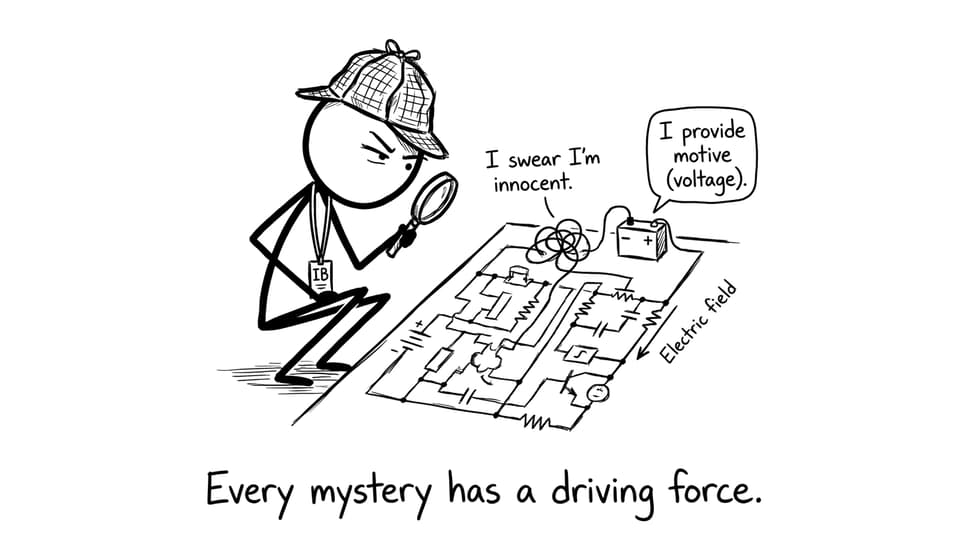
Electric current flows because an electric field is set up in the conductor, and that field exerts a force on charge carriers.
In metals, the carriers are electrons that can move through the lattice. When you connect a battery, you create a potential difference between two points. That potential difference establishes an electric field throughout the wire, and the field gives electrons a tiny net motion called drift. Random motion continues, collisions continue, but the drift is the organized part that counts as current.
This is why in IB Physics, “voltage pushes current” is shorthand for a deeper statement: a potential difference creates an electric field that produces drift. For extra clarity on the energy meaning of voltage, see How potential difference represents energy per charge.
Why the light turns on fast when electrons drift slowly
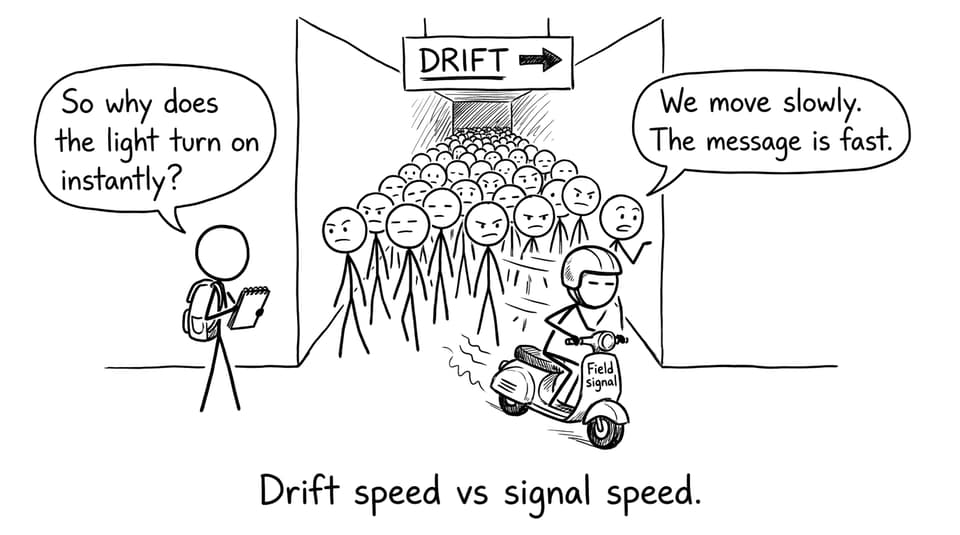
A common exam trap is imagining electrons racing from the battery to the bulb at high speed. In reality, electron drift speed is typically slow. What travels quickly is the electromagnetic signal (the electric field configuration) which propagates through the circuit at a significant fraction of the speed of light.
So when you close the switch, the circuit responds almost instantly because the field becomes established around the loop quickly. Electrons everywhere start drifting almost at once, even though each individual electron moves slowly and keeps colliding.
If you want practice questions that target exactly this style of explanation, the B.5 Current and Circuits Questionbank is designed for IB-level phrasing and markscheme logic.
The battery’s real job: maintaining the potential difference
A battery is not a “charge factory.” The wire already contains huge numbers of mobile electrons. The battery acts more like an energy pump: it does work to separate charge and maintain the potential difference between its terminals.
When the circuit is closed, charges move through components and transfer energy (heat in resistors, light in lamps, etc.). Without continuous work by the source, the potential difference would collapse, the electric field would fade, and current would stop. This is also why “closed circuit” is not a mere formality in IB Physics explanations; it is the condition that allows the field-driving loop to persist.
For the broader topic structure, use the IB Physics B.5 Current and Circuits hub.
Resistance: why drift is organized, but never effortless
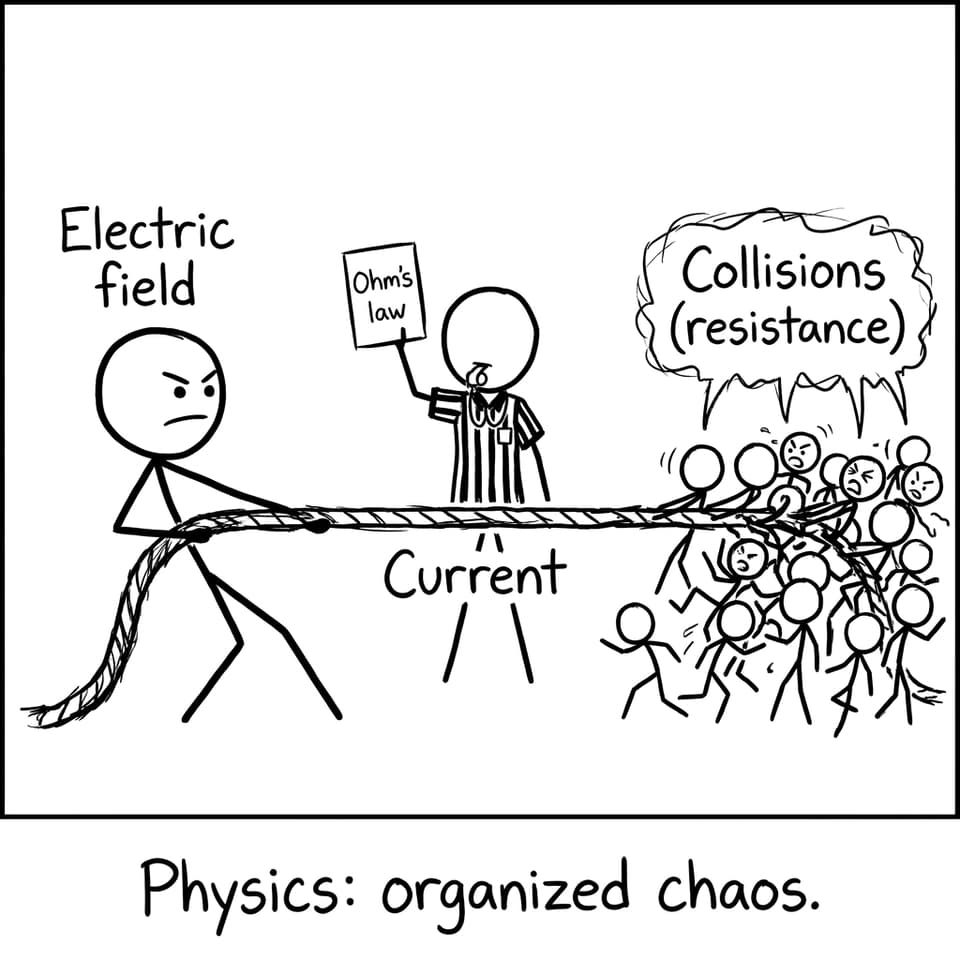
Even with an electric field, electrons do not accelerate freely for long. They collide with ions in the metal lattice, which opposes drift and converts electrical energy into thermal energy.
That opposition is resistance, and it’s why Ohm’s law is so central in IB Physics:
When voltage is fixed, higher resistance means lower current. When resistance is fixed, higher voltage means higher current. If you want an exam-focused explanation of the relationship, read IB Physics: How Resistance Affects Current and pair it with What Does Ohm's Law State?.
Bringing it back to RevisionDojo (and your next marks)
If you can write one calm sentence in IB Physics terms, you’re ahead: Electric current is the net drift of charge carriers caused by an electric field set up by a potential difference, limited by resistance from collisions.
To turn that understanding into exam performance, RevisionDojo is built for repetition with feedback: use the Study Notes to lock definitions, the Flashcards to keep equations automatic, and the Questionbank to practice explanation questions under time pressure. When your wording gets shaky, the AI Chat can help you refine a markscheme-ready paragraph, and the Grading tools, Mock Exams, and Predicted Papers help you rehearse full-paper stamina. Add the Tutors when you want personal correction on how you explain fields, drift, and resistance in IB Physics.
Keep the mechanism clear, keep the language simple, and let practice do the rest.