


A familiar sound, a sneaky syllabus point
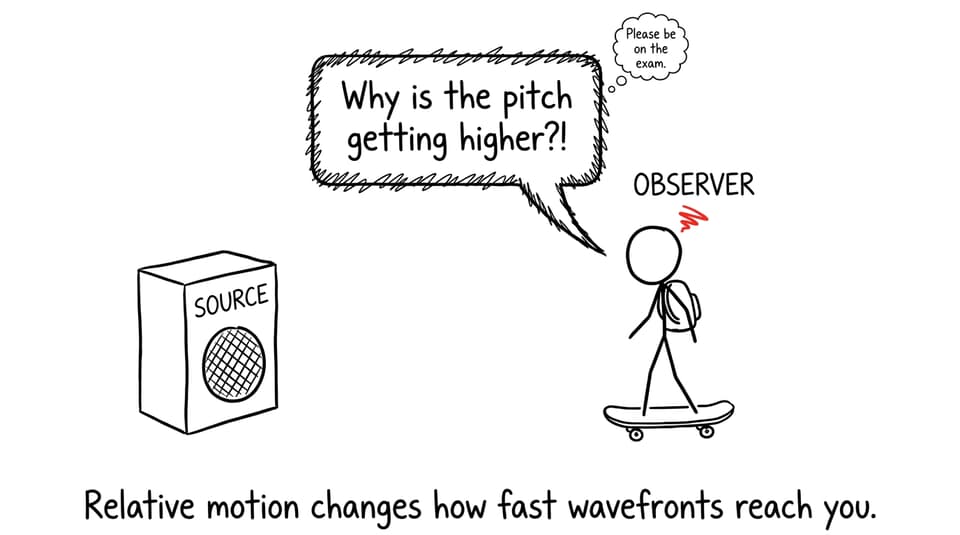
In IB Physics, there’s a moment almost everyone recognizes: a siren passes by and the sound flips from “too high” to “suddenly low.” It feels like the world changed in an instant. But what actually changed wasn’t the wave’s speed through the air. What changed was the rate at which wavefronts reached you.
That single idea is the heartbeat of the Doppler effect, and it’s one of those IB Physics topics that rewards understanding over memorising. If you can picture wavefronts like evenly spaced footsteps, you can answer most exam questions with calm confidence.
Quick checklist (what examiners want you to say)
For IB Physics Doppler questions, keep this mental checklist:
-
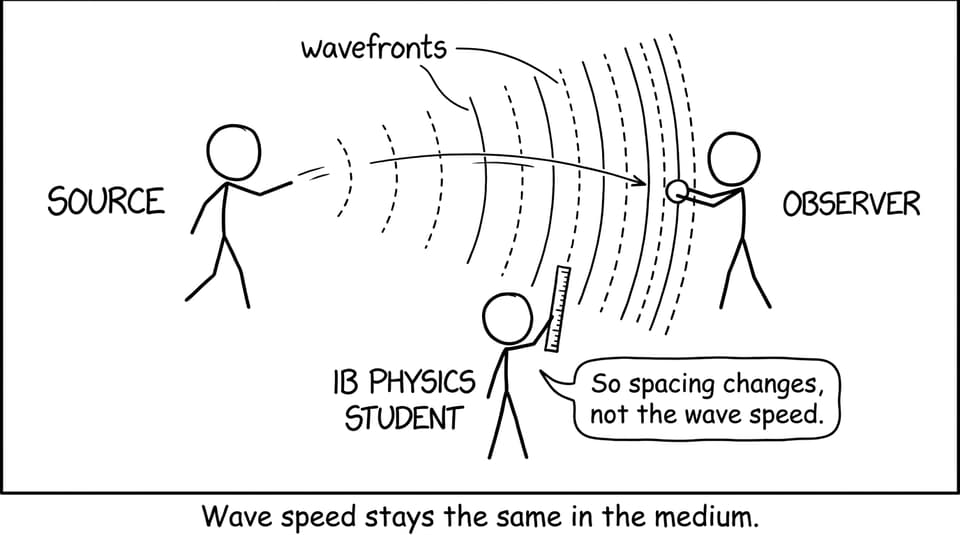
The observed frequency changes because the relative motion changes how often wavefronts arrive.
-
If the source moves toward the observer: wavefronts in front are compressed (shorter wavelength), so observed frequency is higher.
-
If the source moves away: wavefronts are stretched (longer wavelength), so observed frequency is lower.
-
If the observer moves toward incoming wavefronts: they meet wavefronts more often (frequency increases).
-
Wave speed in a given medium stays (approximately) constant; it’s the spacing and encounter rate that change.
If you want the syllabus-aligned definitions and worked examples, the IB Physics C.5 Doppler effect notes are the fastest reference.
IB Physics intuition: wavefront spacing is the whole story
Imagine a source emitting wave crests every fixed time interval. That emission frequency is set at the source. In IB Physics, we treat that as the “true” frequency.
Now let the source move.
When the source moves
If a source moves toward you, the next crest is emitted from a position slightly closer to you than the last one. So in front of the source, the crests are bunched together: wavelength decreases. Since the wave speed in the medium is (roughly) fixed, and since for waves we use the relationship between speed, frequency, and wavelength, a smaller wavelength means the observed frequency must be higher.
If the source moves away, the opposite happens: crests spread out, wavelength increases, observed frequency drops.
RevisionDojo’s IB Physics C.5 Doppler Effect topic hub connects the ideas, the equations, and the exam-style question patterns in one place.
When the observer moves
In IB Physics, moving the observer is conceptually simpler: the wavefronts are already in the medium, traveling at the wave speed. If you walk (or run) toward the oncoming crests, you encounter them more frequently. If you move away, you encounter fewer per second.
What’s subtle (and examinable) is this line: the wave itself hasn’t “sped up” because you moved. Your motion changes the rate at which you meet the wavefronts.
To reinforce the basic wave language (frequency, wavelength, wave speed), see Wave characteristics notes.
Sound vs light: same IB Physics principle, different emphasis
For sound, Doppler shift is heard as a pitch change because our ears interpret frequency directly. That’s why ambulances are the classic example.
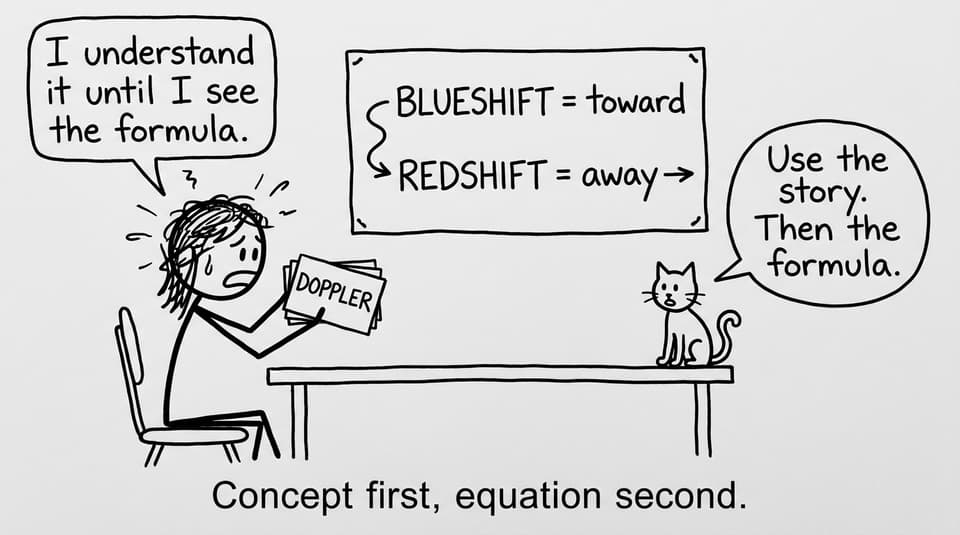
For light, we usually talk about wavelength shifts: moving toward a source gives a blueshift (shorter wavelength), moving away gives a redshift (longer wavelength). The principle stays the same: relative motion changes how the wavefront spacing is measured by the observer.
If you want the astronomy connection (often used as an application question), The Big Bang theory notes tie redshift back to expansion.
How to practise this fast with RevisionDojo
In IB Physics, Doppler questions can feel “easy until the numbers arrive.” The cure is structured practice:
-
Drill definitions and key relationships with C.5.1 Doppler effect flashcards.
-
Train exam instincts with the C.5 Doppler effect Questionbank.
-
If you need a guided walkthrough, use the C.5 Doppler effect lessons.
RevisionDojo also supports the rest of your IB Physics workflow: Study Notes for clarity, Flashcards for recall, AI Chat when you’re stuck mid-problem, and Grading tools + Mock Exams to pressure-test understanding before the real exam.
Closing: make Doppler feel inevitable
The Doppler effect in IB Physics isn’t a trick; it’s what you’d expect once you accept one calm idea: motion changes how often wavefronts reach you. Keep that picture clear, and the formulas stop feeling like magic.
When you’re ready to lock this down with real exam-style practice, use RevisionDojo’s Questionbank, Study Notes, Flashcards, and AI Chat to turn the Doppler effect from a memorable siren into reliable marks.