



IB Physics: why orbits make more sense when you think in energy
The first time orbital motion really clicks, it’s rarely because of a new formula. It’s because you stop imagining a satellite “held up” by something and start seeing a moving object negotiating an energy landscape. In IB Physics, that landscape is gravitational potential: an invisible map that tells you how much energy per kilogram is stored at each distance from a mass.
Instead of asking “what force keeps it in orbit?”, gravitational potential nudges you toward a calmer question: “how does energy shift as it moves?” Once you think that way, circular, elliptical, and even escape trajectories stop feeling like separate topics.
Quick checklist: what you must know for IB Physics questions
-
Gravitational potential: (V = -\frac{GM}{r}) (J kg⁻¹)
-
Potential energy: (E_p = mV)
-
Total mechanical energy: (E = E_k + E_p) (constant in ideal orbits)
-
“More negative” potential means deeper in the potential well
-
Orbit type depends on total energy (negative, zero, positive)
For syllabus-aligned coverage, use RevisionDojo’s D.1 Gravitational fields hub and the Notes for D.1 Gravitational fields.
Gravitational potential (IB Physics) as an “energy map” for motion
In IB Physics, gravitational potential (V) is defined as the work done per unit mass to bring a test mass from infinity to a point in the field. That definition matters because it explains two exam-favorite ideas:
-
Why it’s negative: we set (V=0) at infinity, so being closer to the mass means you’ve “fallen into” a region of lower (more negative) potential.
-
Why motion speeds up when lower: as an object drops to more negative potential, its potential energy decreases, so kinetic energy increases (if total energy is conserved).
If you want the cleanest formula set and worked examples, anchor your revision with D.1.3 Gravitational potential energy and potential (HL only) notes.
Orbital motion is a continuous trade: potential down, kinetic up
A satellite in orbit is essentially in free fall with enough sideways speed to keep missing the planet. The useful part of gravitational potential is that it makes the speed changes feel inevitable.
-
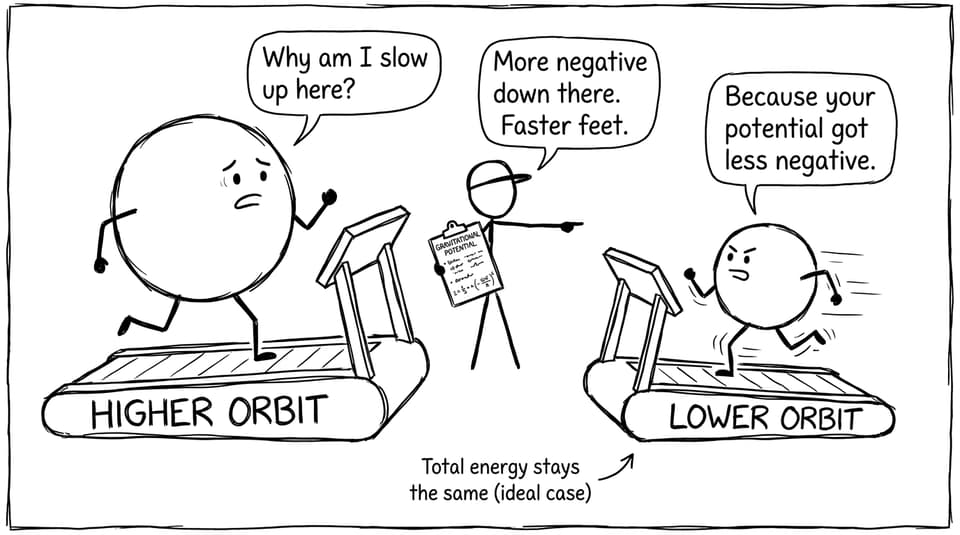
Move up to a higher orbit: (r) increases, so (V) becomes less negative. That raises potential energy, so kinetic energy must drop. The satellite slows down.
-
Move down to a lower orbit: (V) becomes more negative. Potential energy drops, so kinetic energy rises. The satellite speeds up.
That same energy story supports the qualitative meaning of Kepler’s observations. For a focused refresher, see D.1.2 Orbital motion and Kepler’s laws notes and then drill it with the D.1.2 questionbank.
Orbit shapes come from total energy relative to gravitational potential
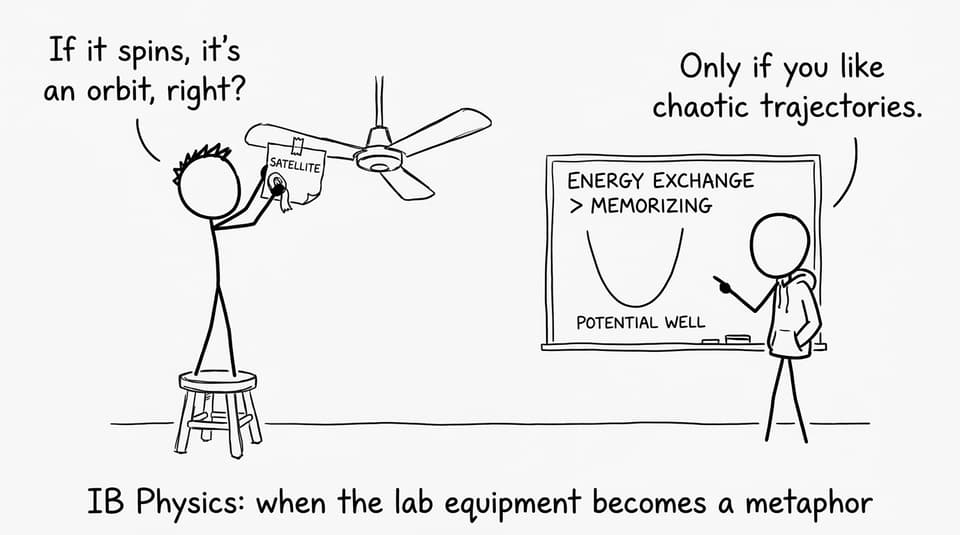
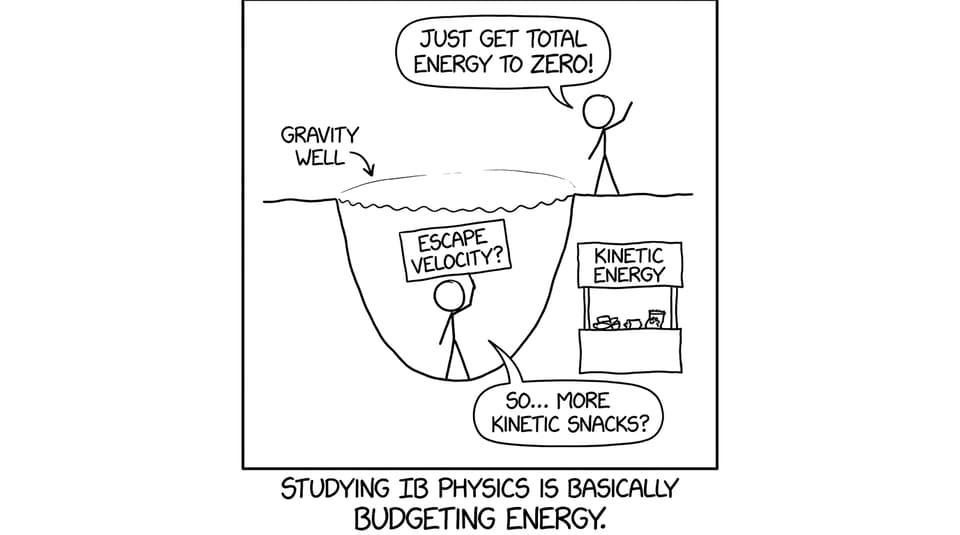
Gravitational potential is often drawn as a “well.” It’s not just a pretty sketch: it’s a decision chart.
-
Negative total energy: the object is bound in the well, giving closed orbits (circular or elliptical).
-
Zero total energy: the object just escapes the well, giving a parabolic trajectory.
-
Positive total energy: the object has extra energy, giving a hyperbolic flyby.
This is exactly where many IB Physics students lose marks: they memorize orbit labels but don’t connect them to the energy sign. To tighten that link, revise with D.1.4 Energetics of orbits and escape velocity notes.
How to turn this into exam marks with RevisionDojo
Concepts become reliable when you see them in varied question styles. RevisionDojo is built for that: use the D.1 Gravitational fields questionbank to practice energy-change questions, then check your reasoning with AI Chat, and finally lock in definitions with the D.1 flashcards.
If you need the bigger map of the course, the IB Physics resources page connects Study Notes, Questionbank, Mock Exams, Predicted Papers, and Tutors in one place.
Conclusion: use gravitational potential to think, not just calculate
In IB Physics, gravitational potential is the quiet tool that turns orbital motion into a single story: objects move through a potential well, swapping potential and kinetic energy while total energy sets the trajectory. Once you can explain that in words, the equations stop being isolated facts.
If you want this to stick before exams, combine RevisionDojo’s Study Notes, Flashcards, and Questionbank for D.1, then use AI Chat to test your explanations and build your own timed Mock Exams. That’s how gravitational potential becomes more than a definition; it becomes your default way of thinking about orbits in IB Physics.