

Proteins don’t usually “break” in a dramatic way. They drift.
One moment, an enzyme fits its substrate like a key. The next, the same enzyme is still made of amino acids, still the same sequence, yet useless because its shape has quietly stopped being itself.
That quiet collapse is denaturation, and for IB Biology it’s one of the highest-return ideas you can learn: it links bonding, enzymes, membranes, homeostasis, and even exam data questions. If you understand what causes denaturation and why structure matters for function, a lot of IB Biology stops feeling like memorization and starts feeling like cause-and-effect.
The IB Biology checklist: what you must be able to say
When you see “protein denaturation” in IB Biology, be ready to state:
-
Proteins function because of a specific 3D shape (tertiary and sometimes quaternary structure).
-
That shape is maintained by hydrogen bonds, ionic bonds, hydrophobic interactions, and sometimes disulfide bridges.
-
Denaturation disrupts these interactions, altering the active site or binding region.
-
Common causes: temperature changes, pH changes, chemical agents, and mechanical stress.
-
Loss of shape usually means loss of function (often irreversible, sometimes reversible with help).
For a tight syllabus-aligned overview, use RevisionDojo’s hub on B1.2 Proteins.
What causes protein denaturation in IB Biology?
Denaturation is not the breaking of peptide bonds (that would be far more extreme). In IB Biology, denaturation mainly means the disruption of the weaker interactions that hold the protein folded.
Heat: when motion becomes a wrecking ball
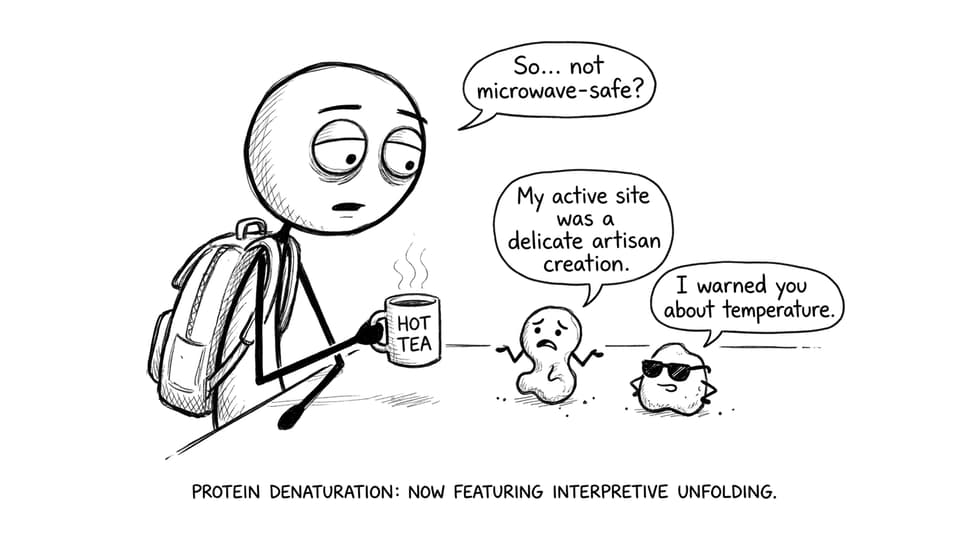
Increasing temperature increases kinetic energy. Bonds that were “just strong enough” to hold a fold start to fail. Once the tertiary structure changes, an enzyme’s active site stops matching its substrate.
This shows up constantly in IB Biology enzyme questions and labs. If you’re revising enzyme graphs, pair this article with RevisionDojo’s notes on effects of temperature and pH on enzyme activity and the practical walkthrough in IB Biology Lab 1: Enzyme Activity.
pH: changing charges, changing shape
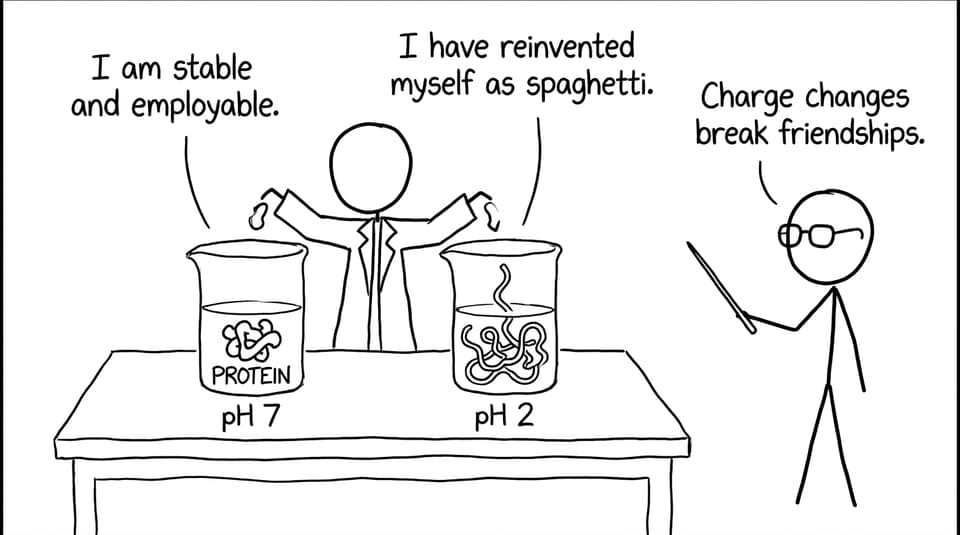
Many R-groups (side chains) are charged. If pH shifts, those charges can change, which disrupts ionic interactions and hydrogen bonding patterns. The active site can deform even if the overall protein isn’t fully “unfolded.”
If you want the examiner-friendly language for this, use RevisionDojo’s tertiary structure and functional groups notes (HL).
Chemicals: detergents, alcohols, and heavy metals
In IB Biology, chemical denaturation usually means “something interferes with R-group interactions.”
-
Detergents can disrupt hydrophobic interactions by surrounding nonpolar regions.
-
Alcohols can disturb hydrogen bonding and internal interactions.
-
Heavy metals may bind to certain side chains (especially sulfur-containing ones), disrupting structure.
The key exam phrase is simple: these agents alter the interactions that maintain tertiary structure.
Mechanical stress: the underrated example
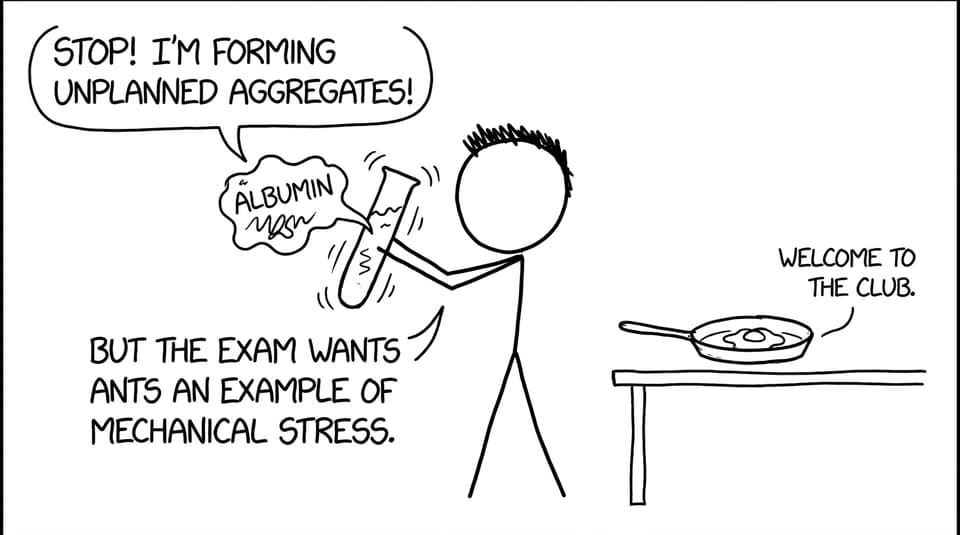
Shaking, whipping, or strong agitation can unfold proteins and promote aggregation. The classic demonstration is whisking egg whites: proteins unfold and then form a new network.
Why structure matters for function (the marks are in the logic)
In IB Biology, “structure determines function” is not a slogan. It’s a scoring method.
-
Enzymes: altered active site means substrate no longer binds (lower rate, eventually zero).
-
Transport proteins: altered channel or carrier shape means molecules cannot pass.
-
Antibodies: altered binding site means reduced antigen recognition.
-
Structural proteins (e.g., collagen): altered structure means reduced strength.
If you need rapid practice to make this automatic, drill topic questions in the B1.2 Proteins Questionbank and then check understanding with C1.1.7 active site and denaturation.
A simple way to revise denaturation without overstudying
Pick one protein example (enzyme, antibody, or membrane transport protein). Then write three short sentences: “Normal structure,” “Denaturing condition,” “Functional consequence.” Do that for heat and for pH. You’ve essentially built an IB Biology answer template.
To turn that template into exam performance, RevisionDojo is the fastest loop: learn with IB Biology revision notes, test with the Questionbank, reinforce with Flashcards, ask Jojo via AI Chat when a graph confuses you, and then simulate pressure using Mock Exams and Predicted Papers. If you want human strategy too, the Tutors and Coursework Library are there when revision gets messy.
Protein denaturation is a small topic with a big shadow. In IB Biology, it’s one of the cleanest examples of how invisible structure becomes visible marks.