

If you’ve ever looked at a company like Apple and thought, “So… is this manufacturing, retail, or tech?”, you’re already thinking like an IB Business Management student. The four-sector model sounds simple until an exam question asks you to apply it to a real business. Then suddenly everything feels like it belongs everywhere.
The good news: once you understand what each sector does in the value-creation journey, IB Business Management sector questions become some of the easiest marks in Unit 1.
The four sectors in one exam-ready checklist
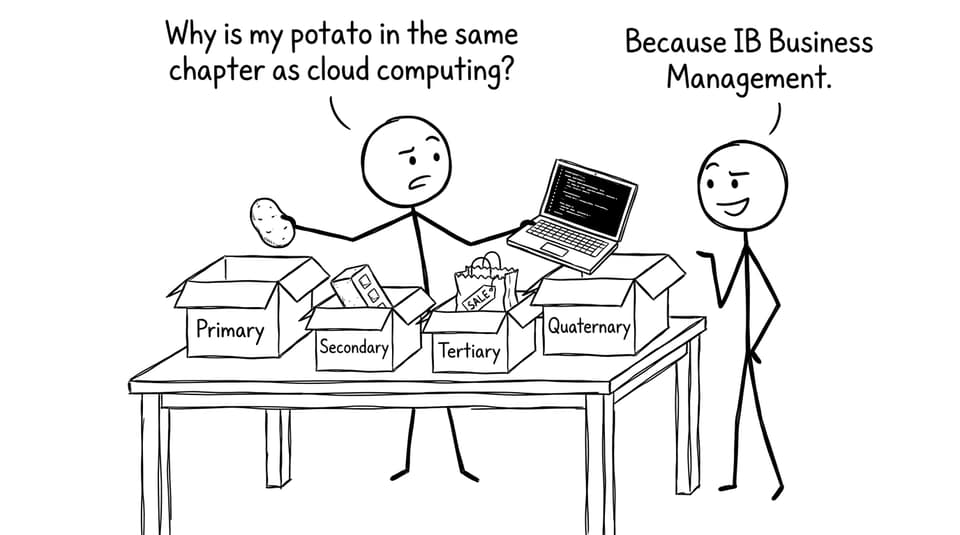
Use this fast filter (perfect for IB Business Management definitions and short answers):
-
Primary: takes from nature (extract)
-
Secondary: makes tangible goods (transform)
-
Tertiary: delivers services (support/sell)
-
Quaternary: creates knowledge (research/data/innovation)
For the syllabus-aligned version, keep this open: Primary, secondary, tertiary and quaternary sectors (Topic 1.1.3).
Primary sector in IB Business Management
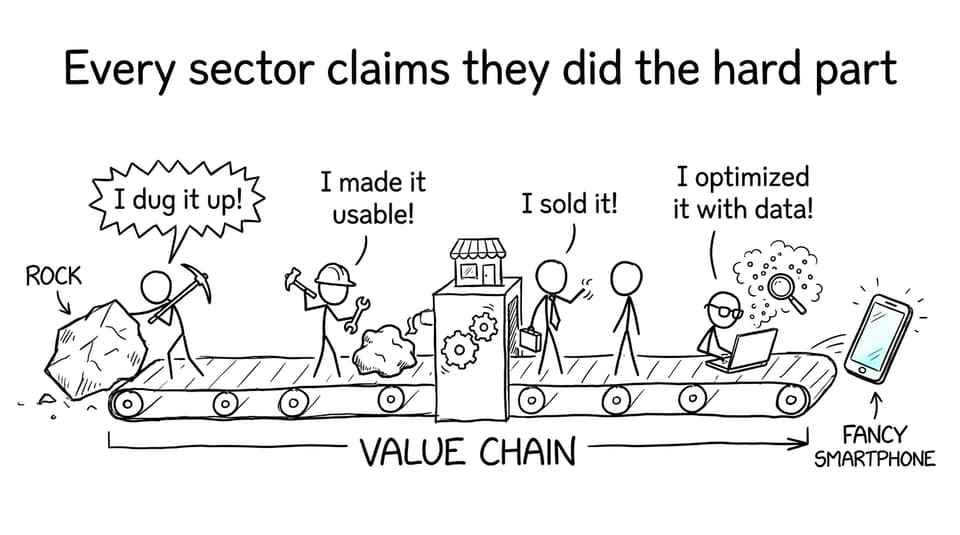
The primary sector is where economic activity begins: extracting natural resources. Think farming, fishing, forestry, and mining. In IB Business Management, the key idea is that primary firms sell inputs (raw materials) that other sectors depend on.
Exam tip: when you write examples, be specific. “Mining” is okay. “Lithium mining for EV batteries” shows sharper application.
Secondary sector in IB Business Management
The secondary sector transforms raw materials into finished or semi-finished goods. Manufacturing and construction are the big two. This is where value often increases dramatically because the product becomes more useful, branded, and standardized.
In IB Business Management, link secondary activities to operations decisions: capacity, efficiency, quality control, and costs. A timber company cutting logs (primary) is different from a factory producing furniture (secondary).
Tertiary sector in IB Business Management
The tertiary sector provides services instead of physical goods. Retail, transport, banking, education, healthcare, tourism, and entertainment all sit here. Many developed economies are dominated by tertiary activity because as incomes rise, demand for services rises too.
For IB Business Management responses, the best angle is often “value through convenience and expertise.” A delivery company doesn’t change the product, but it changes the customer experience.
Quaternary sector in IB Business Management
The quaternary sector focuses on knowledge-based work: R&D, IT, data analytics, consultancy, scientific development, and innovation. Some textbooks treat it as a subset of the tertiary sector, but in IB Business Management it’s useful as a separate label because it explains modern competitive advantage.
A simple way to spot it: if the output is information (models, code, insights, patents), you’re likely in quaternary.
To tighten your terminology, bookmark: IB Business Management Key Definitions.
How to score higher with sector questions
In IB Business Management, examiners reward clear classification and clean application. A strong mini-structure is:
-
Define the sector
-
Apply to the business in the question
-
Add one “so what” implication (costs, skills, risk, growth)
Then practise under time using the IB Business Management Questionbank and check your phrasing against mark demands with IB Business Management Marks Format Explained.
Conclusion: turn sectors into easy IB Business Management marks
The primary, secondary, tertiary, and quaternary sectors are not just definitions to memorize. In IB Business Management, they’re a shortcut to understanding how businesses create value, where their costs come from, and why economies change over time.
If you want this topic to stick, practise it the way exams demand it: definitions plus application. Start with RevisionDojo’s Topic 1.1.3 sectors page and then lock it in with the IB Business Management Questionbank.