
If you have ever read a climate hazards case study and thought, “So… what are people actually doing about this?”, you are already thinking like a top-scoring IB Geography student. Mitigation is about cutting causes. Adaptation is more personal: it is what societies do when impacts are already at the door. And in exam questions on vulnerability and resilience, adaptation strategies are often where evaluation marks are hiding.
In IB Geography, adaptation strategies help reduce risk, manage exposure, and build the capacity to cope with shocks like flooding, sea-level rise, drought, and heatwaves. The trick is to learn strategies as categories, then practise comparing costs, limits, and who benefits.
IB Geography adaptation strategies: a fast exam checklist
Use this checklist to structure any 6-, 10-, or 16-mark response in IB Geography:
-
Hard engineering (infrastructure protection)
-
Planning and land-use (avoidance and risk reduction)
-
Water management (supply, efficiency, and governance)
-
Agriculture and livelihoods (food security under stress)
-
Community-based adaptation (preparedness and early warning)
-
Evaluation (costs, equity, long-term sustainability)
For syllabus-aligned coverage, anchor your revision in IB Geography Resources and the unit hub for 2 Global Climate - Vulnerability and Resilience.
Infrastructure adaptation in IB Geography: protection with trade-offs
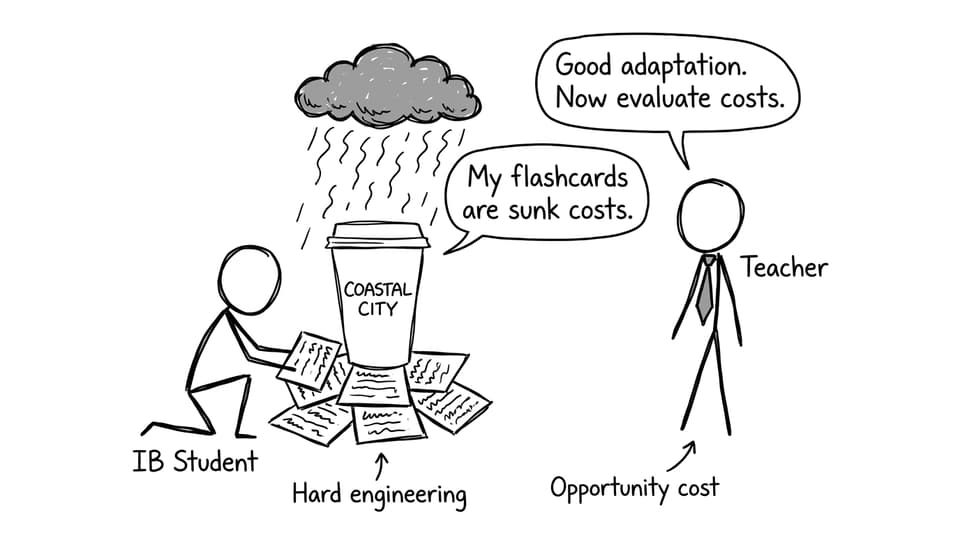
Infrastructure is the most visible form of adaptation, and it tends to appear in IB Geography essays because it is easy to link to real places. Coastal defenses (sea walls, storm surge barriers, flood barriers) aim to reduce exposure to sea-level rise and stronger storms. In river basins, levees, dams, and flood relief channels lower flood probability for certain locations.
But evaluation matters: these projects are expensive, require maintenance, and can shift risk downstream rather than removing it. In an exam, you can score by contrasting short-term protection with long-term sustainability.
To practise exam-style wording and command terms, use the Questionbank for Global Climate - Vulnerability and Resilience.
Planning and land-use: the adaptation strategy people forget
Planning is a quieter form of adaptation, but it is powerful. Governments can restrict development on floodplains, unstable slopes, or low-lying coasts. Building codes can require elevation, stronger materials, and heat-ready design. Green infrastructure (parks, wetlands, permeable surfaces) helps absorb rainfall and reduce urban flooding.
In IB Geography, planning is an easy place to evaluate inequality: who gets protected zones, who gets relocated, and who pays when land values shift? If you want a clean syllabus map for this content, use C.4.4 Climate Change Impacts and Adaptation alongside the matching C.4.4 Notes.
Water management: resilience starts with reliability
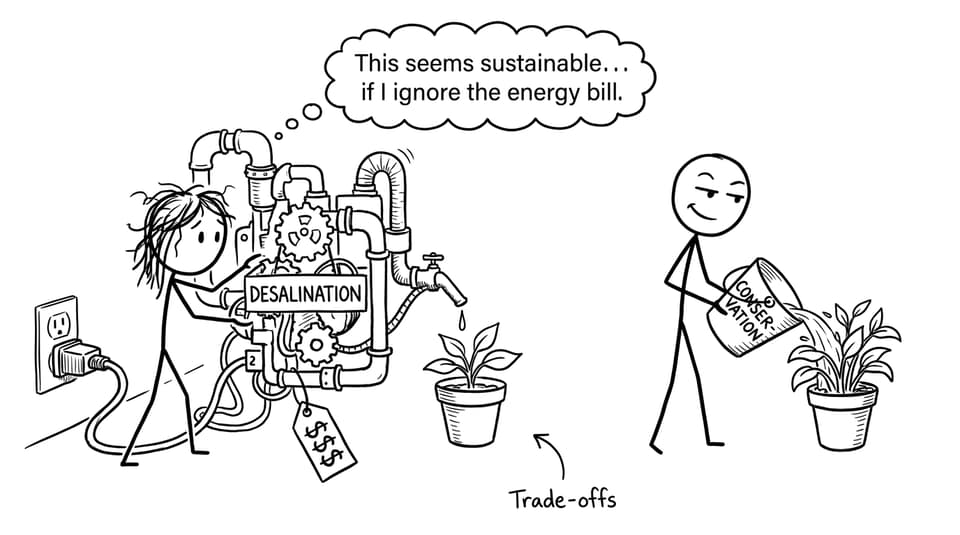
Water adaptation strategies are central wherever rainfall becomes less predictable. Options include reservoirs, improved irrigation efficiency, wastewater recycling, and conservation campaigns. Desalination can increase supply in arid coastal regions, but it is energy-intensive and costly.
A strong IB Geography answer links these to changing temperature and precipitation patterns, then weighs feasibility: high-income countries often scale technology faster, while low-income countries may rely more on governance, local knowledge, and targeted aid.
For broader context on linked systems, connect this to 3.2.2 Climate Change and the Nexus Notes and the blog explanation of climate change, food and water security.
Agriculture and livelihoods: adapting food systems, not just farms
Agricultural adaptation includes drought-resistant crops, changing planting dates, soil management, and diversifying income sources so households are not trapped by climate-sensitive farming. This matters in IB Geography because vulnerability is often highest where livelihoods depend on rainfall and where safety nets are weaker.
Evaluation is straightforward: some strategies are low-cost but slow to scale; others raise yields but depend on capital, training, and stable governance.
Community-based adaptation: the fastest resilience gains
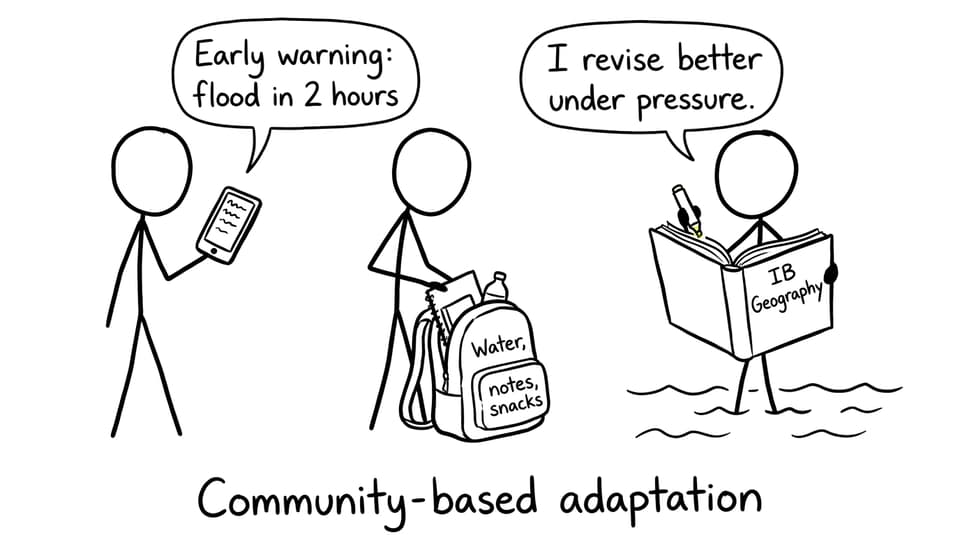
Sometimes the biggest improvement is not a wall or a dam, but time. Early warning systems, evacuation planning, hazard education, and disaster drills help communities respond before losses compound.
In exam evaluation, point out that community-based adaptation works best when local people shape the plan. It is usually cheaper than mega-projects, but it still requires trust, communication networks, and consistent funding.
Closing: Turn adaptation into marks with RevisionDojo
Adaptation strategies are not just a list to memorise for IB Geography. They are a way to think: what is the hazard, who is exposed, what reduces vulnerability, and what are the trade-offs? If you want that thinking to become exam confidence, RevisionDojo helps you train it with targeted Study Notes, rapid Flashcards, an exam-focused Questionbank, and AI Chat for instant clarification. When you are ready to test performance under time pressure, use Mock Exams, Predicted Papers, and the Grading tools to tighten evaluation and command terms. Start with the IB Geography blog tag and build your next answer around adaptation, resilience, and real-world decision-making in IB Geography.