
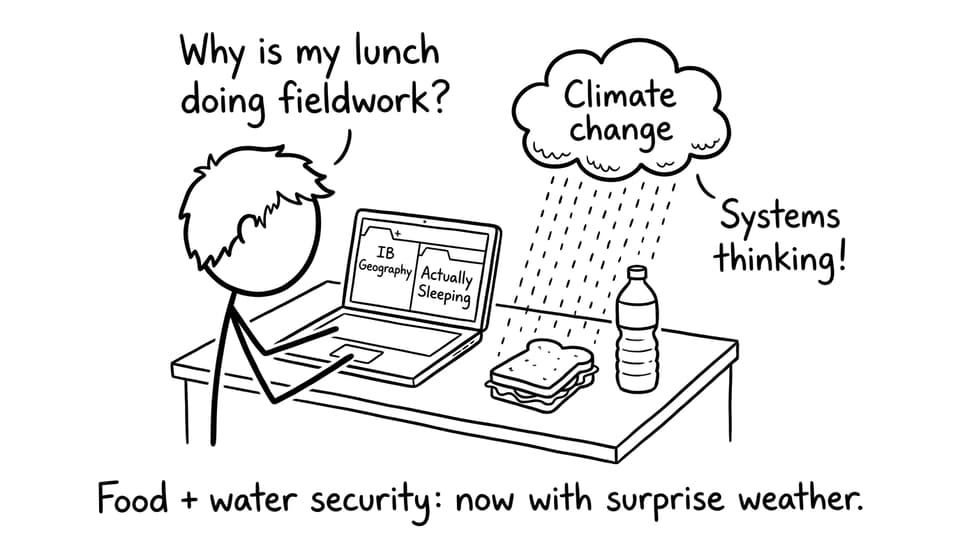
Climate change doesn’t usually arrive as a dramatic movie scene. For many communities, it shows up as a late rainy season, a heatwave that won’t quit, or a river that swings from “too much” to “not enough.” In IB Geography, that quiet instability matters, because it reshapes two basics of life: food security and water security.
The exam-friendly big idea (IB Geography)
In IB Geography, climate change affects food and water security through three connected pathways:
-
Availability: how much food and freshwater exist.
-
Access: who can afford or reach them.
-
Reliability: how stable supplies are across seasons and years.
A strong answer links physical processes (temperature, precipitation, extremes) to human outcomes (prices, malnutrition, migration, conflict), then evaluates vulnerability and responses.
How climate change threatens food security
Food systems depend on predictable climate patterns. Climate change disrupts them in several familiar IB Geography ways:
Heat stress and shifting rainfall
Higher temperatures raise evapotranspiration and increase heat stress on crops and livestock. Many staple crops (like wheat, maize, and rice) have temperature thresholds: beyond them, yields fall even if farmers do everything “right.” Unreliable rainfall also makes rain-fed agriculture riskier, especially where irrigation is limited.
Droughts, floods, and storms
More frequent and intense extremes can wipe out harvests in days. Floods erode fertile topsoil and damage storage and transport networks. Drought reduces soil moisture and irrigation potential. Either way, the result can be local shortages and price spikes that ripple through trade.
Sea-level rise and salinisation
In low-lying coastal areas, saltwater intrusion contaminates soils and groundwater. Farmland can become less productive or unusable, tightening food supply and pushing farmers to adapt, move, or abandon land.
If you want to connect this to the syllabus quickly, pair it with the resilience framing in Responding to climate change and building resilience (notes).
How climate change threatens water security
Water security means reliable access to sufficient, safe water. Climate change undermines this reliability.
Higher evaporation and less dependable storage
Warmer air increases evaporation from rivers, lakes, and reservoirs, reducing available supply. Where precipitation becomes more variable, planning becomes harder: infrastructure built for “normal” seasons is suddenly mismatched.
More variable rainfall
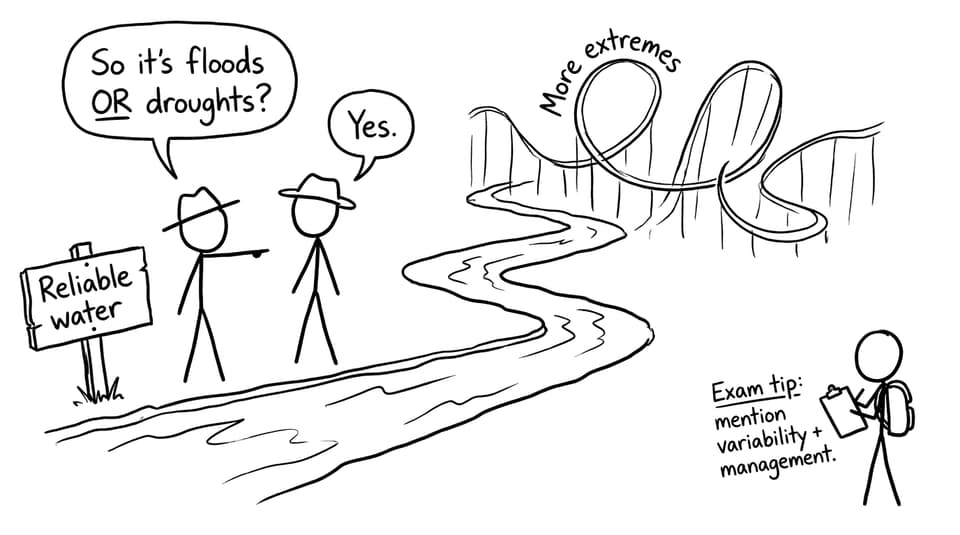
Some regions face longer dry seasons; others see heavier downpours concentrated into shorter periods. That can mean more runoff and flooding, but not necessarily more usable water, especially where storage and treatment capacity are limited.
Glacial melt: short-term gain, long-term loss
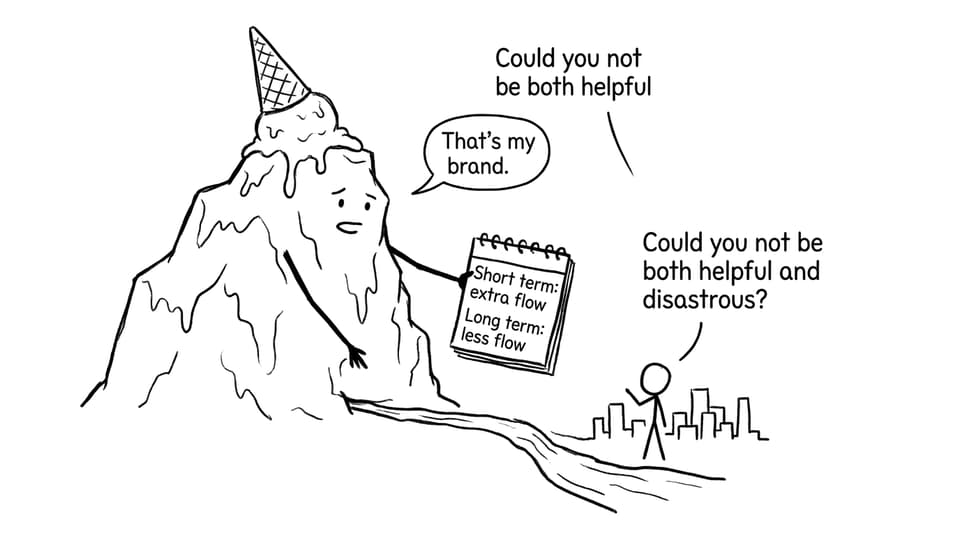
Melting glaciers can increase river discharge in the short term (raising flood risk), but shrinking glaciers reduce meltwater in the long term, threatening drinking water, irrigation, and hydropower for downstream populations.
To sharpen your water-system language, use Impacts on the hydrosphere and atmosphere (notes) and, for core hydrology terms, Drainage basin hydrology and geomorphology (notes).
Why vulnerability is uneven (and why examiners care)
A key IB Geography move is showing that climate change impacts are not evenly distributed. Low-income countries are often more exposed because they may rely on rain-fed farming, have less resilient infrastructure, and have fewer resources to adapt. That increases the risk of malnutrition, unstable food prices, and disputes over scarce water.
For evaluation, connect food and water to the Water-Food-Energy nexus: pressure in one system amplifies stress in the others. Revision help here is excellent in Water-food-energy nexus notes and the broader explanation in How changing resource consumption trends impact the WFE nexus.
Quick exam checklist (IB Geography)
Before you finish a paragraph, check you have:
-
A named process (heat stress, evapotranspiration, salinisation, glacial retreat)
-
A clear impact (yield decline, water shortages, price rises)
-
A place-based angle (coastal, arid, monsoon, glacier-fed basins)
-
One line of evaluation (who is most vulnerable, and why)
To build strong evidence fast, use IB Geography case studies: a comprehensive exam guide.
Conclusion: turn instability into analysis (IB Geography)
Climate change doesn’t just “cause problems.” In IB Geography, it’s a risk multiplier that destabilises rainfall, raises extremes, and quietly shifts the foundations of food and water security. Your advantage in the exam is being able to explain those mechanisms clearly, then evaluate who is most vulnerable and why.
If you want to convert this topic into marks, revise the linked notes, drill exam questions in RevisionDojo’s Questionbank, and build a small set of adaptable case studies you can deploy under pressure.