
Western Buddhism developed as Buddhist traditions encountered new languages, cultures, institutions, and social questions in Europe, North America, and other Western societies. It is not a single denomination. It is a diverse field that includes Asian diaspora temples, convert meditation communities, traditional monastic lineages, socially engaged movements, and secular mindfulness programs.
For IB World Religions SL, the central issue is therefore not whether Buddhism was simply preserved or replaced. It is how practitioners selected, translated, emphasized, and sometimes contested different elements of the tradition. Adaptation can make a religion accessible, but it also raises questions about authority, continuity, and cultural appropriation.
A strong IB answer should present this complexity rather than treating Western Buddhism as a simplified version of an unchanging Asian original.
Western Buddhism at a glance
| Area | What to remember |
|---|---|
| Historical development | Immigration, translation, colonial encounters, missionary activity, travel, and modern media all shaped Buddhism's Western presence. |
| Major traditions | Theravada, Mahayana, and Vajrayana communities are all represented, alongside newer hybrid and secular forms. |
| Common adaptations | Greater lay participation, meditation-centered practice, local-language teaching, psychological vocabulary, and socially engaged action. |
| Continuing elements | The Three Jewels, ethical discipline, karma, meditation, wisdom, and liberation remain important, although interpretations differ. |
| Central debate | Does adaptation transmit the Dharma effectively, or detach selected practices from their religious setting? |
Students can establish the wider doctrinal context through RevisionDojo's introduction to the Buddha and Buddhist branches before comparing Western expressions.
What does western Buddhism mean?
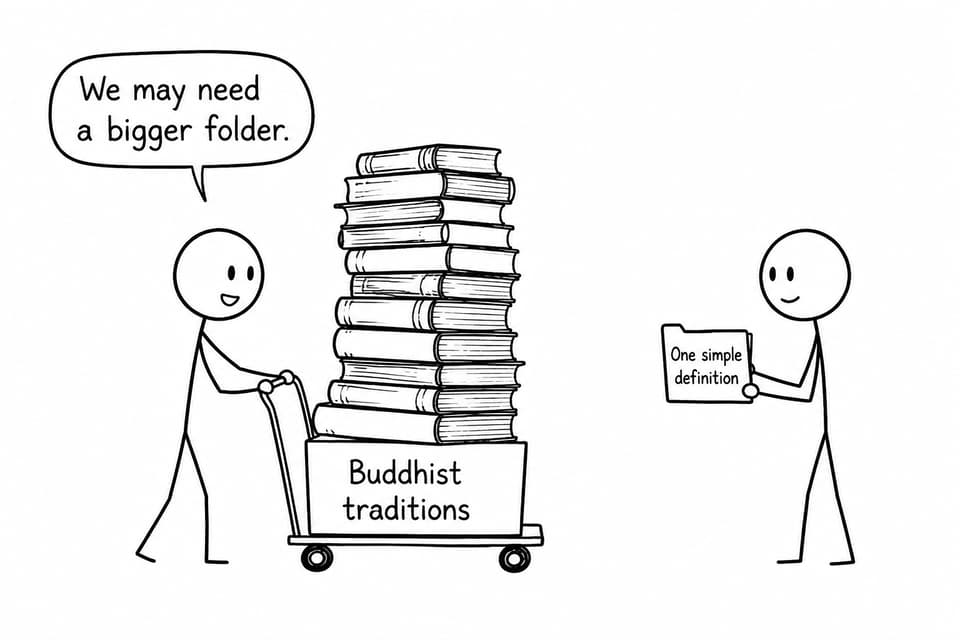
The label generally describes Buddhist beliefs, institutions, and practices as they exist in Western cultural settings. Yet the term can hide as much as it reveals. A Japanese American Jodo Shinshu temple, a British Theravada monastery, a French Tibetan center, and a secular mindfulness course may all be called Western Buddhist, despite having different texts, rituals, and understandings of liberation.
Scholars sometimes distinguish between heritage Buddhism, maintained largely within communities with Asian family or cultural connections, and convert Buddhism, adopted by people without that inherited background. This distinction can be useful, but it is imperfect. Communities overlap, identities change, and second-generation practitioners may be both culturally Western and deeply rooted in Asian lineages.
Another useful term is Buddhist modernism. It describes forms of Buddhism that emphasize meditation, rational inquiry, personal experience, compatibility with science, and individual spiritual development. These emphases have Asian as well as Western histories. Buddhist reformers in Sri Lanka, Japan, China, and elsewhere actively shaped modern Buddhism, so Western practitioners were never the only agents of change.
Historical forces behind adaptation
Buddhism entered Western awareness through several routes. Translated texts and colonial scholarship introduced European readers to Buddhist ideas, although early translations sometimes forced Buddhist categories into Christian or philosophical frameworks. Asian migration subsequently established living communities, temples, festivals, and family institutions. These communities demonstrate why Buddhism in the West cannot be understood only through meditation retreats or popular books.
During the twentieth century, Zen teachers, Theravada meditation masters, Tibetan teachers, and Asian diaspora organizations built institutions across Europe and North America. Japanese Jodo Shinshu communities, for example, developed congregational temples where the nembutsu, the recitation of Namo Amida Butsu, expressed gratitude and reliance upon Amida Buddha's compassion. This differs significantly from the image of Western Buddhism as entirely focused on silent meditation.
Later, meditation entered healthcare and psychology. Mindfulness-Based Stress Reduction was developed by Jon Kabat-Zinn at the University of Massachusetts Medical Center in 1979. Its language was deliberately accessible to clinical participants. This helped mindfulness reach large audiences, but it also created debate about whether sati, the Pali term commonly translated as mindfulness, can be separated from ethics, wisdom, and the goal of liberation.
Buddhism key concepts that continued and changed
Adaptation rarely means that every belief disappears. More often, inherited concepts receive new explanations.
The Three Jewels, or tiratana in Pali and triratna in Sanskrit, are the Buddha, the Dhamma or Dharma, and the Sangha. Western communities may interpret Sangha narrowly as the ordained monastic community or more broadly as everyone participating in a Buddhist center. RevisionDojo's notes on Sangha, Dhamma and the cultivated path help clarify this distinction.
The Four Noble Truths, taught in the Dhammacakkappavattana Sutta, diagnose dukkha, identify craving as its origin, affirm its cessation, and prescribe the Noble Eightfold Path. Dukkha may be translated as suffering, dissatisfaction, or unreliability. Psychological presentations sometimes describe it primarily as emotional distress. Traditional readings place it within the larger cycle of samsara, repeated birth and death.
Anatta in Pali, or anatman in Sanskrit, means not-self. The Anattalakkhana Sutta analyzes bodily and mental processes as impermanent and not appropriately regarded as a permanent self. Some Western interpreters connect this teaching to flexible identity or reduced ego attachment. Traditional interpretations also connect it to insight that releases beings from samsara.
Nibbana, or Sanskrit nirvana, is liberation from greed, hatred, delusion, and the cycle of rebirth. It should not be reduced to calmness. Calm may support the path, but nirvana is the transforming goal described within Buddhist traditions.
Different traditions adapted in different ways
Theravada and insight meditation
Theravada, meaning the Teaching of the Elders, preserves the Pali Canon as its central scriptural collection. Western Theravada communities have often emphasized vipassana, insight meditation, and samatha, calm-abiding meditation. Lay retreats may give non-monastics intensive access to practices formerly associated particularly with renunciant settings.
This can be interpreted as a democratization of contemplative practice. A more critical interpretation argues that focusing almost entirely on meditation can obscure merit-making, chanting, monastic discipline, devotion, and communal ritual. Both interpretations are useful in an IB evaluation.
Mahayana, Zen, and Pure Land
Mahayana, the Great Vehicle, emphasizes the bodhisattva, one who seeks awakening for the benefit of all beings. Zen communities have attracted Western practitioners through seated meditation, known as zazen in Japanese, direct teacher-student transmission, and apparently simple forms of practice. Yet Zen also contains ritual, ethics, monastic rules, devotional forms, and textual traditions that popular representations may overlook.
Pure Land traditions offer a contrasting Mahayana example. They emphasize trust, compassion, and birth in a purified realm associated with Amitabha or Amida Buddha. Western Buddhism is therefore not adequately described as individual meditation alone. Review the distinctions in Theravada, Mahayana and Vajrayana schools.
Vajrayana and Tibetan Buddhism
Vajrayana, the Diamond or Thunderbolt Vehicle, uses mantras, visualizations, initiations, ritual objects, and close teacher relationships. Tibetan Buddhist communities translated complex philosophical and ritual systems for Western students while maintaining lineage authority. Their adaptation raises serious questions about translation, teacher accountability, cultural context, and which practices require formal empowerment.
Students should avoid describing Vajrayana as merely a more colorful form of meditation. RevisionDojo's guide to Mahayana and Vajrayana scriptures shows how different textual canons shape doctrine and practice.
The three fundamental questions
The IB framework turns description into analysis through three questions.
What is the human condition?
Buddhist traditions commonly describe existence as marked by dukkha, impermanence (anicca or anitya), and not-self. Western psychological interpretations may focus on anxiety, habitual reactions, and unstable identity. Traditional cosmological interpretations additionally include karma and rebirth across samsara.
Where are we going?
The ultimate goal is awakening and liberation, although traditions explain it differently. Theravada discussions often foreground arahantship and nibbana. Mahayana traditions emphasize Buddhahood, the bodhisattva path, or birth in a Pure Land. A secular program may seek well-being rather than liberation, which creates an important point of comparison.
How do we get there?
Answers include ethical conduct, meditation, wisdom, devotion, compassion, ritual, study, and participation in Sangha. The Noble Eightfold Path integrates these dimensions. An IB response should question any claim that meditation is the only Buddhist path.
Connecting adaptation to the five themes
| IB theme | Western Buddhism focus |
|---|---|
| Rituals | Meditation retreats may expand while chanting, refuge ceremonies, nembutsu, initiations, and festivals continue in many communities. |
| Sacred texts | Translation broadens access but requires choices about terms such as dukkha, sati, and nirvana. |
| Doctrines and beliefs | Karma and rebirth may be affirmed literally, interpreted symbolically, treated as open questions, or deemphasized. |
| Religious experience | Meditation experiences can receive psychological, doctrinal, devotional, or mystical interpretations. |
| Ethics and moral conduct | The Five Precepts remain influential, while engaged Buddhists apply compassion to war, racism, environmental harm, and economic injustice. |
These themes are explained further in RevisionDojo's guide to World Religions misconceptions. The key analytical lesson is that the same adaptation can receive two defensible interpretations. Translating meditation into psychological language may be skillful communication, known as upaya or skillful means. Alternatively, removing karma, ethics, Sangha, and liberation may transform the practice into something no longer fully Buddhist.
Building a balanced IB response
Begin with a precise claim: Western Buddhism is diverse and historically connected to both Asian diaspora communities and convert movements. Add one named tradition, one key concept in its original language, and one primary text. Then compare interpretations and connect your evidence to a fundamental question or compulsory theme.
Use the IB World Religions resource hub to combine Study Notes with the Buddhism Flashcards collection. RevisionDojo's Questionbank and Grading tools can then test whether your comparison is analytical rather than merely descriptive. AI Chat can clarify unfamiliar terminology, while Mock Exams and Predicted Papers help build timed structure. The Coursework Library and Tutors provide further support when refining independent research and argumentation.
Western Buddhism is best understood as an ongoing conversation about what can change and what must remain. RevisionDojo helps you enter that conversation with accurate vocabulary, contrasting evidence, and the confidence to explain why adaptation matters.