This site uses cookie tracking technologies. Learn more in our Cookie Policy.
IB Digital Society: Values in Tech (Examiner Guide) | RevisionDojo
Join 600k+ students breezing through the IBReady to breeze through the IB?
A ranking algorithm decides what you see.
It feels like math. Clean. Neutral.
But then you notice what it rewards: outrage travels faster than nuance, the loudest posts rise, and some communities get flattened into stereotypes. Suddenly, the “technical system” looks more like a mirror of human priorities.
That pivot is the heart of IB Digital Society. Examiners aren’t asking you to fear technology or worship it. They want you to show, calmly and precisely, how values shape digital systems and how those choices affect people.
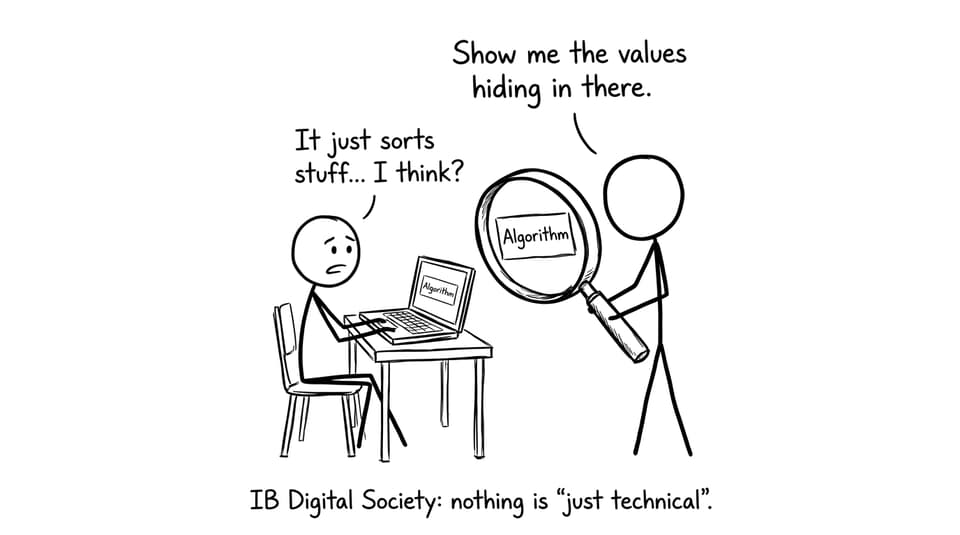
Stick figure examiner with magnifying glass over an algorithm box
Quick checklist: what examiners want from values analysis in IB Digital Society
Use this as a fast mental routine in IB Digital Society exams and your IA:
Name the value (e.g., fairness, efficiency, security, profit, transparency, wellbeing).
Show where it appears in the digital system (design choice, metric, policy, default setting).
Explain the mechanism (how the system’s features or incentives push outcomes).
Identify stakeholders and show different priorities.
Evaluate trade-offs and justify a balanced conclusion using evidence.
If your response hits those five steps, you stop “describing tech” and start doing the kind of analysis is built to reward.
In IB Digital Society, values are the principles that guide decisions about how a digital system is designed, deployed, and governed. Values can be stated openly (a platform promises “community safety”) or embedded silently (the system ranks content using “time spent,” which values engagement).
A strong way to revise the vocabulary is to keep your definitions tight and usable. RevisionDojo’s IB Digital Society glossary of key terms helps you write with the subject’s actual language, not vague generalities.
Values often show up as priorities such as:
Efficiency (speed, automation, scale)
Profit (ad revenue, retention)
Fairness (equal treatment, bias reduction)
Security (fraud prevention, risk control)
Privacy (data minimization, consent)
Transparency (explainability, accountability)
Wellbeing (harm reduction, safety)
How to spot values inside a digital system
Examiners reward students who can detect values from system behavior, not just list ethical words.
Try three prompts:
What does the system optimize for?
If a recommendation engine optimizes for watch time, it effectively values attention. In IB Digital Society, you’d then ask what gets boosted as a result: sensationalism, repetition, or polarizing content.
Metrics are values turned into numbers. If success equals “daily active users,” the system values frequency. If success equals “false positives minimized,” the system may value efficiency over fairness (depending on who pays the cost of errors).
What gets ignored becomes invisible
If a system never measures harm to minority users, that harm becomes easy to deny. In IB Digital Society, this is where stakeholder analysis becomes essential.
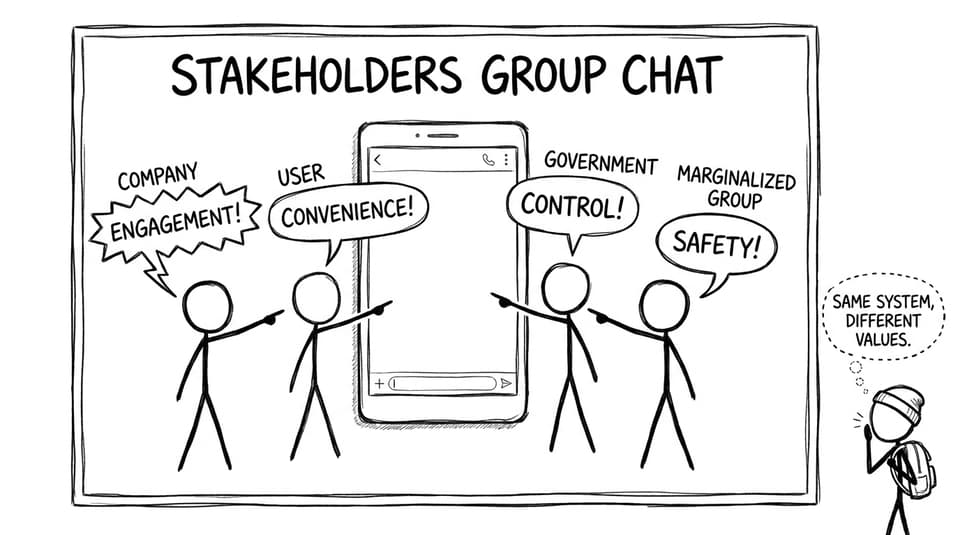
Stakeholders arguing at a phone labeled with priorities
Trade-offs: the examiner’s favorite moment
Most real digital systems can’t maximize every value at once. So the marks usually sit in the tension.
Common trade-offs in IB Digital Society include:
Security vs privacy
Efficiency vs fairness
Profit vs wellbeing
Innovation vs accountability
Transparency vs manipulation-resistance
Examiners don’t want you to pick a “good” value and moralize. They want you to weigh consequences, show who benefits, show who pays, and reach a justified judgment.
Seesaw labeled Privacy and Security with a student holding Analysis
Values + stakeholders: show the same system through different eyes
In IB Digital Society, values aren’t universal. A company might value engagement, a government might value control, and a marginalized community might value safety or representation.
A high-scoring paragraph often sounds like this:
Claim: The system prioritizes efficiency.
Evidence/example: Automated moderation removes posts at scale using pattern detection.
Stakeholder lens: Creators value expression; vulnerable users value protection.
Evaluation: Efficiency reduces response time, but errors can silence legitimate speech, affecting fairness and trust.
The simplest way to think about IB Digital Society is this: digital systems are arguments about what matters. Your job is to uncover that argument, show who it serves, and evaluate the trade-offs with evidence.
If you want a clean routine, build it in RevisionDojo: learn the concepts with Study Notes, lock in precision with Flashcards, practice with the Questionbank, stress-test with Mock Exams and Predicted Papers, and use AI Chat, Grading tools, and Tutors to turn good thinking into examiner-readable marks.
That’s how “values” stops being a vague word and becomes a reliable way to score in IB Digital Society.