


It usually happens at 11:47 p.m.
You reread your paragraph for the tenth time, and it still sounds smart. You add one more quote. You tweak the topic sentence. You tell yourself it’s “pretty good.”
Then the grade comes back, and the comments feel like weather reports: unclear, needs depth, more analysis. In the IB, this gap between effort and outcome is rarely about how hard you worked. It’s about whether your work matches the language of the rubric.
Rubric language isn’t just how your teacher justifies a mark. In IB courses, it’s the closest thing you get to a map: what quality looks like, how it scales, and what moves you from one band to the next. Once you learn to speak that language, self-evaluation stops being guesswork and becomes a tool you can actually trust.
Quick checklist: rubric language that actually helps (5 minutes)
Use this before any draft, timed practice, or final submission in the IB:
-
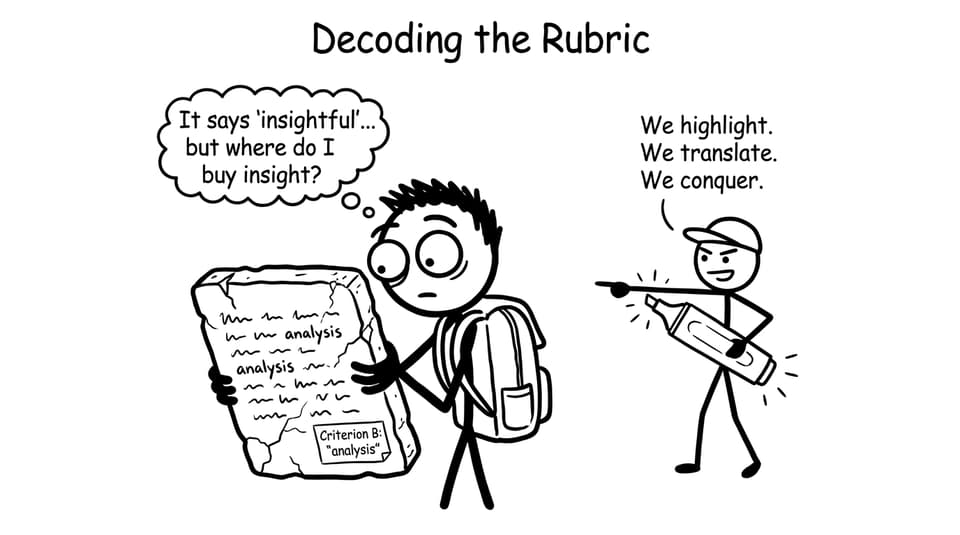
Identify the criteria being assessed (don’t evaluate everything at once).
-
Underline 3-5 descriptor words (e.g., “focused,” “developed,” “insightful,” “thorough”).
-
Translate each descriptor into a visible behaviour in your work.
-
Collect evidence lines: where, exactly, in your response you meet each descriptor.
-
Write one “next step” that uses rubric wording (not motivation).
If you want a digital place to run that loop, RevisionDojo’s tools make it surprisingly clean: Study Notes for clarity, Flashcards for daily recall, Questionbank for technique, AI Chat for quick unblocking, and Grading tools for criterion-level feedback.
Why rubric language matters for IB exam prep
The IB isn’t only testing what you know. It’s testing whether you can show what you know in a specific way: structured, justified, relevant, and aligned with command terms.
Rubrics do three quiet things that change your results:
Rubric language makes self-evaluation measurable
When you say “this is good,” nothing changes. When you say “my explanation is accurate but not yet developed,” you’ve created a clear target. In the IB, targets are everything because your time is limited.
Rubric language trains you to think like an assessor
Markers are not reading for vibes. They’re scanning for proof: analysis, structure, justification, relevance, evaluation. If you self-evaluate with the same lens, you stop being surprised by marks.
Rubric language turns feedback into a repeatable system
One strong comment can feel helpful, but it often dies in your notebook. Rubric language helps you convert feedback into patterns you can practice again in new questions and new tasks.
For daily practice that reinforces this assessor mindset, the RevisionDojo Questionbank is built around mark-scheme logic and fast iteration.
How to decode IB rubric descriptors (without memorising them)
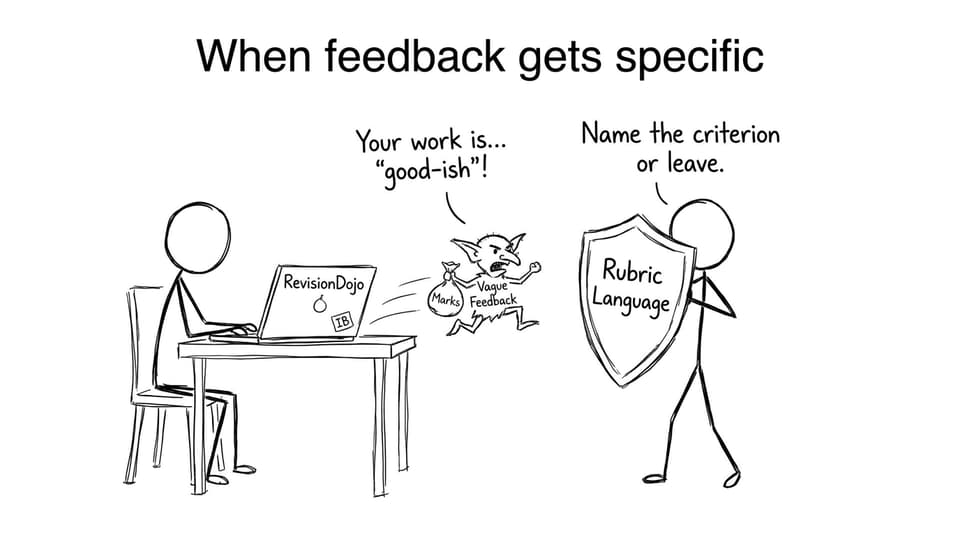
A rubric descriptor is not a vocabulary test. It’s compressed meaning.
Here’s a simple decoding method many IB students miss: Descriptor: Evidence: Upgrade.
Start with the words that cause the most confusion
Common rubric words include:
-
Effective: the reader can follow the logic; structure supports meaning.
-
Developed: you’ve gone beyond naming; you explain and connect steps.
-
Insightful: you show independence; you connect ideas in a non-obvious way.
-
Limited: something is missing or unclear (often justification or depth).
Now convert each word into evidence you can point to:
-
“Developed” in an essay might look like: claim + evidence + explanation + implication.
-
“Effective” in a response might look like: clear definitions, correct method, and no leaps.
To speed this up, pair your rubric work with focused content review. For example, read a single section of Digital IB Study Notes, then immediately ask: Which rubric word would this knowledge help me prove?
Embed rubric language into your everyday revision (not just assessments)
Rubric literacy works best when it becomes normal. The goal is that rubric terms feel as familiar as your subject vocabulary.
Use rubric words as your self-talk during practice
When you do a timed response, don’t just ask “was I right?” Ask:
-
Was my reasoning clear or just fast?
-
Did I justify the step, or assume the marker would follow?
-
Was my evaluation balanced, or did I repeat the same point?
This is where a platform like RevisionDojo helps. After practice, you can move from questions to clarification quickly using RevisionDojo App: The Smarter Way to Prep for IB Exams as a full workflow: learn, practice, get feedback, repeat.
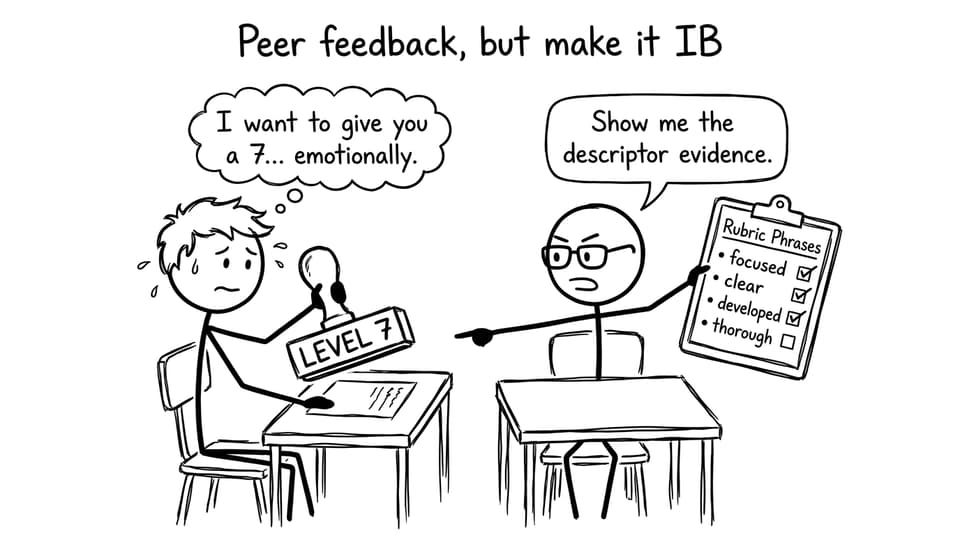
Run peer feedback using the rubric, not opinions
Peer feedback fails when it becomes emotional (“this sounds nice”). In the IB, your friend isn’t your audience. The criteria is.
Try this format:
-
One sentence: “According to Criterion X, this is currently developing because…”
-
One quote or line reference as proof
-
One sentence: “To reach effective/thorough, add…”
Use exemplars the right way: compare decisions, not sentences
Don’t copy phrasing. Copy judgment. Ask:
-
Why would a marker call this “developed” instead of “adequate”?
-
What is the difference in structure, depth, or precision?
For coursework-style tasks, it helps to see criterion-level breakdowns. RevisionDojo’s IB Coursework Grader shows feedback aligned to rubric criteria so your self-evaluation becomes faster and more accurate.
A practical self-evaluation routine for IB students (10 minutes)
This is a simple loop you can repeat across subjects in the IB:
Step 1: Choose one criterion only
You’ll self-evaluate better if you narrow the lens. One criterion. One focus.
Step 2: Highlight 2 rubric phrases you’re aiming for
Pick phrases that represent the next level up, not perfection.
Step 3: Mark your own work with evidence tags
Write in the margin:
-
“Here is my analysis.”
-
“Here is my justification.”
-
“Here is my evaluation.”
If you can’t label it, it probably isn’t there.
Step 4: Create one upgrade sentence
Example: “To move from adequate to developed, I will add a link between evidence and implication in paragraph 2.”
Step 5: Turn the upgrade into practice
Do 10-15 targeted questions right away. A rubric insight without practice disappears.
If you need a repeatable revision system around that loop, the routines in How to Study for IB Exams: Step-by-Step Guide make the process feel less chaotic and more controllable.
Closing: make IB self-evaluation a skill, not a mood
The strongest IB students aren’t those who never doubt themselves. They’re the ones who can translate doubt into a plan: Which criterion? Which descriptor? Which evidence? What’s the next upgrade?
Rubric language is how you turn “I studied a lot” into “I improved.” It’s how you stop waiting for feedback and start generating it yourself.
If you want one place to build that habit, RevisionDojo connects the full loop: Study Notes for understanding, Flashcards for recall, Questionbank for exam-style practice, AI Chat for quick clarification, Grading tools for rubric-aligned feedback, plus Mock Exams and Predicted Papers to make real exam pressure feel familiar. In the IB, that combination isn’t just convenience. It’s consistency, and consistency is what raises marks.