
Evidence can feel like safety.
The night before a deadline, it’s comforting to stack tabs, screenshots, and statistics until your browser looks like a crowded city skyline. But in the IB Digital Society IA, that kind of research panic often backfires: you can include “a lot” and still lose marks because the evidence sits there like furniture, not like support beams.
In IB Digital Society, evidence isn’t a trophy that proves you worked hard. It’s a tool that helps you explain how a specific digital system works and what it does to specific people and communities. Your goal is not volume. Your goal is reasoning.

A quick checklist for evidence in IB Digital Society
Before you paste a quote or drop in a stat, run this fast filter. In a strong IB Digital Society IA, each piece of evidence should:
-
Name or clearly relate to your digital system (platform, feature, policy, algorithm, dataset)
-
Support one claim you are making (not “background reading”)
-
Be followed by your explanation of why it matters
-
Connect to at least one course concept (power, identity, change, systems, ethics, values, etc.)
-
Help you evaluate impacts on individuals and communities (not “society” in general)
If you want to sanity-check your overall structure before you fine-tune evidence, pair this with IB Digital Society IA Structure Explained.
What counts as evidence in IB Digital Society?
In IB Digital Society, evidence is any information that strengthens a claim about how your chosen system operates and how it shapes real outcomes. That can include:
-
Platform rules, policies, and transparency statements
-
Reported outcomes (measured effects, trends, usage data)
-
Research findings (relevant studies, surveys, analyses)
-
Observed patterns you can justify (for example, a structured content analysis)
The key is not “where it’s from,” but how you use it. A credible source used without analysis becomes decoration. A modest source used with precise reasoning can become high-scoring.
To ground your concepts while you write, it helps to keep your notes open. RevisionDojo’s IB Digital Society resources hub makes it easy to jump between concepts, content, and examples without losing focus.
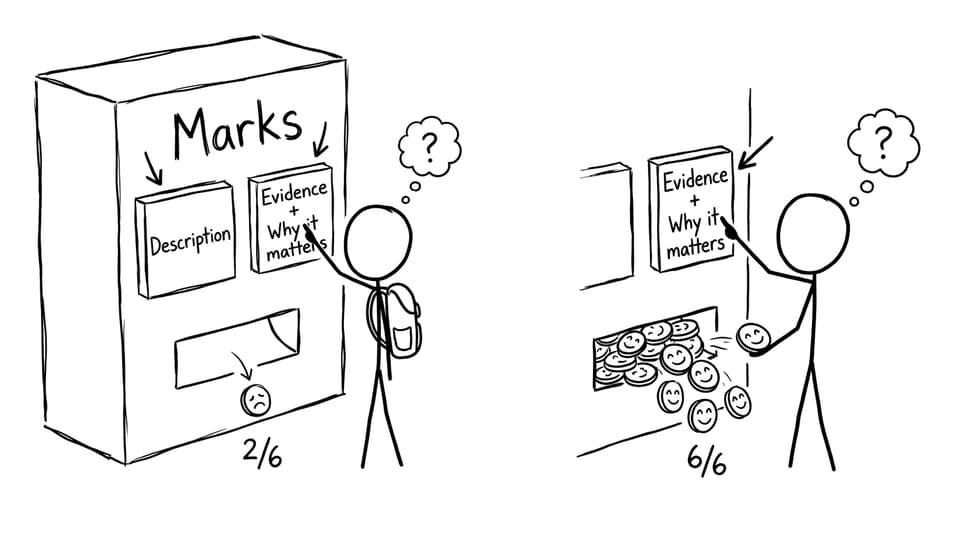
Evidence supports analysis, not description
Description tells the reader what exists.
Analysis explains what it means.
In the IB Digital Society IA, examiners reward the second one. A common weak pattern looks like this:
-
Evidence appears (quote/stat/screenshot)
-
No reasoning follows
-
Paragraph ends
A stronger pattern is:
-
Claim (your arguable point)
-
Evidence (the support)
-
Why it matters (your reasoning)
-
Concept link (the lens)
-
So what (impact on people/communities)
If you’re unsure what the examiner is really looking for when they say “supported,” skim the markband language in Criterion C: Analysis and Evaluation (Digital Society IA). It’s basically a reminder that evidence only “counts” when it is doing work.
Keep evidence chained to the digital system
The fastest way to weaken an IB Digital Society IA is to drift into general tech commentary. You’ll feel it happening when your writing starts using phrases like “technology today” or “social media in general” without naming your system.
A simple fix: after every piece of evidence, add a sentence that explicitly ties it back.
Example sentence starters:
-
“This matters because [feature/policy] changes how [user group] experiences [outcome].”
-
“This suggests that the system’s design choice [X] creates [power/inequality/ethical issue] for [community].”
-
“In this context, the evidence indicates a shift in [identity/change/values] because…”
To sharpen your system thinking, RevisionDojo’s 2.6 Systems topic page is a useful reset: it nudges you to treat your case study like interacting parts, not a story you retell.
Use evidence to apply concepts (not to name-drop them)
Concepts in IB Digital Society are like lenses. They don’t earn marks because you mention them. They earn marks because they change what you notice.
Try this approach:
-
Pick one concept as your “home base” (for example, power or values and ethics)
-
Use evidence to show the concept in action
-
Evaluate trade-offs (who benefits, who is harmed, what changes over time)
If you want a clean concept menu to work from, keep Key Themes in IB Digital Society bookmarked while drafting.
Individual-level vs community-level evidence
Strong IB Digital Society IAs usually move between two zoom levels.
Individual-level evidence
This is where you show how the system changes experiences: behavior, access, privacy, wellbeing, opportunity, identity, or agency.
The trap: students lean on one vivid anecdote and treat it like proof.
A better move: use evidence that is specific to a group (teen users, gig workers, content moderators, patients, teachers) and then explain mechanism: which system feature creates which outcome.
Community-level evidence
Here you show patterns and unevenness: which groups gain power, which groups are excluded, what becomes normalized, what becomes harder to challenge.
Community-level evidence tends to be stronger when you can point to:
-
differences across regions or demographics
-
documented systemic outcomes (not just feelings)
-
policy or institutional responses
If you’re still choosing or refining your focus, How to Write a Strong IB Digital Society IA Research Question helps you build a question that naturally “demands” good evidence instead of inviting description.
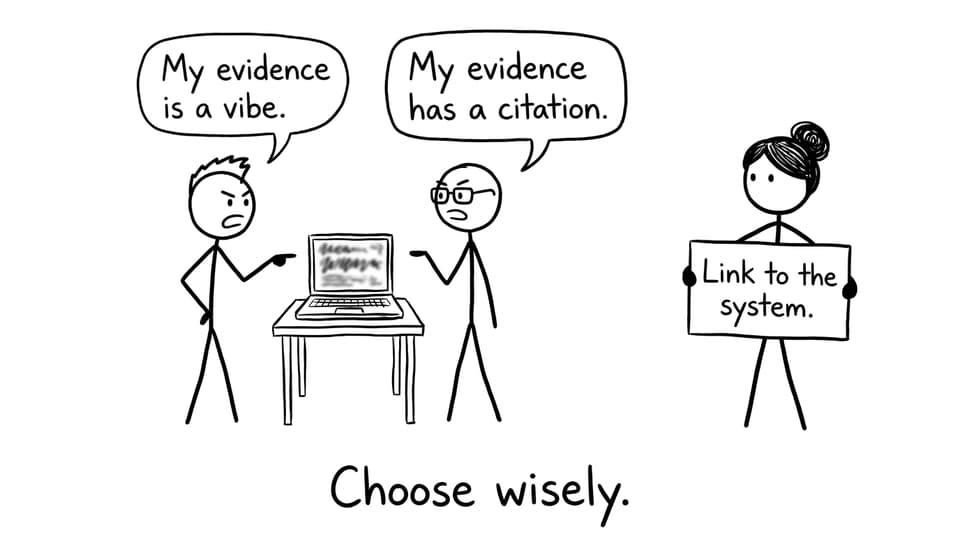
Ethical evaluation needs evidence, not vibes
Ethics paragraphs often sound confident and still score poorly because they read like opinion.
In IB Digital Society, ethical evaluation is strongest when you:
-
identify stakeholders (who is responsible, who is affected)
-
use evidence that shows harm/benefit distribution
-
acknowledge limits (what your evidence cannot prove)
-
reach a justified judgment
RevisionDojo’s IB Digital Society Internal Assessment Guide is helpful here because it translates “evaluation” into practical moves: balance, specificity, and a clear link back to your inquiry focus.
Avoid evidence overload (and protect your word count)
Evidence overload usually looks like long blocks of quotes, back-to-back stats, or repeated examples that all prove the same small point.
A calmer strategy for IB Digital Society is to pick fewer pieces and squeeze more meaning out of each one:
-
Use one strong statistic, then spend sentences unpacking mechanism and implications.
-
Use one short quote, then explain what it reveals about power, values, or incentives.
-
Use one comparison (two stakeholder groups), then evaluate the trade-off.
When you need practice turning evidence into exam-style reasoning, RevisionDojo’s Questionbank is a practical training ground: it forces you to make claims, support them, and stay within markband expectations.
Closing: Make evidence feel like reasoning
The best IB Digital Society IAs don’t feel like research dumps. They feel like a guided walk: each piece of evidence arrives exactly when it’s needed, gets interpreted, and nudges the reader toward a clearer judgment about impacts on people and communities.
If you want to tighten your evidence fast, build a simple workflow in RevisionDojo: use the Study Notes to lock in concepts, Flashcards to keep your terminology precise, AI Chat to challenge weak claims, the Coursework Library to benchmark against real exemplars, and Tutors when you want human feedback before submission. Then practise the same evidence-to-analysis move in the Questionbank until it becomes automatic.
In IB Digital Society, evidence doesn’t win marks by existing. It wins marks by being explained.
