
The IB exam room has a secret curriculum
The first time you sit an IB exam, it can feel like walking into a familiar classroom that has quietly changed the rules overnight.
You studied the content. You memorised the definitions. You did the practice questions.
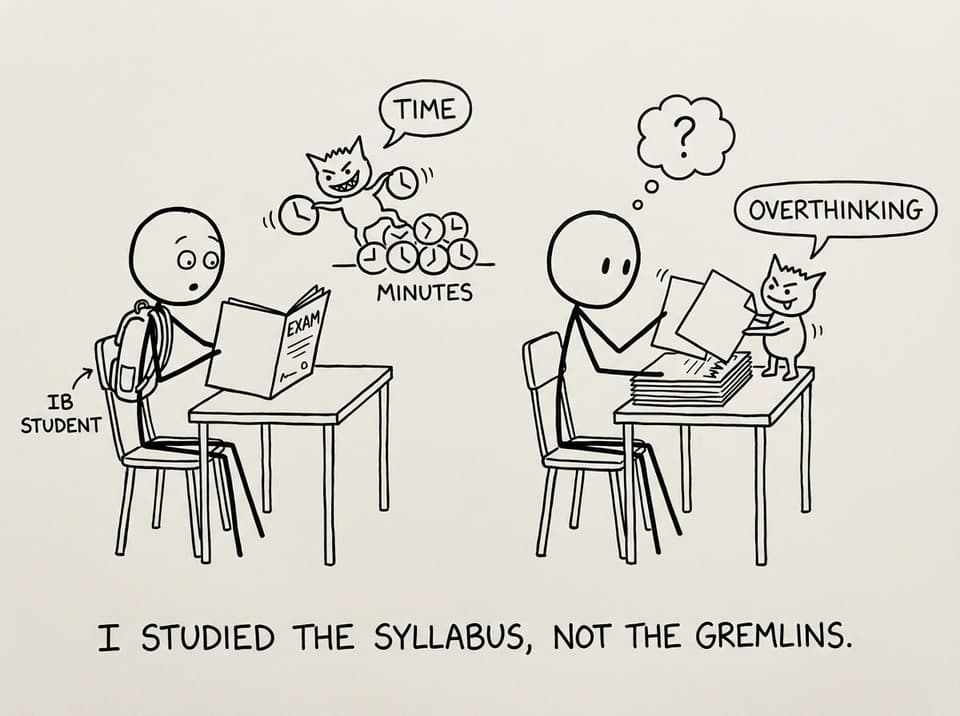
And then the paper lands on your desk and your brain does something unhelpful: it starts negotiating. Should I start with the hardest question? What if I run out of time? How neat is neat enough? Is this a trick?
That negotiation is the real exam.
Because the IB isn't only testing what you know. It's testing whether you can show what you know under strict constraints: time, structure, markschemes, fatigue, and nerves. Most students don't fail because they didn't learn the syllabus. They lose marks because no one taught them the unwritten rules.
Below are the unwritten rules of IB exams that quietly separate "I know this" from "I scored it."
Quick checklist: the unwritten rules to remember
Before we go deeper, here's a simple checklist you can return to the night before any IB exam:
- Read the command terms like they are the real question.
- Spend time where the marks are (not where your anxiety is).
- Write for the examiner, not for your teacher, not for yourself.
- Plan first, then execute (even if it's a 20-second plan).
- Bank easy marks early to calm your brain.
- Keep your handwriting and layout "markable."
- Use the paper's structure (lines, boxes, question parts) to your advantage.
- Don't let perfection steal completed answers.
If you want these habits to become automatic, build them into how you revise: RevisionDojo is designed for exactly that, from targeted Questionbank practice to Mock Exams and Grading tools that teach you what earns marks.
Rule 1: In IB exams, marks are the currency; spend time accordingly
A strange thing happens in an IB exam: students treat every question like it deserves equal attention.
But the paper doesn't.
A 2-mark subpart is not a moral commitment. It is a small transaction. If you're stuck, you're allowed to move on.
A practical habit:
- For long-answer sections, glance through and quickly mark which prompts feel "high-confidence."
- Start there to build momentum.
- Come back for the harder ones with time still in the bank.
This isn't about avoiding challenge. It's about making sure your final grade reflects the knowledge you actually have.
To train this, use timed sets in a Questionbank environment so you learn pacing under pressure. RevisionDojo's Questionbank and Mock Exams help you rehearse the real constraint: minutes per mark.
Rule 2: Command terms are the hidden instructions of the IB
In IB exams, the same topic can demand wildly different responses depending on one verb.
"Outline" isn't "Explain."
"Compare" isn't "Evaluate."
"Discuss" isn't "Describe."
Many students lose marks because they answer the topic while ignoring the task.
A useful mental move is to translate the command term into a mini-checklist before you write:
- Explain = how/why + clear chain of reasoning.
- Compare = similarities and differences, often with a conclusion.
- Evaluate = criteria + judgement + limitations.
The goal is not to sound smart. It's to be scorable.
RevisionDojo's Study Notes and AI Chat are ideal here: you can ask for a quick command-term breakdown, then practise applying it to multiple question styles until it feels routine.
Rule 3: The examiner is tired: make your answer easy to reward
This is one of the most practical unwritten rules of IB exams: examiners don't award marks for "potential." They award marks for what they can clearly see.
So make your work easy to mark:
- Use short paragraphs.
- Use signposting (e.g., "First…", "However…", "Therefore…").
- When asked for two reasons, label them (Reason 1, Reason 2).
- When comparing, use a clear structure (A vs B).
Think of your answer like a well-lit hallway. The examiner shouldn't have to search for the points.
If you want feedback on whether your structure is "markable," RevisionDojo's Grading tools can help you practice writing in a way that matches what markschemes reward.
Rule 4: Planning is not optional: it's how you buy clarity
Students often skip planning because it feels like wasted time.
But in an IB exam, planning is how you avoid writing a long answer that earns short marks.
A fast plan can be tiny:
- 3 bullet points for the body
- 1 counterpoint
- 1 conclusion line
That's it.
Planning prevents the most common long-response failure mode: saying many true things with no clear argument.
Build this habit during revision by doing "plan-only" drills. Use RevisionDojo Flashcards for key evidence/definitions, then practise 30-second plans before writing full responses.
Rule 5: Your first 5 minutes decide your score more than your last 5 minutes
The opening minutes of an IB exam are when panic is loudest. Your job is to lower the noise.
A calm routine helps:
- Write your candidate details carefully.
- Take 3 slow breaths.
- Skim the paper for structure.
- Start with something you can definitely answer.
When you collect early marks, you collect something else too: proof that you belong in the room.
This is why "easy-first" is not cowardice. It's strategy.
Rule 6: Perfection is a hidden time thief in IB exams
Perfection doesn't usually show up as arrogance. It shows up as small, expensive habits:
- rewriting introductions
- re-reading the same question five times
- trying to force the "ideal" example
- polishing one paragraph while another question stays blank
In IB exams, a good complete answer beats a perfect incomplete one.
A practical rule:
- If you've earned most of the marks, move.
This is where timed practice matters. RevisionDojo Mock Exams and Predicted Papers style practice sets help you experience the trade-offs before the real day.
Rule 7: The layout of your answer is part of the answer
The IB rewards clarity. Layout is clarity made visible.
- Leave a line between ideas.
- Use headings if appropriate.
- Keep diagrams labelled and readable.
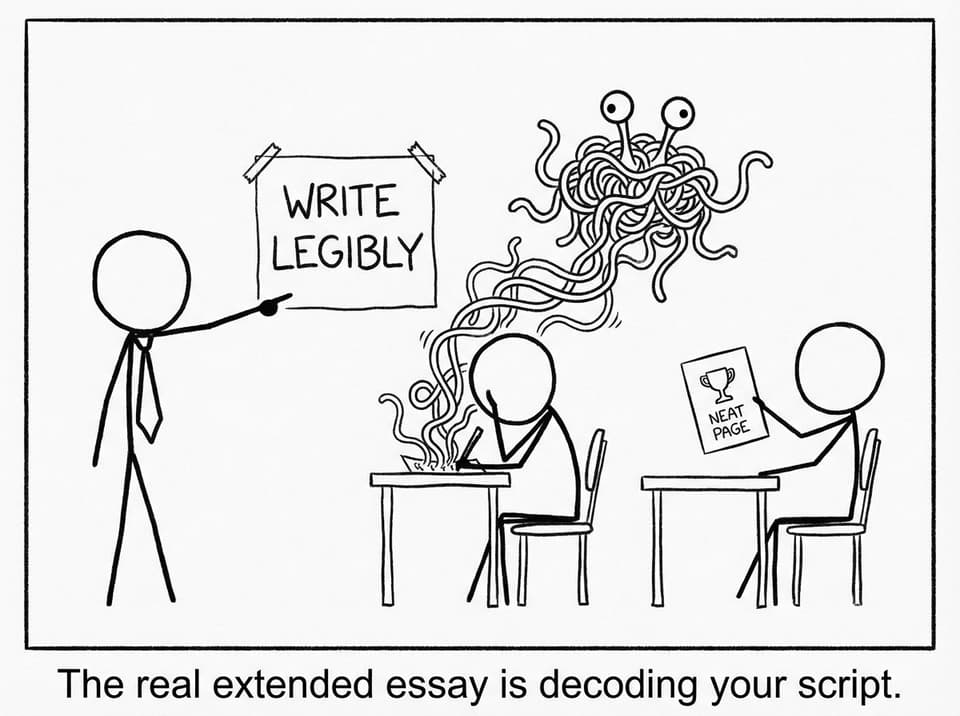
- If you correct something, do it cleanly (no angry scribbling wars).
You're not writing a novel. You're building a scorable object.
And yes, handwriting matters only in one way: the examiner must be able to read it quickly.
Rule 8: The paper is designed to lure you into over-answering
Many IB questions are written to tempt you into saying more than the marks require.
A 4-mark question rarely wants a 20-line essay.
Train yourself to match length to marks:
- 2 marks = 2 crisp points (often one sentence each)
- 4 marks = 2-4 developed points
- 10+ marks = structured argument with evidence and evaluation
If you struggle with this, practise with markschemes and self-checking. RevisionDojo's Grading tools can help you calibrate what "enough" looks like.
Rule 9: Your brain will try to solve anxiety by collecting pens
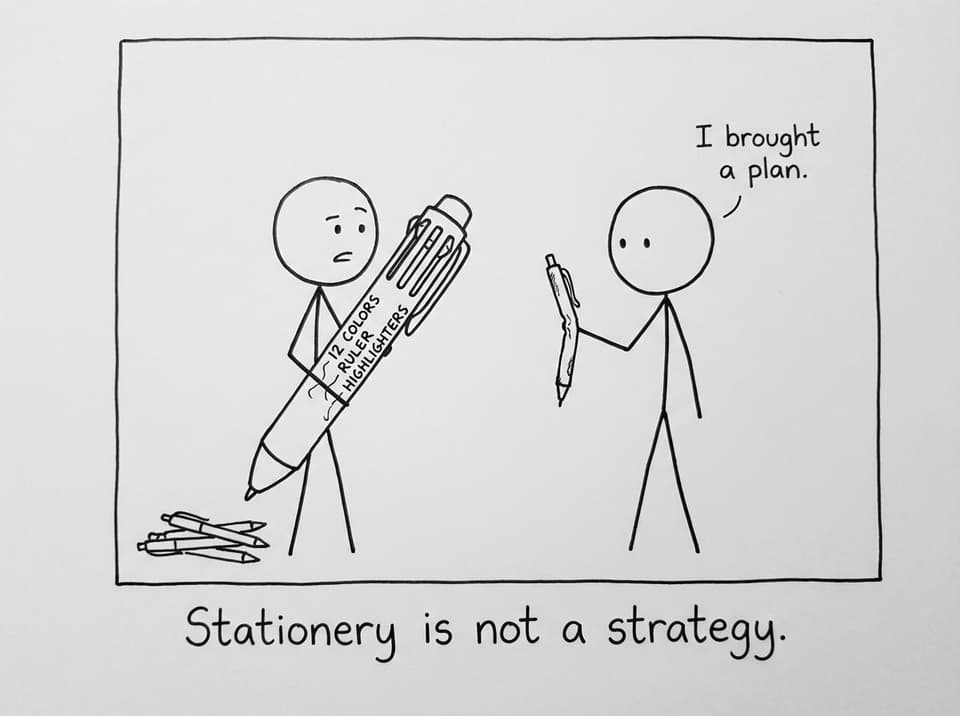
The night before an IB exam, your mind looks for control.
Sometimes it chooses the wrong target.
You can't control the question. But you can control the kit, the highlighters, the rulers, the lucky calculator battery.
Bring what you need. Then stop.
The deeper control is process:
- Do you know your pacing?
- Do you know how to structure responses?
- Do you know what the markscheme rewards?
That's why RevisionDojo's ecosystem matters: Study Notes for clarity, Flashcards for recall, Questionbank for application, AI Chat for doubts, and Tutors when you need a human to straighten the knots.
Rule 10: The best IB students don't feel confident; they feel prepared
Confidence is a mood. Preparation is a system.
The best IB students often walk in nervous, but they have rehearsed the essentials:
- timed writing
- typical question styles
- common traps
- quick planning
- mark-aware structure
They don't rely on motivation. They rely on familiarity.
If you want that kind of familiarity, build a loop:
- Learn (RevisionDojo Study Notes)
- Drill (RevisionDojo Flashcards)
- Apply (RevisionDojo Questionbank)
- Simulate (RevisionDojo Mock Exams)
- Review and correct (RevisionDojo Grading tools)
The quiet advantage: treat IB exams like a skill, not an event
The unwritten rules of IB exams aren't secrets because they're complicated. They're secrets because they're not taught directly, and most students only discover them after losing marks.
But you can learn them early.
Make your answers easy to reward. Spend time where the marks are. Plan briefly, write clearly, and move on before perfection starts negotiating with your clock. That's how IB performance becomes predictable.
If you want a single place to build that predictability, RevisionDojo is built for it: Study Notes to understand, Flashcards to remember, AI Chat to unblock confusion, Questionbank to apply, Predicted Papers and Mock Exams to simulate, Grading tools to calibrate, a Coursework Library for reference, and Tutors when you want personal guidance.
The IB will still be hard. But it won't be mysterious.