


If you have ever opened the HL formula booklet in the middle of an IB Math paper and felt your brain go quiet, you are not alone. The booklet is supposed to reduce memorization pressure, yet under exam timing it can turn into a frantic page-flip. The shift that changes everything is simple: treat the booklet like a navigation tool you train with, not a rescue rope you grab when you are already sinking.
The IB Math formula booklet mindset: tool, not crutch
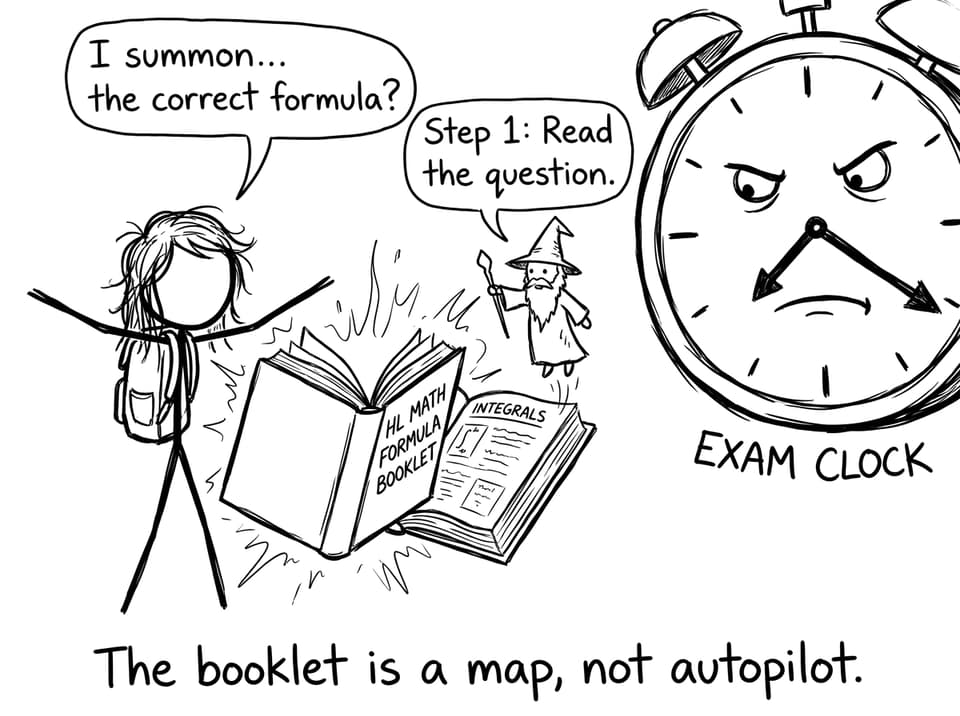
In IB Math, marks usually come from method and reasoning, not just the final line. The formula booklet helps you access the “language” of the course (calculus rules, trig identities, distributions), but it will not decide which formula fits the question. That decision is still yours.
A helpful reframe: the booklet is a map of what the exam expects you to recognize quickly. If you can spot the topic and the pattern, the formula is easy to retrieve.
Quick checklist to maximize the booklet fast
Use this mini-routine during revision so your IB Math exam day feels familiar:
-
Skim the booklet once per week to learn its layout.
-
Build a mental index: “Where do integrals live? Where are distributions?”
-
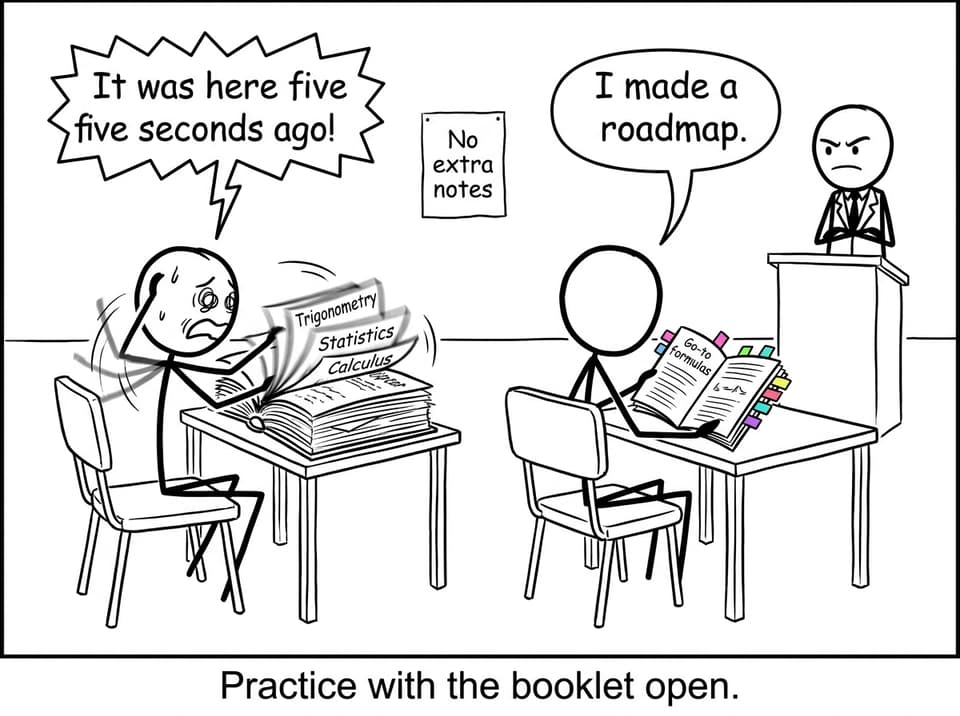
Practice questions with the booklet open (timed).
-
After each question, use the booklet to verify notation and final forms.
-
Keep an error log: “I chose the wrong formula because…”
For a deeper explanation of what the booklet contains and how it works across courses, see What Is the IB Math Data Booklet?.
Learn the layout before you learn speed
Speed in IB Math rarely comes from rushing. It comes from removing tiny delays that compound: searching, second-guessing, rewriting.
One of the highest-return habits is simply training your eyes to know where things are. When you repeatedly locate the same calculus rule or trig identity, you stop “looking” and start “moving.” That is what calm looks like in a timed paper.
If you want a structured way to make your study materials easier to navigate, borrow ideas from IB Math Note-Taking Strategies That Actually Work.
Use the booklet to spot patterns, not just formulas
Many HL questions are not “apply one formula.” They are “connect two ideas.” The booklet helps you notice those connections.
Examples of pattern thinking in IB Math:
-
A volume of revolution question often starts as a graph/feature problem, then becomes an integral setup.
-
A trig equation might require an identity transformation before any calculus even matters.
-
Statistics questions often reward choosing the right distribution model and interpreting parameters correctly.
To practice these ideas in a syllabus-aligned way, explore the IB Mathematics Analysis and Approaches Resources hub, and for targeted practice use the Calculus Questionbank or Statistics & Probability topic page.
Train under pressure: your “formula roadmap” routine
On exam day, the biggest danger is not forgetting a formula. It is losing time deciding what the question is really asking.
Try this routine in timed practice:
-
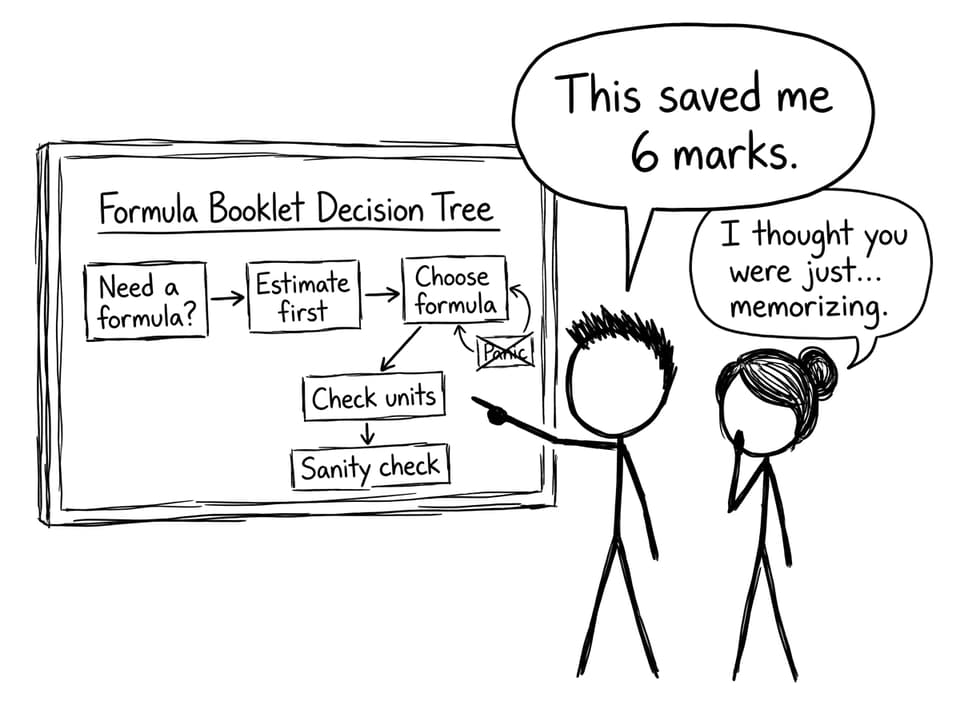
Read the question and identify the topic in one sentence.
-
Predict what kind of expression you expect (derivative, integral, probability statement).
-
Open the booklet only to confirm the exact form and notation.
-
After solving, return to the booklet for a quick sanity check (signs, constants, conditions).
If you want a practice system that keeps you honest, pair the booklet with Targeted Revision Using the Questionbank so every session has a clear goal.
How RevisionDojo makes IB Math formula mastery easier
RevisionDojo is built around the exact moment students struggle: you know the topic, but you cannot convert it into marks quickly enough.
Use the Study Notes to understand why a formula works, then drill the same skill in the Questionbank with mark-scheme-aligned solutions. When you get stuck, AI Chat helps you diagnose the mistake without turning revision into a three-hour detour. Closer to exams, run Mock Exams and Predicted Papers to rehearse timing and decision-making. If your working is messy, the Grading tools and Tutors can tighten your method marks. And for daily retention, Flashcards keep key identities and conditions active.
To see how an interactive, exam-focused approach can reduce confusion, read How RevisionDojo’s Data Booklet Simplifies Complex Calculations.
Conclusion: make the booklet feel boring (that is the goal)
The HL formula booklet becomes powerful when it stops feeling magical. In IB Math, your advantage comes from familiarity: knowing where to look, what to ignore, and how to confirm your work fast. Practice with the booklet until opening it feels routine, almost dull.
When you are ready to turn that routine into exam marks, use RevisionDojo’s Study Notes, Questionbank, Flashcards, AI Chat, Mock Exams, and Tutors to train the exact skills the booklet supports. Build your roadmap now, and your future self will thank you in the last 20 minutes of the paper.