




University open days can feel unusually consequential for an IB family. A single visit appears to carry several decisions at once: course, country, cost, entry requirements and the place where your child may spend the next three or four years.
The reassuring answer is that an open day does not need to produce a final decision. Its purpose is simpler: to test whether the reality of a university matches what the website promises. For IB students preparing for exams, that means checking academic fit without turning the visit into another source of pressure.
This university open days guide for IB families explains what to investigate, which IB-specific questions to ask and how parents can remain useful while allowing the student to lead.
The open day checklist for IB families
Before travelling, agree on five priorities:
- Confirm the exact course and campus being visited.
- Compare published IB entry requirements with the student's subjects and likely results.
- Book essential course, accommodation and admissions sessions.
- Prepare separate questions for academics, admissions staff and current students.
- Record impressions immediately after the visit, before different universities blur together.
An open day is most valuable when it reduces uncertainty. You do not need to attend every talk or inspect every building. You need enough evidence to answer three questions: Can my child enter this course? Would the course suit them? Could they realistically live and study here?
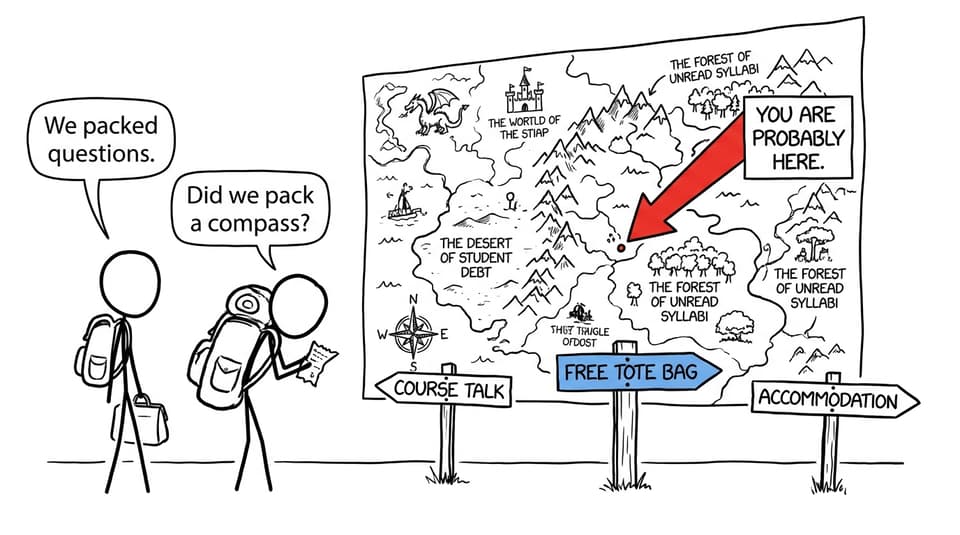
Prepare before the open day
Open days commonly include subject presentations, campus and accommodation tours, admissions sessions, support-service information and conversations with current students. Programmes vary, and popular sessions may have limited capacity, so check the university's current event page and book in advance where required.
Start with the course page rather than the general university homepage. Verify the course title, location, duration, available modules, placement or study-abroad options and published entry criteria. A university with several campuses may teach a particular degree somewhere other than the campus featured most prominently in its marketing.
IB families should then create a one-page information sheet containing:
| What to record | Why it matters |
|---|---|
| Required total IB score | Helps assess whether the course is academically realistic |
| Required Higher Level subjects and grades | A total score alone may not satisfy subject prerequisites |
| Additional selection requirements | Interviews, portfolios, tests or written work may apply |
| Application route and deadline | Systems and timelines differ among countries |
| Estimated tuition and living costs | The full cost is more informative than tuition alone |
| Questions not answered online | Keeps the day focused on information that requires a human answer |
The IB reports that universities in many countries receive applications and transcripts from IB students. Recognition, however, is not the same as admission. Each institution can establish its own course-level criteria, and national recognition or equivalency rules may also apply. Always confirm requirements on the university's official course and admissions pages.
Families comparing several countries may find it helpful to review the broader IB university application process before arranging visits. Students considering Britain can also clarify the application structure through this guide to UK university admissions for IB students.
Ask precise questions about IB university requirements
The strongest open-day questions are specific enough to produce an actionable answer. Asking whether a university “accepts the IB” reveals little. Asking how a course evaluates total points, Higher Level subjects and predicted results is far more useful.
Questions for admissions staff
- Is the published IB requirement a minimum threshold or a typical competitive level?
- Does the offer specify both total points and grades in particular Higher Level subjects?
- Are core points included in the stated total?
- How are predicted IB results considered before final results are available?
- Are there country-specific documentation, language or qualification-equivalency requirements?
- If the student narrowly misses a condition, what process is normally followed?
- Who should the school contact if an IB subject title does not fit the application form neatly?
Predicted results deserve special attention because their use differs across application systems and institutions. They may support an admissions decision or a conditional offer, but they are not achieved results. Parents who want more context can read about the role of predicted grades in university admissions and the distinction between predicted IB grades and final scores.
Do not rely on a hurried verbal answer for a decisive requirement. Note the staff member's department, then verify the information in writing through the official admissions channel after the event.
Look beyond entry and investigate the course
Meeting an offer is only the doorway. The student must still want the education waiting behind it.
Attend the subject session even if the general welcome talk sounds more impressive. Ask how teaching is divided among lectures, seminars, laboratories, tutorials, studios or independent study. Find out how the course is assessed, which modules are compulsory and how much choice students receive later.
Useful questions for academic staff include:
- What does a typical first-year week look like?
- How much scheduled teaching and independent study should students expect?
- Which first-year topics are most challenging?
- Can students change pathways or specialisms?
- How are academic advisers allocated?
- What research, placement or study-abroad opportunities are realistically available?
- What happens when a student struggles with a required module?
IB students may be attracted to a university because its published score appears attainable. That is necessary information, but not sufficient information. A course whose content and assessment style suit the student may be a wiser choice than a more famous institution whose programme does not.
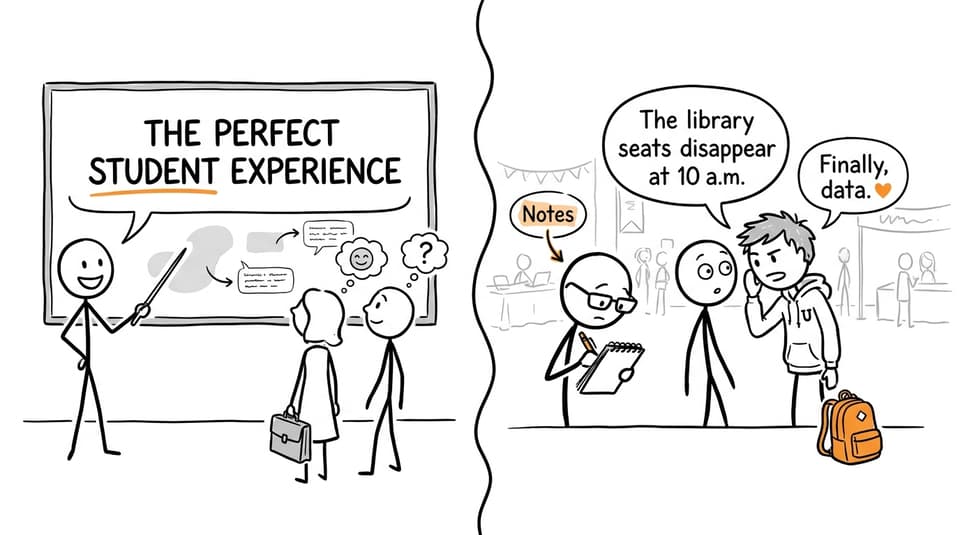
Speak to current students without staff hovering nearby
Official presentations explain how the university is designed to work. Current students can describe how it feels when it actually does.
Ask questions grounded in ordinary life:
- How easy is it to contact lecturers or tutors?
- Where do students study when deadlines approach?
- What surprised you after arriving?
- How reliable is transport between accommodation and teaching buildings?
- What do students typically do after first-year housing?
- Is it easy for international students to join societies and meet people?
- What would you investigate more carefully if choosing again?
One student's view is not universal. Treat each answer as a clue, not a verdict. If several students independently mention the same strength or difficulty, it deserves further investigation.
Parents should also notice what is not staged. How long does it take to walk between key buildings? Are signs understandable? Do students use the spaces being showcased? Can your child imagine managing an ordinary rainy Tuesday there, not merely enjoying a well-organised Saturday?
Check accommodation, wellbeing and international support
Accommodation tours can become strangely focused on room size. The more consequential questions concern contracts, availability and daily logistics.
Ask whether first-year accommodation is guaranteed, and under what conditions. Check contract length, deposits, payment schedules, meal arrangements, internet, laundry and travel time to the relevant teaching site. Ask where students usually live in later years and what local rents and transport typically involve. Because fees and policies change, request current written information rather than relying on remembered figures.
For international IB families, investigate:
- Visa and immigration guidance provided by the institution
- Arrival and orientation arrangements
- Support for opening bank accounts or accessing healthcare, where applicable
- Holiday accommodation rules
- Airport or station transport information
- International student societies and language support
- Emergency and out-of-hours assistance
Students with disabilities, long-term health conditions or specific learning needs can contact the university's support team before visiting. This allows the family to arrange access for the day and ask privately how adjustments work in teaching, assessment and accommodation.
Wellbeing support should be discussed practically. Ask how students request help, whether waiting periods vary during busy times and what academic support exists alongside counselling or health services. A list of services matters less than understanding how a student reaches them.
Let the student lead while the parent observes
The parent's most useful role is not to conduct the visit. It is to preserve enough calm and structure for the student to notice what matters.
Before arriving, agree on roles. The student might ask questions about course content and student life. The parent might track costs, contracts and details that are easy to miss. If a sensitive or complex question arises, ask your child whether they want you to raise it.
This balance is especially important during IB exam preparation. Students may already feel that every conversation is about predicted results, deadlines or performance. Open-day discussions can restore perspective by asking not only “Can you get in?” but also “Would this place help you learn and live well?”
Parents concerned about supporting rather than intensifying pressure may find the guidance on helping a teenager during IB exam season and supporting an IB student's mental health useful.
Use virtual open days strategically
International travel can make visiting every university unrealistic. A virtual event is not a lesser choice when used deliberately. It can help a family reduce a long list before committing money and time to selected in-person visits.
Virtual events may offer live question sessions, subject presentations, student panels and digital campus or accommodation tours. Attend live where possible so the student can ask course-specific questions. Afterwards, email admissions about anything unresolved and seek independent detail about the surrounding area, transport and housing.
If an in-person visit is impossible, ask whether the university offers online appointments, student chats, recorded sessions or a later applicant event. Open-day attendance is generally a research opportunity rather than a standard admissions requirement, but families should confirm any course-specific expectations directly.

Compare universities after the visit
The best time to record an open day is the journey home, before polished images replace honest impressions.
Ask the student to score each university privately against the same criteria: course, teaching, location, accommodation, support, affordability and overall fit. Parents can complete the same exercise separately. Compare notes later, beginning with areas of agreement rather than trying to settle the decision immediately.
Keep facts separate from feelings. “The accommodation contract lasts 40 weeks” is a fact. “The campus felt too quiet” is an impression. Both matter, but they should not be confused.
A useful final question is: What would we regret not checking before applying? Send those remaining questions to the appropriate department. Then review how the requirements relate to the student's current academic position, using careful resources such as the global guide to IB university score requirements as context rather than a substitute for official course criteria.
Make the next step smaller
A successful university open day does not end with certainty. It ends with a clearer shortlist, a few verified facts and better questions.
Within 48 hours, organise the notes, remove any university that clearly fails an essential criterion and identify one follow-up action for each remaining option. That action might be checking an official IB requirement, attending a virtual subject event, calculating realistic living costs or speaking with the school's university counsellor.
For IB diploma parents, the central task is not to choose on the student's behalf. It is to help turn a large, emotional decision into several smaller and more manageable ones. The next natural step is simply to agree on the family's non-negotiables, book the most useful events and let the student begin forming an informed view of their own future.