

If you have ever read a Digital Society stimulus and thought, “Obviously this is bad”, you are already close to what examiners want from IB Digital Society. The problem is that “obvious” doesn’t earn marks.
Ethics in IB Digital Society is less about the strength of your feelings and more about the quality of your justification. It asks whether a digital system’s design, use, and impact can be defended in a world where benefits are real, harms are real, and trade-offs are unavoidable.
The good news: ethical analysis is a skill you can make repeatable. Once you have a structure, your answers stop drifting into opinion and start landing like evaluation.
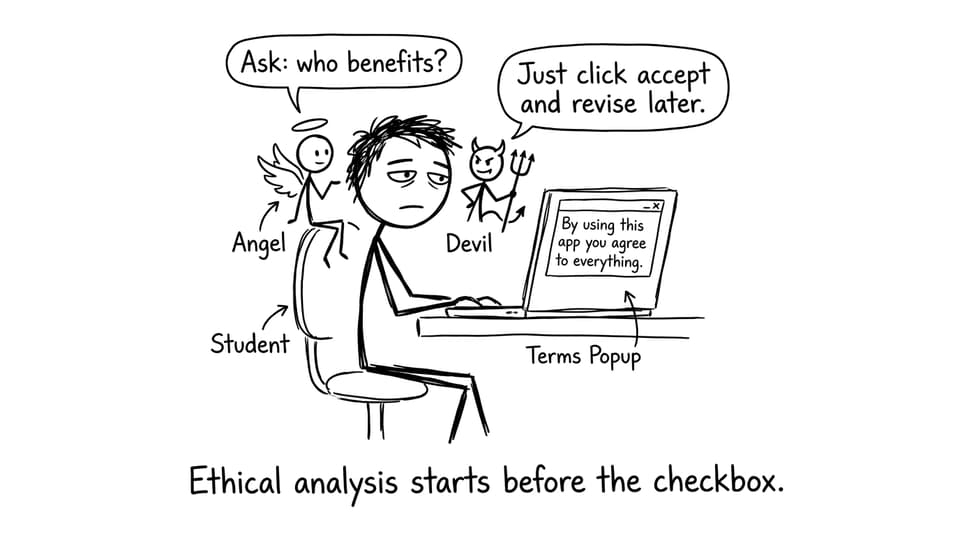
A quick ethics checklist for IB Digital Society
Use this as your 60-second plan before you write any ethics paragraph in IB Digital Society:
-
Name the digital system (be specific: feature, workflow, or decision).
-
Identify stakeholders (at least two groups affected differently).
-
Spot the ethical tension (privacy vs convenience, efficiency vs fairness, etc.).
-
Link to design choices (what the system does that creates the issue).
-
Assess impacts (individual + community level).
-
Assign responsibility (who can change outcomes, not just who uses it).
-
Make a judgement (justified, conditional, balanced).
For a clean place to revise definitions and examples, start from the IB Digital Society Resources hub.
What “ethics” means in IB Digital Society
In IB Digital Society, ethics means evaluating whether a digital system is morally justifiable given its consequences, processes, and power relationships.
Notice what is missing: it does not mean writing a list of worries, or giving a personal reaction, or treating “harmful” as self-explanatory. Ethical analysis is a structured argument.
A strong shortcut is to frame ethics as a question:
- Can the system be justified? If yes, under what conditions and safeguards? If not, why not?
If you want the course lens spelled out in a broader way, connect this to themes using IB Digital Society: Key Themes Explained.
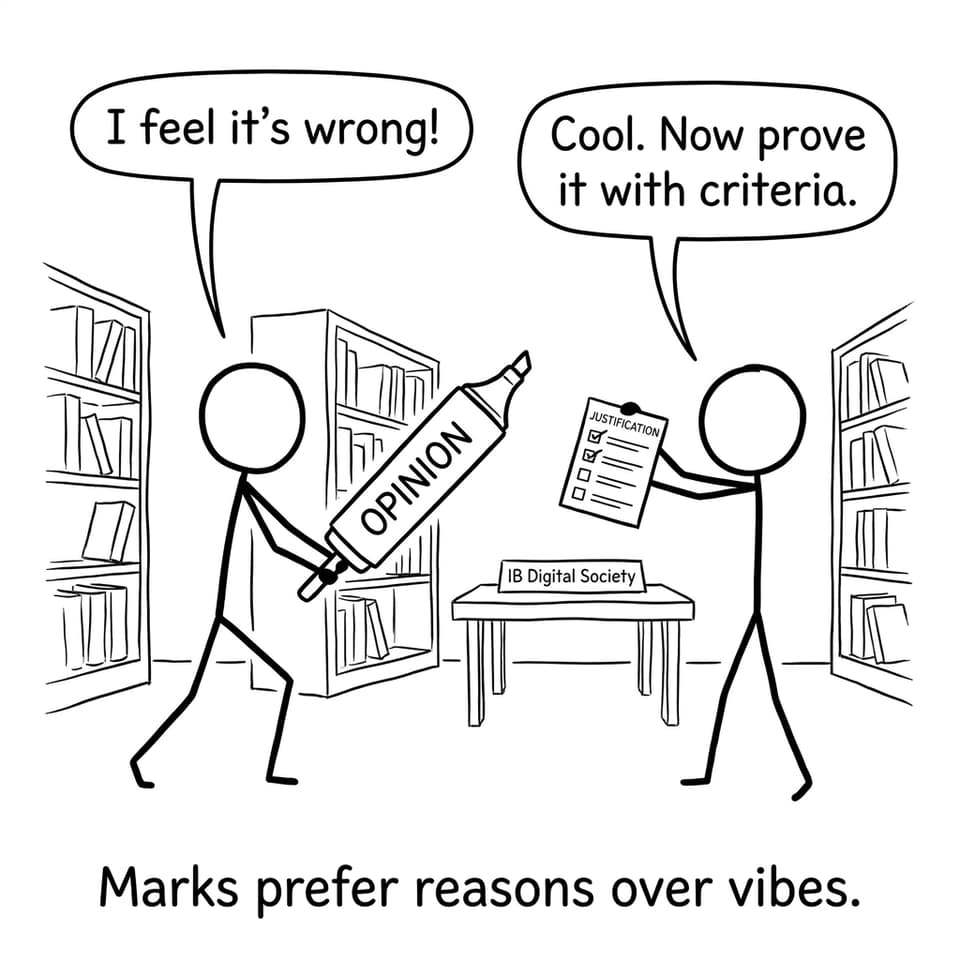
Ethical analysis starts with justification, not vibes
Many students in IB Digital Society write ethics like a verdict. Examiners want the reasoning that earns the verdict.
A high-scoring ethics paragraph typically includes:
-
Benefit claim: what good the system produces (for whom, and how).
-
Harm claim: what damage it creates (for whom, and how).
-
Avoidability: whether harm is necessary, reducible, or negligent.
-
Weighing: why one side matters more using a criterion (fairness, autonomy, consent, transparency, safety).
-
Judgement: “largely justified,” “partially justified,” “largely unjustified” with conditions.
This connects directly to how the IB rewards evaluation. If you struggle to conclude, read What Evaluation Means in IB Digital Society.
Link ethics to design choices inside the digital system
The easiest way to make ethics sound “IB” is to stop talking about technology in general and start talking about system features.
Instead of:
- “Social media is unethical.”
Try:
- “The recommendation algorithm optimizes watch time, which encourages emotionally extreme content. This design choice increases engagement benefits, but also amplifies misinformation risks and reduces user autonomy through manipulation.”
That single move ties ethics to how the system works, which is exactly what IB Digital Society is testing.
To build more system-specific language, use Study Notes and reinforce key terms with Digital Society Flashcards.
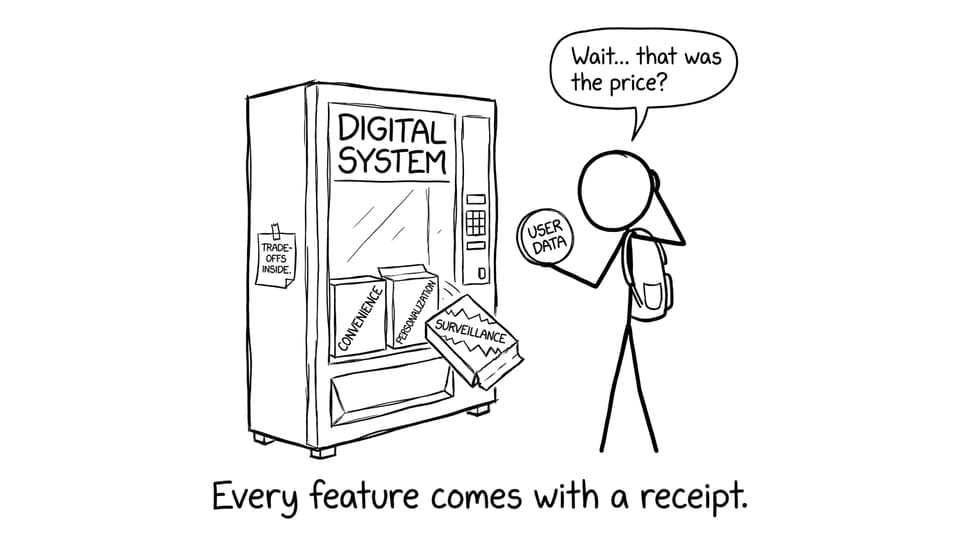
The trade-offs examiners love (because they are real)
Most ethical problems in IB Digital Society are not clean battles between good and evil. They are trade-offs between values.
Common trade-offs you can apply quickly:
-
Convenience vs privacy (frictionless login, location tracking, personalization)
-
Efficiency vs fairness (automated decisions, ranking, sorting people)
-
Security vs freedom (surveillance, moderation, identity verification)
-
Innovation vs protection (deploy fast vs safeguard vulnerable users)
-
Access vs control (open platforms vs gatekeeping and regulation)
When you explicitly weigh a trade-off, your answer becomes evaluation instead of description. For a related lens, see Cybersecurity and Digital Risk in IB Digital Society Explained.
Impacts: always write at two levels
A reliable way to deepen ethics in IB Digital Society is to separate individual impact from community impact.
Individual-level ethical impacts
At the individual level, ethical issues often involve:
-
Autonomy: can users meaningfully choose, or are defaults and nudges steering them?
-
Consent: do users understand what they agree to, and can they opt out realistically?
-
Harm exposure: scams, harassment, manipulation, discrimination.
Community-level ethical impacts
At the community level, ethical issues often involve:
-
Unequal distribution of harm and benefit (some groups pay more of the cost).
-
Marginalization through biased data or unequal access.
-
Long-term social change, like weakened trust or polarized public debate.
This two-level structure helps you earn depth marks without writing more than you need.
Responsibility, accountability, and power (your “top band” trio)
A system can harm people even if no single user intends harm. That is why IB Digital Society cares about responsibility and power.
Ask:
-
Who designed the system and its incentives?
-
Who controls the data, the model, the rules, the updates?
-
Who can appeal decisions or challenge outcomes?
-
Who profits, and who carries risk?
If you only blame users, your ethics usually stays shallow. Strong answers assign responsibility where the power to change outcomes actually sits.
For example, AI-driven decisions are perfect for power analysis. Build vocabulary and examples via IB Digital Society: AI in Exams, Ethics, and IA Ideas and connect rights language with Digital Rights and Responsibilities in IB Digital Society.
How to write ethics paragraphs that score in exams
When a question invites ethics in IB Digital Society, do not wait until the end. Put the judgement into your paragraph early, then justify it.
A simple exam-ready structure:
-
Claim (judgement): “This system is partially justified because…”
-
Design link: “This results from…” (feature, incentive, automation)
-
Impact: individual + community
-
Trade-off weighing: why one value outweighs another, with conditions
-
Responsibility: who should act, and what action changes the ethical balance
To tighten your exam technique across command terms, use How to Use Command Terms Effectively in IB Exams and Structure IB Answers to Maximize Marks.
Closing: make ethics your advantage in IB Digital Society
Ethics is not the “extra” part of IB Digital Society. It is the part that turns knowledge into marks: you show you can judge a digital system, not just describe it.
If you want a calm, repeatable way to train this skill, build a loop in RevisionDojo: learn definitions with Study Notes, lock language in with Flashcards, practice argument structure in the Questionbank, get unstuck with AI Chat, then pressure-test your timing using Mock Exams and Predicted Papers. Add the Grading tools to see what top-band answers do, and use the Coursework Library plus Tutors when you want targeted feedback.
Start today with one stimulus: write one justified ethical judgement in IB Digital Society, and make sure your conclusion actually answers, “Can this system be justified?”


