Join 650k+ students breezing through the IBReady to breeze through the IB?
You know the feeling: you open an unseen text, your pen hovers, and for a second your brain tries to bargain with the universe. “If I just write quickly, maybe it will sound smart.”
That moment is the real challenge of IB English. Not because you lack ideas, but because you need a repeatable way to find them under time pressure.
This guide is a calm, practical path for the HL essay task (the same core skills that power Paper 1 analysis). Follow these 10 steps and you’ll stop relying on hope and start writing with confidence in IB English.
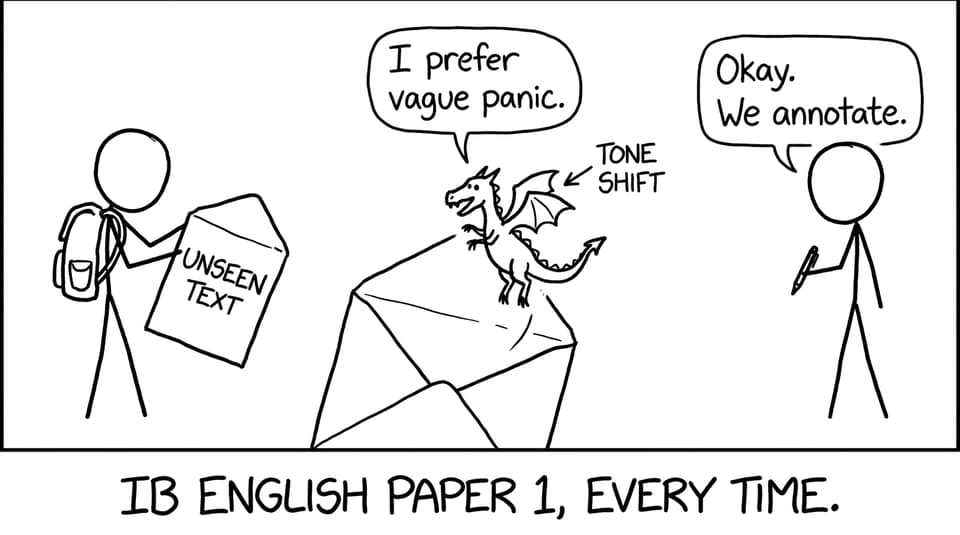
A student meets a tone-shift dragon
A quick IB English HL essay checklist
Before the 10 steps, here’s the whole strategy in one glance:
Understand the task and the assessment focus (analysis, not summary)
Read once for meaning, once for method
Frame the text with audience and purpose
Choose 3-5 features you can analyze deeply
Write a thesis that answers “how meaning is made”
Build paragraphs that stay glued to the thesis
Use embedded quotations, not long extracts
Keep time for editing and clarity
If you want structured practice, start with the and the page on RevisionDojo.
To see the target, study an exemplar and reverse-engineer it. RevisionDojo’s English Lang & Lit Paper 1 Exemplar is useful because you can annotate what the writer does in each paragraph, not just what they say.
Step 2: Build your “first 10 minutes” routine
Confidence in IB English is often just familiarity with the opening.
In your first 10 minutes, do this every time:
Annotate for patterns (repetition, contrasts, shifts)
Box 3-5 quotes you know you’ll use
Note audience + purpose in the margin
Sketch 3 body paragraph ideas
This routine becomes automatic through repetition. Use targeted drills from the Paper 1 Questionbank so you’re not always starting from scratch.
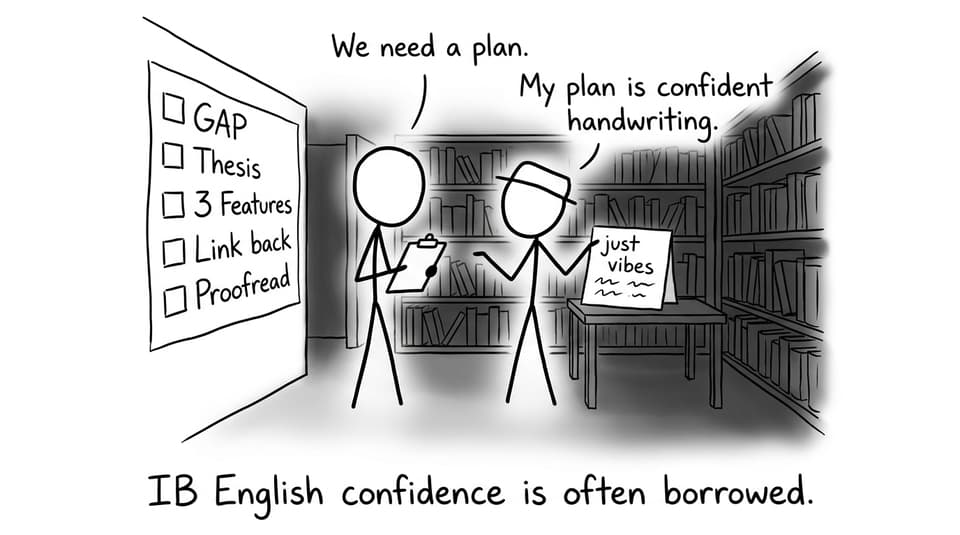
Checklist vs just vibes
Step 3: Frame the text without forcing external context
A common trap in IB English is trying to “sound knowledgeable” by adding biography or historical facts that the passage doesn’t earn.
Instead, anchor your opening with a simple frame:
What is the genre/text type?
Who is the audience?
What is the purpose?
What is the central tension or message?
You’re not guessing facts. You’re explaining what the text itself implies.
Step 4: Choose fewer features, go deeper
Most students lose marks by listing techniques. High-scoring IB English responses commit to depth.
Pick 3-5 features you can return to repeatedly, such as:
Tone shifts and stance
Imagery clusters and motifs
Syntax and pacing (short sentences, fragments, accumulation)
Then ask one question: “How does this choice shape meaning for the reader?”
Step 5: Write a thesis that can steer the whole essay
A useful IB English thesis is not a theme. It’s a claim about method.
Try this template:
The text creates ____ by using ____ to ____ , ultimately positioning the reader to ____.
Now each paragraph has a job: prove one part of that claim.
Step 6: Plan paragraphs with a repeatable structure
When stress rises, structure saves you.
Use a consistent paragraph pattern:
Point (linked to thesis)
Evidence (short, chosen quote)
Analysis (effect and meaning)
Link (back to thesis and forward to next idea)
For extra support, RevisionDojo’s Paper 1 success guide breaks down planning frameworks you can reuse across text types in IB English.
Step 7: Quote like a surgeon
In IB English, quotations are not proof by volume.
Aim for:
Embedded quotes (4-10 words)
One quote per analytic move
Commentary that outweighs quotation
A good rule: if your paragraph is mostly text from the passage, you’re hiding. If it’s mostly your analysis, you’re scoring.
Step 8: Train timing like a skill, not a personality trait
Some students claim they’re “slow writers.” Usually they’re slow decision-makers.
Practice time blocks:
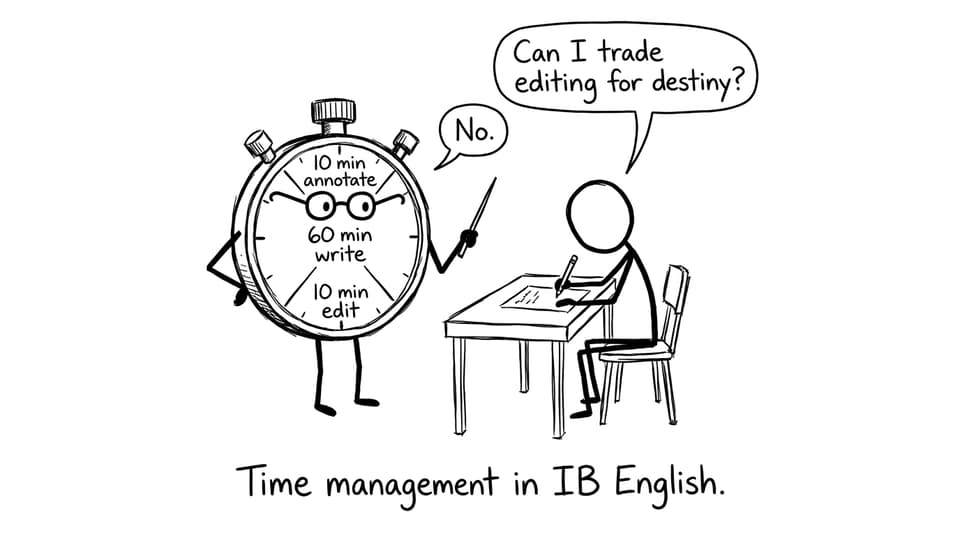
10 minutes annotate + plan
Main writing window (stay in motion)
Final 10 minutes edit
You can also simulate full exam conditions with RevisionDojo’s IB Predicted Papers and build stamina with realistic pacing.
A stopwatch coaches a student
Step 9: Turn mistakes into tools (not guilt)
After each practice, write down:
One strength to repeat
Two habits that cost marks
One sentence you’d rewrite
Then convert recurring issues into memory prompts. RevisionDojo’s Flashcards feature is perfect for things like “avoid summary openings” or “name effect on reader,” so your weakest patterns stop reappearing.
Step 10: Use feedback that resembles the marking process
The fastest improvement in IB English comes from feedback tied to criteria.
A strong loop looks like:
Write a timed response
Get it graded using examiner-style language
Rewrite one paragraph to a higher band
RevisionDojo supports this with AI Chat for quick clarification, Grading tools for written responses, Questionbank practice, Study Notes, Flashcards, and Mock Exam-style rehearsal through predicted sets. The point is simple: practice only counts when you review it well.
The best IB English writers don’t wait to feel ready. They rehearse readiness until it becomes familiar.
Use the 10 steps as your default loop: annotate for patterns, choose a few features, write a method-based thesis, build clear paragraphs, and edit with purpose. Then let RevisionDojo carry the heavy logistics: Questionbank drills, Study Notes, Flashcards, AI Chat, Grading tools, Predicted Papers, Mock Exams, a Coursework Library, and Tutors when you want human guidance.
If you want to start today, open the IB English A Lang & Lit Resources page, pick one timed task, and run the process once. In IB English, confidence isn’t a mood. It’s a repeatable method.