

A marker once described a strong IB Math IA as “a guided walk, not a box of receipts.” That line stuck with me because it explains why so many solid explorations still underperform: the mathematics may be correct, but the reader gets lost.
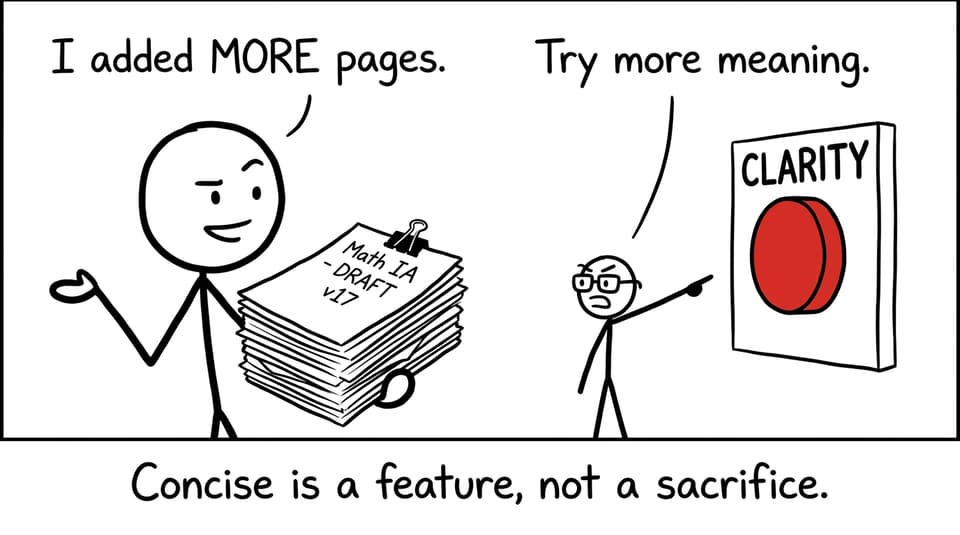
If you want your IB Math IA to feel calm, convincing, and easy to award marks to, you need two things: a clean structure and ruthless clarity. The good news is that both are editable skills. Below is a practical framework (built for real deadlines) to help you write a clearer, more concise IB Math IA using RevisionDojo.
A quick IB Math IA clarity checklist
Before you rewrite a single paragraph, run this checklist:
-
Your aim/research question appears on page 1 and is echoed later.
-
Your sections follow one storyline (context, method, math, results and reflection).
-
Every equation is introduced, then explained in words.
-
Graphs/tables sit next to the paragraph that interprets them.
-
You reflect on assumptions, limitations, and what you would change.
If you need a reliable structure template, borrow one from How to Structure Your IB Math IA Logically and compare it to your draft.
Start with a sharp, focused research question (IB Math)
A clear research question does more than “sound specific.” It forces decisions: what data matters, what mathematics you will use, and what you can reasonably conclude.
A strong IB Math question is usually:
-
Narrow enough to answer within 12-20 pages
-
Mathematical (not just descriptive)
-
Built for reflection (assumptions you can critique)
If you are still choosing, scan The Best IB Math IA Topics for 2025 and then commit to one sentence you can defend.
Build structure that reads like a story, not a folder
Most students “have headings,” but the IA still feels jumpy. The missing ingredient is transition logic: tiny bridge sentences explaining why the next step exists.
A reliable IB Math IA layout looks like:
-
Introduction & rationale (hook + aim + why it matters)
-
Method + data/model (what you did and why it fits)
-
Mathematical exploration (derivations, calculations, justification)
-
Results + interpretation (what the math means)
-
Conclusion + reflection (limits, improvements, extensions)
For a more examinator-friendly flow, use the guidance in How to Structure the IB Math IA for Maximum Clarity and mirror its “walkthrough” pacing.
Communicate mathematics with precision (without sounding robotic)
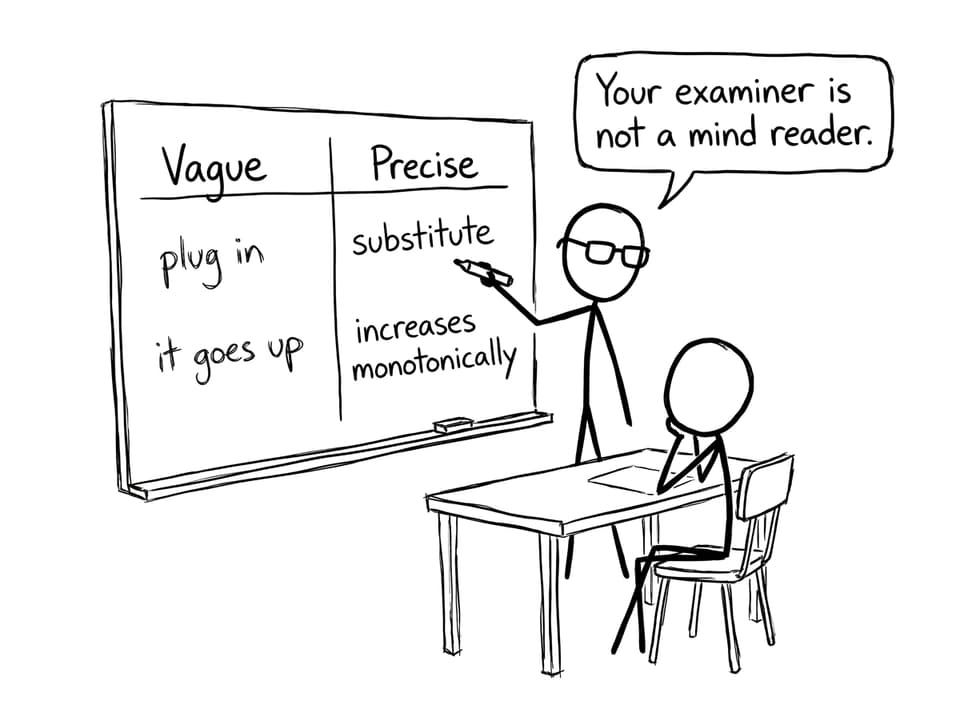
Clarity in IB Math is often lost in tiny phrases. Replace casual language with mathematical intent.
Try edits like:
-
“plug in” -> “substitute”
-
“it goes up” -> “increases monotonically over the interval”
-
“we can see” -> “this suggests, because…”
If you want examples of high-scoring commentary tone, steal patterns from IB Math: 10 Tips for a Strong IA Commentary.
Put visuals where the thinking happens
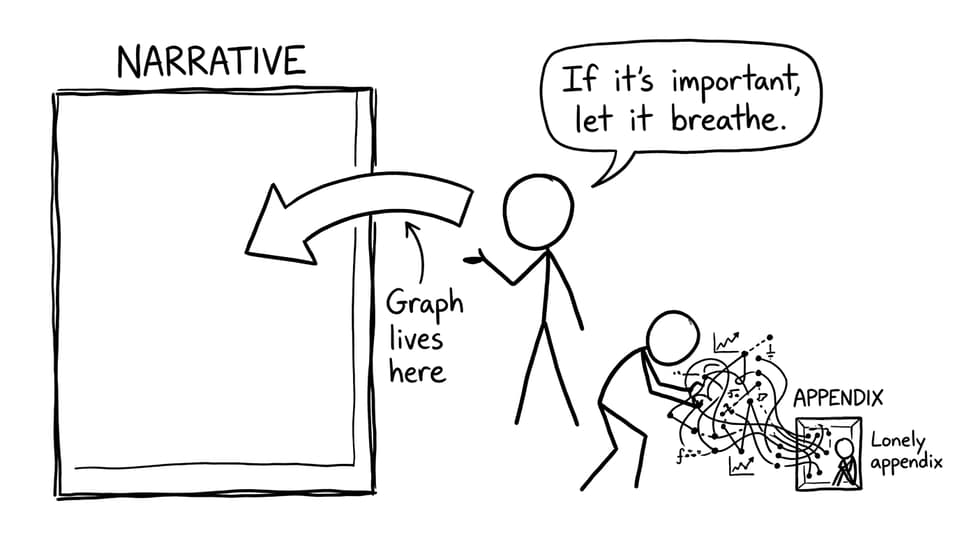
The fastest way to lose clarity is to exile important graphs to the back. In a strong IB Math IA, visuals are part of the argument.
Place each graph/table immediately beside:
-
what it shows,
-
what decision it triggers (model choice, parameter estimate, outlier handling), and
-
how it links back to the aim.
For data-heavy explorations, follow the workflow in How to Use RevisionDojo to Prepare for IB Math IA Data Analysis and How to Use Data Effectively in Your IB Math IA.
Use RevisionDojo to tighten drafts (and protect marks)
When your IA is messy, the fix is rarely “do more math.” It is usually “make the math legible and defensible.” RevisionDojo helps you do that with a full workflow:
-
Use the Study Notes and Flashcards to keep definitions and notation consistent.
-
Practice the techniques you rely on using the Questionbank (so your steps are clean under pressure).
-
Run explanations through AI Chat to test whether your reasoning is actually understandable.
-
Use Grading tools to spot where communication and reflection are thin.
-
Compare against real standards in the Coursework Library (exemplars).
-
If you want human feedback, connect with Tutors for targeted edits.
Helpful next reads:
Final thought: make IB Math easy to follow
A high-scoring IB Math IA is rarely the one with the most complicated technique. It is the one that makes the examiner feel safe: safe that your aim is focused, your steps are justified, your graphs are readable, and your reflection is honest.
When you are ready to tighten your draft, open RevisionDojo and run the loop: Study Notes -> Questionbank -> AI Chat -> Grading tools -> Coursework Library. Your IB Math improves fastest when clarity becomes your default, not your last-minute edit.