

If you have ever read a headline about AI, surveillance, or social media and felt two opposite things at once--this matters and I have no idea where to start--then you already understand why IB Digital Society is built on inquiry.
The course is not asking you to memorize a frozen list of “facts about technology.” Digital systems change too quickly for that. Instead, IB Digital Society trains you to do something more durable: ask good questions, investigate evidence, and evaluate the human consequences of digital life.
In exams, that mindset becomes a competitive advantage. When you can run an inquiry cycle under pressure, unfamiliar case studies stop feeling like traps and start feeling like opportunities.
A quick checklist: what inquiry looks like in IB Digital Society
Use this mini-checklist whenever you revise IB Digital Society (or when you see a new stimulus in an exam question):
-
Identify the digital system (platform, tool, policy, algorithm, network).
-
Define the context (place, group, time period, regulation, culture).
-
Ask an open inquiry question (not a “what is…” question).
-
Select evidence (specific examples, stakeholder claims, relevant data).
-
Analyze impacts (what changed?) and implications (so what might follow?).
-
Compare perspectives (who benefits, who loses, who decides?).
-
Evaluate (trade-offs, ethics, uncertainty, possible interventions).
If you want a home base for resources while you practise this, start with the IB Digital Society Resources hub.
What “inquiry” really means in IB Digital Society
In IB Digital Society, inquiry is a structured investigation into how a real digital system shapes people and communities. It is disciplined curiosity.
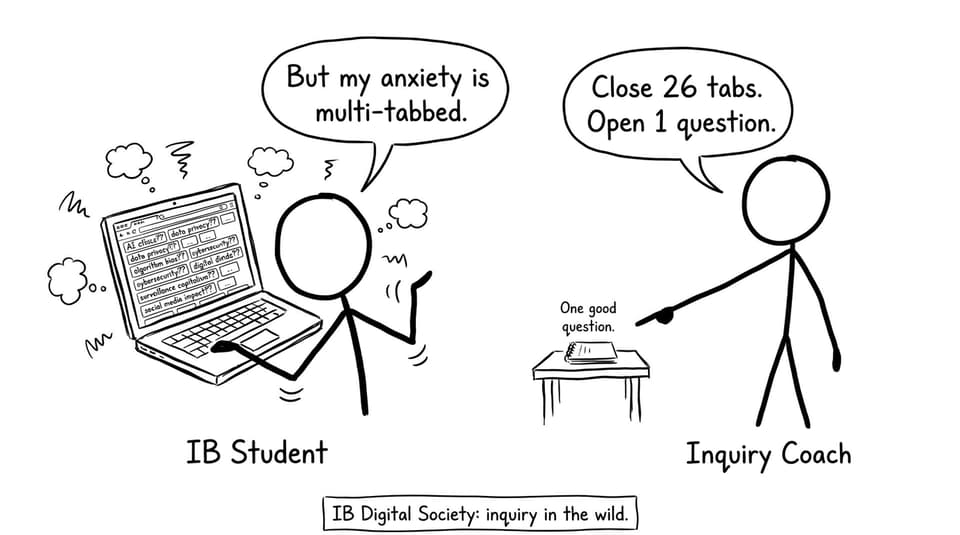
That word “structured” matters. Inquiry is not the same thing as collecting lots of information. The strongest students often use fewer sources than everyone else, because they choose evidence that actually helps them reason.
A useful way to remember it: in IB Digital Society, inquiry is a method for turning “interesting tech news” into “marks on a page.”
Why inquiry sits at the center of IB Digital Society (and the exam)
Digital Society rewards students who can think in moving water.
A platform updates its policies. A recommendation system shifts what content gets amplified. A government introduces new regulation. The surface details change, but your inquiry skills still work: you can test claims, map stakeholders, and evaluate consequences.
That is why the course emphasizes:
-
Complexity over simple “technology is good/bad” conclusions
-
Transfer to unseen examples in exam prompts
-
Independent thinking grounded in evidence
-
Ethical reasoning that considers power, access, and accountability
For a quick way to organize your thinking across any case study, keep the themes nearby: IB Digital Society: Key Themes Explained.
The inquiry cycle explained simply
Most strong answers in IB Digital Society follow an inquiry cycle, even if you do not label the steps.
Start with a real digital system (not a category)
Pick something specific: a particular social platform feature, a biometric ID rollout, a school proctoring tool, an AI chatbot in customer service.
Specific systems create specific impacts, which gives you something real to analyze.
If you are building your content knowledge at the same time, RevisionDojo’s syllabus-aligned notes help you move faster without drowning in detail, especially in Topic 3: Content and the Topic 4 contexts notes.
Ask inquiry questions that demand analysis
A strong IB Digital Society inquiry question is open-ended, focused, and tied to a concept like power, identity, change, or responsibility.
Try stems like:
-
“To what extent does __ shift power between __ and __?”
-
“How does __ reshape participation for __ in __ context?”
-
“What trade-offs emerge when __ is used to __?”
If your questions feel vague, it can help to learn how IB-style questioning works more generally: Teaching with Concept-Based Questions.
Investigate impacts and implications (the “what” and the “so what”)
Impacts are observable effects: behavior changes, access changes, new risks.
Implications are what those impacts might lead to: longer-term inequality, normalization of surveillance, trust erosion, new opportunities for civic action.
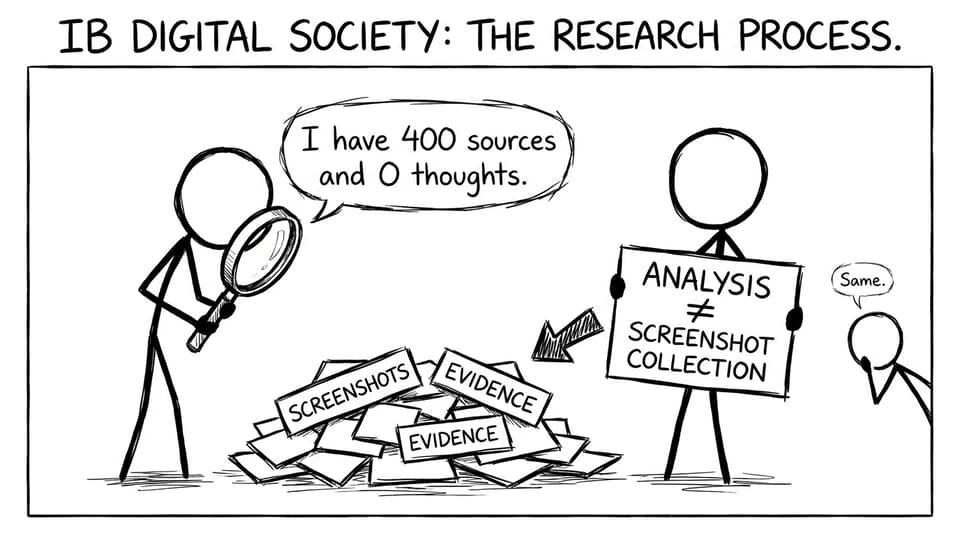
This is where students often lose marks by describing instead of analyzing. A good fix is to practise with targeted prompts and immediate feedback using the RevisionDojo Questionbank.
Consider perspectives like a stakeholder map
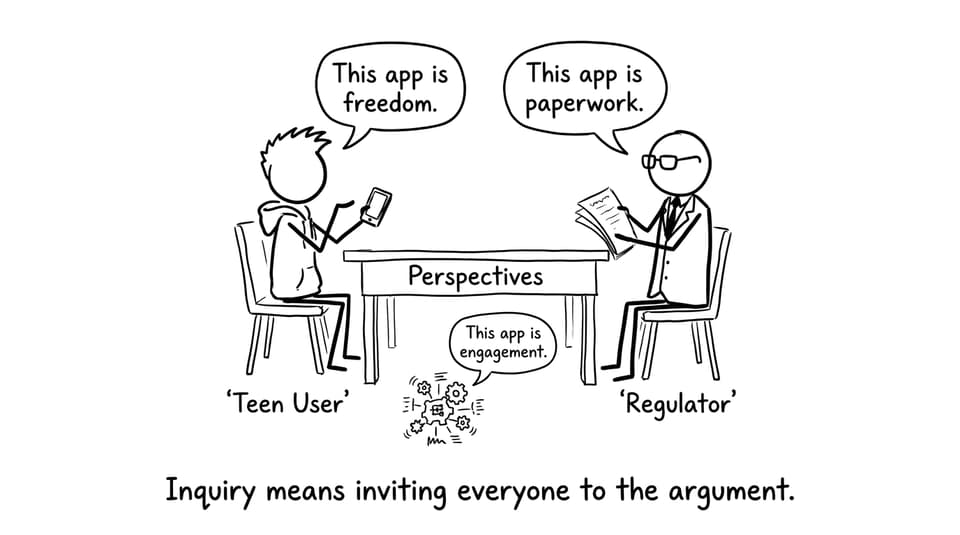
Inquiry in IB Digital Society is incomplete without perspectives. Your goal is not to “sit on the fence,” but to show you can reason from multiple positions.
Stakeholders might include users, non-users affected indirectly, platform designers, advertisers, regulators, schools, employers, activists, and marginalized communities.
If you want a realistic sense of what students struggle with here (and how to fix it), read Common challenges IB Digital Society students face.
Reflect and evaluate (where top-band answers live)
Evaluation is where you weigh trade-offs, acknowledge uncertainty, and make a justified judgement.
Useful evaluation moves in IB Digital Society include:
-
comparing short-term benefits vs long-term harms
-
identifying who carries the risk vs who gains profit or power
-
testing whether an intervention is realistic in the given context
-
naming limitations in evidence (bias, missing data, changing conditions)
To sharpen your conceptual lens for evaluation, the change concept is especially high-value: Understanding Change in Digital Society.
How to practise inquiry fast for exams
Inquiry is a skill. Skills improve through repetitions that are small enough to finish.
A simple routine many IB Digital Society students can sustain:
-
10 minutes: skim one concept or context in notes
-
20 minutes: do a short Questionbank set on that idea
-
10 minutes: write an “error rule” (what you missed and how to fix it)
-
5 minutes: convert 3 key ideas into flashcards
If you want a broader structure for your revision workflow, see Ultimate Survival Guide for IB Digital Society Students and pair it with Effective Note-Taking Tips for IB Digital Society.
On RevisionDojo, this routine becomes smoother because the tools connect: Study Notes and Flashcards for recall, Questionbank for application, AI Chat for quick clarification, and Grading tools plus Predicted Papers and Mock Exams when you want exam-pressure practice.
Closing thought: inquiry is your advantage in IB Digital Society
The quiet secret of IB Digital Society is that you do not need to predict the exact example that will appear in your exam. You need a process that works no matter what appears.
Inquiry is that process.
If you want to train it efficiently, build your loop inside RevisionDojo: learn with Study Notes, practise with the Questionbank, lock in precision with Flashcards, clarify confusion with AI Chat, and level up with Grading tools, Predicted Papers, Mock Exams, the Coursework Library, and Tutors when you want human feedback. Start at the IB Digital Society Resources hub and practise one good question today.