


The hardest part of IA and EE deadline season is rarely one dramatic task. It is the accumulation of small obligations: a draft, a reflection meeting squeezed into lunch, a moderation question, an anxious email, and a lesson still waiting to be planned.
Managing teacher workload in IA and EE season requires clear feedback limits, a visible triage system, protected marking blocks, shared expectations, and a firm stopping time. The aim is to complete the work that needs your professional judgment without allowing deadline pressure to occupy every evening.
A quick workload protection checklist
Before the busiest weeks begin:
- Map IA, EE, reporting, moderation, and mock deadlines on one calendar.
- Define what feedback you will provide, when, and in what format.
- Set supervision and marking windows instead of working on demand.
- Ask students to submit a specific question with each draft.
- Use cohort feedback for recurring issues.
- Escalate missed milestones through the school’s agreed process.
- Protect an evening cutoff and at least one work-free weekend day.
- Ask leadership to resolve workload collisions.
Boundaries are easier to uphold when they are agreed before everything feels urgent.
See the season as a capacity problem
Counting submissions alone understates the work. Two polished drafts may take less time than one with missing references, unclear data, and no identifiable question.
Build a workload map recording student numbers, submission stages, feedback depth, moderation duties, meetings, and administration. Estimate the time honestly: twelve drafts at 30 minutes each require six hours before email or follow-up conversations.
A map makes overload visible. It gives your DP coordinator or head of department something more useful than “This week is impossible”: scheduled work that exceeds available non-contact time. Where possible, plan collectively. RevisionDojo for IB teachers and departments describes ways to share resources and assessment workflows across a team.
Triage by consequence, not anxiety
The most anxious student is not automatically the highest priority. Nor is the fullest inbox. Sort work into three groups:
- Time-critical and consequential: authentication concerns, required supervision records, moderation, safeguarding issues, or a submission blocked by a decision.
- Important but schedulable: draft feedback, reflection meetings, criterion clarification, and departmental standardization.
- Student-owned: proofreading, routine formatting, citation organization, and checking requirements already explained.
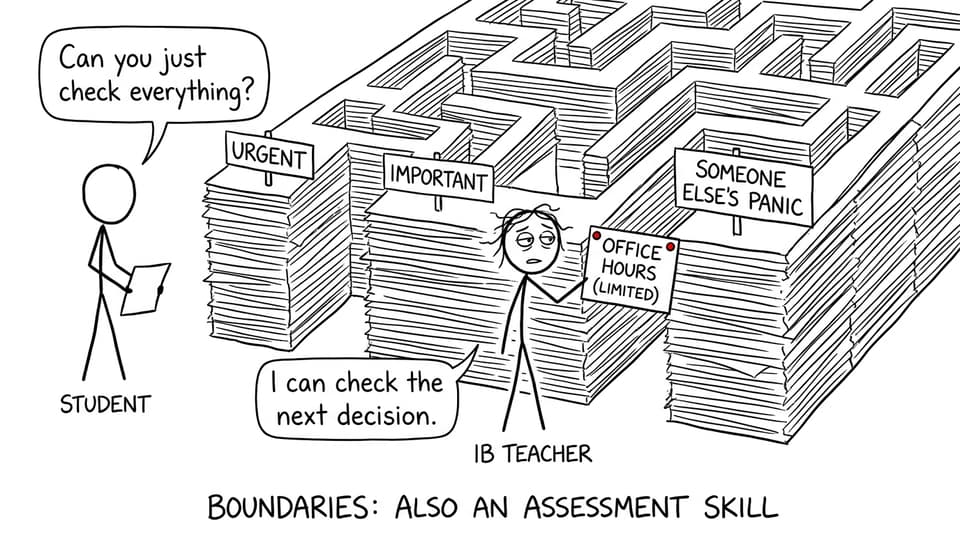
This protects teacher time and student independence. When a student asks, “Can you check everything?”, ask which criterion or decision needs attention. A focused question makes better use of supervision than a request to transfer responsibility.
Put a boundary around feedback
Feedback expands to fill the time available. You might spend 20 minutes identifying the most consequential weakness or 90 minutes refining comments. Students may not benefit proportionally from the extra hour.
Government workload research in England has recommended feedback that is meaningful, manageable, and motivating, including verbal feedback, codes, selective marking, and whole-class approaches where appropriate. The lesson for IA and EE supervision is to make feedback useful, not merely long.
Before opening a draft, establish a feedback contract:
- Review an agreed draft or stage, subject to current IB and school rules.
- Set a time limit and identify two or three priorities.
- Connect comments to criteria instead of editing every sentence.
- Avoid correcting the same issue repeatedly once it has been explained.
- Return incomplete or incorrectly formatted files for correction before review.
Requirements differ by component, subject, and assessment session. Check the current guide and school policy rather than relying on memory. RevisionDojo’s IA guides and rubric resources and Extended Essay guides can help students prepare, while official requirements remain the final authority.
Batch the work and close the door
Fragmented marking forces you to reconstruct each student’s question, evidence, and place in the rubric after every interruption.
Create marking blocks with a defined output, such as four introductions or one criterion across a class. Working on the same criterion across several submissions can support consistency. Keep common comments for recurring weaknesses, but personalize the decision each student needs to make next.
Then set an endpoint: perhaps no coursework after 7:00 p.m., no email after dinner, or one protected weekend day. Put it in the calendar. If the work cannot fit, seek reprioritization, redistribution, or leadership support rather than automatically extending into personal time.
Use meetings to create decisions
A meeting without a purpose can become a tour through everything the student fears. Ask for three things beforehand: the current research question or aim, the decision blocking progress, and the relevant evidence, data, or paragraph.
For the EE, IB guidance includes three formal reflection sessions and recommends a bounded period of supervision across the process. Structure the time accordingly. Record the decision, the student’s next action, and the next checkpoint; do not carry the student’s task away with you.
Students can prepare through IA support and feedback workflows, relevant models in the Coursework Library, and criterion-level coursework feedback as a diagnostic aid. Automated feedback cannot replace teacher judgment, official criteria, or student authorship. It is most useful when it helps students bring precise questions to supervision.
Reduce the work surrounding the work
Coursework becomes difficult to manage when planning, testing, revision, email, and administration continue unchanged around it.
RevisionDojo’s Questionbank, Study Notes, Flashcards, and AI Chat can help students handle routine practice and content questions independently. Predicted Papers and Mock Exams support exam rehearsal without requiring every teacher to build each resource from scratch. Grading tools and the Coursework Library can help students diagnose issues before seeking individual feedback; Tutors offer human help when a learner needs sustained explanation.
Explore RevisionDojo’s IB study features and its guide to saving time on lesson materials. The point is to reserve limited teacher time for decisions that genuinely require expertise, not to add another system to monitor.
Make workload a school responsibility
Surviving deadline season should not depend on personal endurance. Coordinators and leaders shape whether deadlines collide, supervision is distributed fairly, and staff have time for marking and moderation.
Raise capacity concerns early. Ask which deadline can move, meeting can be cancelled, task can be standardized, or moderation duty can be shared. If several teachers face the same bottleneck, treat it as a process problem. After the season, record submission clusters, repeatedly misunderstood instructions, and avoidable administrative work. Use that evidence to improve next year’s calendar.
Protect the person doing the work
Dependability has a hidden cost: people may come to expect you to absorb what the system did not plan. Protecting personal time means preserving the attention that good teaching and fair assessment require.
Set the feedback contract, batch the work, stop at the planned time, and make excess demand visible. RevisionDojo is the ultimate IB resource when its tools help students work independently and leave teachers more time for the judgment only a skilled educator can provide.