


There is a particular kind of tiredness that arrives during IB exam season. It comes from holding consequential details at once: student anxiety, predicted grades, assessment administration, revision planning, examination logistics, and the fear that something important has been missed.
Effective teacher self-care exam season practice is not about adding yoga to an impossible schedule. It starts by reducing avoidable work, containing what remains, and protecting enough recovery to make sound professional decisions. Sleep, movement, food, and connection matter, but they work best alongside systems that remove repetitive tasks.
That distinction matters because burnout is not evidence that a teacher has failed at resilience. The World Health Organization describes burnout as an occupational phenomenon associated with chronic workplace stress that has not been successfully managed. The practical response must include changes to the work, not only the person doing it.
A practical exam-season self-care checklist
Use this as a weekly reset rather than another list to complete perfectly:
- Choose three genuinely essential outcomes for the week.
- Batch similar marking instead of switching repeatedly between tasks.
- Define a daily stopping time before beginning work.
- Replace repetitive individual explanations with shared resources.
- Protect one uninterrupted meal and one movement break each day.
- Ask for a specific task to be redistributed when capacity is exceeded.
- Notice sustained exhaustion, cynicism, or reduced confidence early.
- Seek professional support if stress is affecting normal functioning.
The goal is not to feel relaxed throughout exam season. It is to remain functional, humane, and capable of recovering.
Start by reducing the load
Self-care advice often begins at the wrong end. It asks how teachers can tolerate more pressure rather than whether every task deserves to exist.
Before accepting another piece of work, classify it:
| Category | Practical response |
|---|---|
| Essential and time-sensitive | Schedule it during your highest-energy period |
| Essential but shareable | Delegate, standardize, or complete collaboratively |
| Useful but not urgent | Move it beyond the examination window |
| Repetitive and low-value | Automate, simplify, or stop doing it |
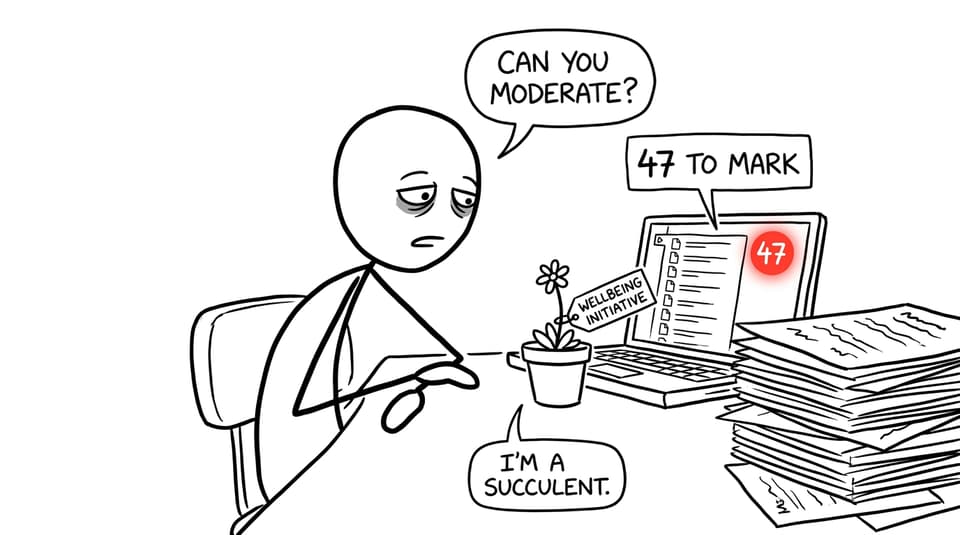
This is particularly important for marking. Personal coping techniques can influence how pressure feels, but they cannot make unnecessary work necessary.
Not every practice response requires individual written feedback. Students can sometimes self-assess against one criterion, compare an annotated model, and write their own correction. Teachers can then intervene where professional judgment has the greatest value.
RevisionDojo’s guide to reducing IB marking workload explains how batching, rubric-led comments, and structured practice can reduce repetition. The purpose is not to withdraw feedback. It is to stop spending expert time on feedback students can generate or interpret independently.
Protect decision-making energy
Exam season contains dozens of small choices. Which misconception should be retaught? Which student needs a conversation? Which task should be marked first? Their accumulation is exhausting.
Make recurring decisions once. Set fixed windows for marking, email, student questions, and revision planning. Use consistent feedback codes for recurring problems. Agree departmental interpretations before several teachers assess the same task. When finishing for the day, leave tomorrow’s first action visible.
Assessing the same question or criterion across a group before moving to the next can reduce context switching and make differences between responses easier to recognize.
RevisionDojo’s IB IA feedback guide recommends making the criterion visible, identifying the highest-impact issue, and resisting the temptation to edit every weakness. Where appropriate, coursework grading tools can provide an initial criterion-level diagnostic. Teachers should still check suggestions against current IB documentation, permitted-feedback rules, and their own professional judgment.
Use boundaries that survive difficult weeks
A boundary that works only during a calm week is not much of a boundary.
Choose rules that remain possible when the calendar becomes crowded. Stop marking at a fixed time, keep one evening free from school communication, or avoid beginning a batch when there is insufficient time to finish it thoughtfully. Tell students and colleagues what response time they can reasonably expect.
Stopping with work unfinished can feel irresponsible. Yet exam-season work is often functionally infinite. If stopping depends on completing everything, stopping will never arrive.
Use a 5-10 minute closing routine:
- Record what was completed.
- Write the next physical action for each live task.
- Move unfinished work into a named time block.
- Close school platforms and silence notifications.
This gives the brain evidence that unfinished work has not been forgotten and makes the next morning less cognitively expensive.
Make student independence part of self-care
One of the healthiest workload changes is to stop being the only route to an answer.
Students can use RevisionDojo’s IB resources to follow a structured learning loop. Study Notes clarify a narrow topic, Flashcards support retrieval, and the Questionbank provides targeted application. AI Chat can address routine confusion before it becomes another queue of identical emails.
Predicted Papers and Mock Exams provide structured rehearsal without requiring teachers to build every resource from the beginning. They are simulations, not guarantees. For coursework, Grading tools and the Coursework Library can help students understand criteria and examples before requesting individual intervention. Tutors offer human support when a learner needs sustained assistance beyond what one classroom teacher can provide.
The RevisionDojo guide for IB teachers and departments shows how these tools can connect practice, feedback, and class-level analysis. Technology does not replace teacher judgment. Used carefully, it prevents that judgment from being consumed by repetitive preparation.
In RevisionDojo’s 2026 State of Learning Survey of 2,975 students and teachers, 60.2% of teachers reported a 31.8% relative reduction in average stress after using RevisionDojo, from 3.47 to 2.36 on a 1-5 scale. These are self-reported, observational findings from RevisionDojo’s own survey. They do not prove causation, but they support examining whether reduced routine friction can create more room for expert work.
Make recovery ordinary and scheduled
Recovery often fails because it is treated as a reward for finishing. During exam season, there may be no natural finish point.
Protect the basics first. Eat before convenience makes the decision. Take a short walk without answering messages. Maintain a stable sleep window where possible. Keep contact with someone who can discuss something other than assessment.
Ask, “What is the smallest form of recovery I can protect repeatedly?” Ten minutes outside each day may be more useful than an ambitious plan abandoned after Tuesday.
Collegial support matters too. Ask someone to compare one difficult judgment, share a reusable resource, or identify what can wait. Support is especially valuable when it changes the task rather than merely offering sympathy.
Recognize when self-management is not enough
Avoiding teacher burnout during exams requires honesty about the limits of individual action. Persistent exhaustion, cynicism, emotional detachment, and reduced professional confidence should not be normalized as the price of caring about students.
If stress is disrupting sleep, relationships, concentration, physical health, or daily functioning, speak to an appropriate school leader, employee support service, union representative, doctor, or qualified mental health professional. When workload is the problem, identify the task, deadline, and adjustment that would help.
Sustainable teaching is still excellent teaching
Useful exam-season self-care is rarely glamorous. It is a protected stopping time, a shared rubric, a meal away from a screen, a task removed from the week, or a student who can find the next step without waiting for you.
RevisionDojo supports that calmer model of IB teaching. Its Questionbank, Study Notes, Flashcards, AI Chat, Grading tools, Predicted Papers, Mock Exams, Coursework Library, and Tutors create more routes for independent practice. For schools, RevisionDojo’s teacher platform can centralize assessment creation, feedback, and progress analysis.
Good self-care does not ask committed teachers to care less. It helps them spend finite energy where care, expertise, and human judgment matter most.