
When a theory feels like a shortcut (and why it isn’t)
In IB Global Politics, theories can feel like the closest thing to a cheat code: pick a lens, explain the event, collect the marks. But the best students learn something subtler. A theory is less like an answer and more like a flashlight. It illuminates part of the room, and the brighter it shines on one corner, the darker another corner becomes.
That’s exactly why examiners reward students who can explain the strengths and weaknesses of global politics theories. Not because they want you to memorise labels, but because they want you to show judgement.
Quick checklist: how to use theories in IB Global Politics exams
Use this as your default move in IB Global Politics essays and Paper 1/3 responses:
-
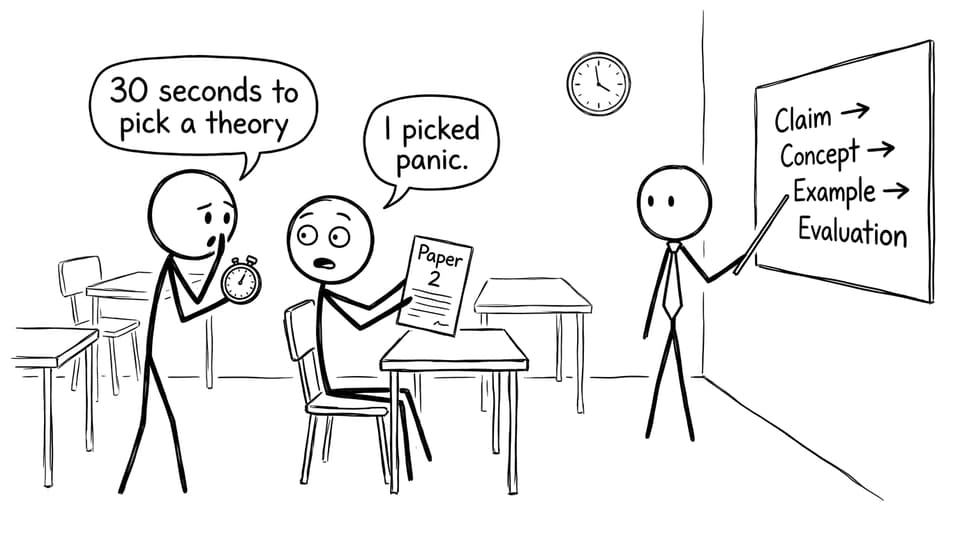
Name the theory only after you’ve made a clear claim.
-
Link it to a core concept (power, sovereignty, legitimacy, human rights, interdependence).
-
Add a tight case study detail (two to three facts that do work).
-
Evaluate: what does this theory explain well, and what does it miss?
-
If useful, bring in a second theory as a counter-perspective.
For practice prompts that force this skill, build a timed set in the Theoretical perspectives Questionbank and mark your own evaluation quality.
Strengths of global politics theories
Theories create structure under pressure
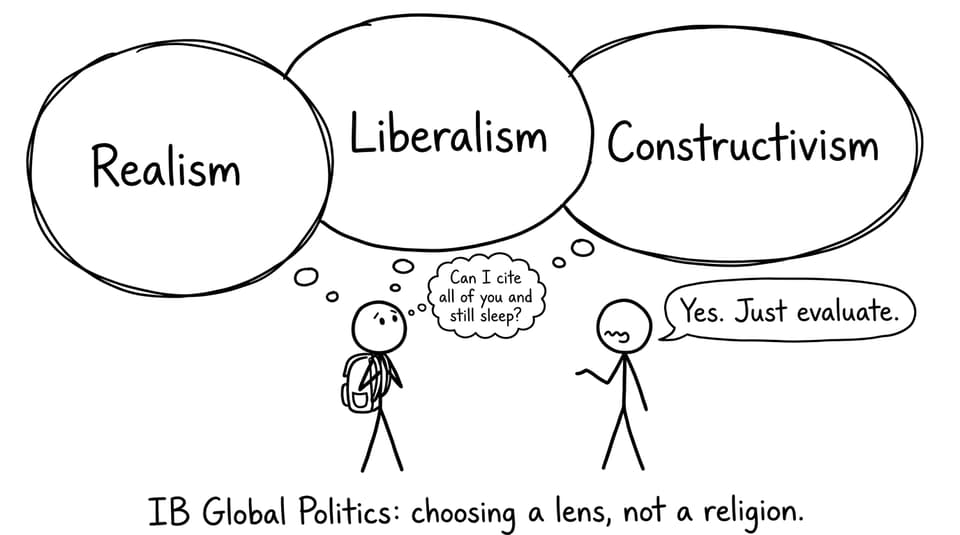
A major strength in IB Global Politics is that theories give you structure when the question feels broad. Realism pushes you to ask: who has power and what are their security interests? Liberalism pushes you to look for cooperation through institutions and rules. Constructivism reminds you that identities and norms can change what actors even want.
This structure is why RevisionDojo’s IB Global Politics Paper 2 Guide Notes and IB Global Politics Paper 1 Guide Notes emphasise clear conceptual framing before you start writing.
Theories make comparison and debate possible
Another strength: theories help you argue with yourself. In IB Global Politics, that’s the difference between description and evaluation. You can show how one perspective explains cooperation (liberalism), while another emphasises coercion and power inequality (realism). That contrast signals to an examiner that you understand global politics as contested.
To build this habit, pair your theory choice with a case study drill from How to Use Case Studies in IB Global Politics.
Theories reveal patterns beyond one event
Theories also help you see patterns: recurring security dilemmas, persistent inequality, or the slow spread of norms. That pattern-building strengthens essay coherence, especially if you revise by concept inside the IB Global Politics Resources hub.
Weaknesses of global politics theories
Oversimplification: the map is not the territory
The biggest weakness is that every theory simplifies. In IB Global Politics, simplification becomes dangerous when you flatten context. Realism can underplay ideology and identity. Liberalism can underestimate coercion, informal power, and unequal bargaining positions. Constructivism can sometimes struggle to specify when material constraints overpower norms.
A good way to train nuance is to revise one theme (like conflict) with a theory lens using Peace and Conflict and then test yourself with Core: Understanding power and global politics Questionbank.
Bias: every lens has blind spots
Theories also carry built-in priorities. Traditional theories often privilege states and formal institutions, while sidelining non-state actors, social movements, or local experiences. Critical perspectives can fix that, but may underplay strategic incentives or economic limits. In an exam, bias becomes a scoring opportunity: you can explicitly say what the theory foregrounds and what it marginalises.
Change and unpredictability
Global politics shifts quickly: technology, new actors, changing norms, sudden crises. Many theories explain stability better than transformation. That’s why high-scoring IB Global Politics answers treat theories as tools to interpret, not crystal balls to predict.
Conclusion: treat theories as tools, not truths
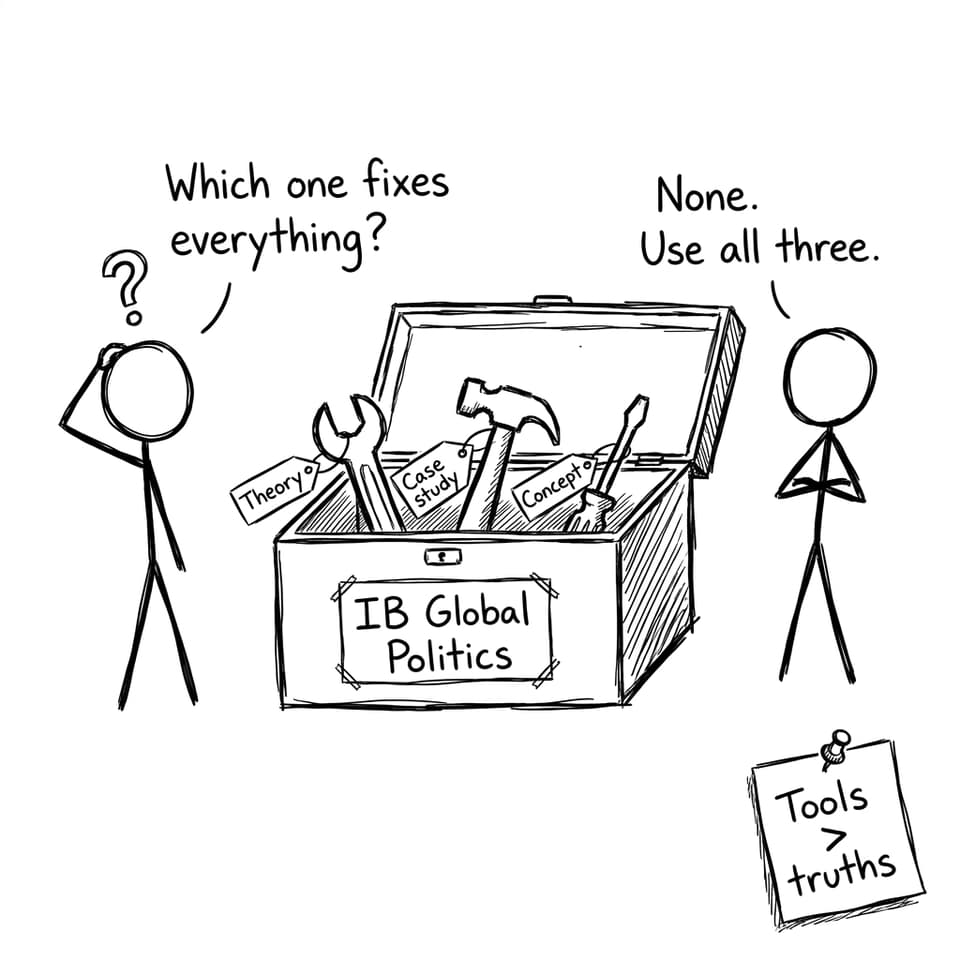
Theories in IB Global Politics are powerful precisely because they’re incomplete. Their strengths give you structure, comparison, and pattern recognition. Their weaknesses remind you to stay humble about complexity, context, and change.
If you want a one-stop system to practise this properly, use the IB Global Politics Resources hub with RevisionDojo’s Questionbank, Study Notes, Flashcards, Mock Exams, Predicted Papers, and Grading tools. The aim isn’t to sound theoretical. It’s to think clearly under pressure -- and prove it on exam day.
