
Stereoisomers are one of those IB Chemistry topics that feel unfair at first. You look at two structures, squint, rotate your paper, rotate the molecule in your mind, and still think: These are the same thing… right? Then the markscheme quietly says they are different, with different properties, different names, and different consequences in reactions.
The good news is that stereoisomers aren’t mysterious. They’re predictable. And in IB Chemistry, predictability is basically free marks.
A quick stereoisomers checklist (exam-ready)
Use this whenever a structure appears in IB Chemistry:
-
Do the molecules have the same molecular formula and same connectivity? If yes, think stereoisomers.
-
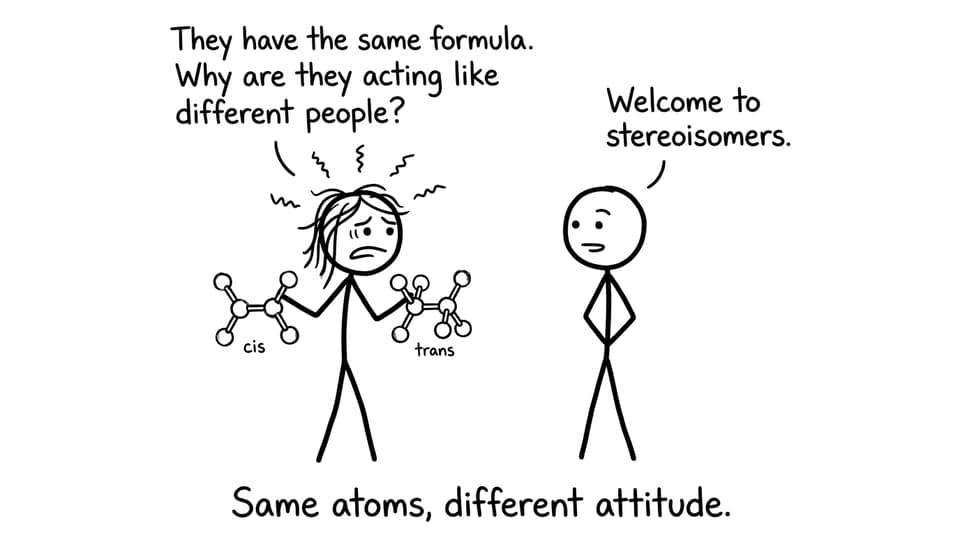
Is there restricted rotation (double bond or ring)? If yes, check cis-trans.
-
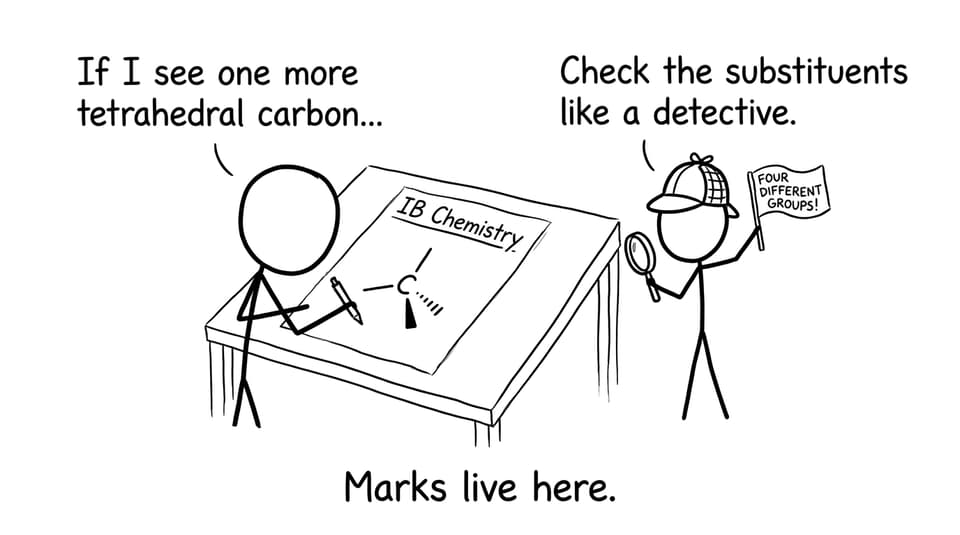
Is there a tetrahedral carbon with four different groups? If yes, check enantiomers.
-
Are you being asked for properties (polarity, boiling point, biological activity)? Link them to 3D shape.
If you want targeted practice on exactly what the syllabus expects, keep the S3.2.7 topic hub open while you revise: S3.2.7 Stereoisomers (HL only).
What are stereoisomers in IB Chemistry?
In IB Chemistry, stereoisomers are compounds that have the same molecular formula and the same structural formula (same atom connectivity), but their atoms are arranged differently in three-dimensional space.
That last phrase matters. Organic chemistry is full of situations where “small” spatial changes aren’t small at all. A molecule can have the same atoms connected in the same order, yet behave differently because the 3D arrangement affects polarity, stability, and how it fits into other molecules.
For a broader revision route through organic content, bookmark: IB Chemistry Organic Chemistry (HL).
IB Chemistry geometric stereoisomers (cis-trans)
Geometric stereoisomerism appears when rotation is restricted. In IB Chemistry, that’s most commonly:
-
Alkenes (the C=C contains a pi bond that “locks” rotation)
-
Cycloalkanes (the ring prevents free rotation)
When cis-trans isomerism is possible
A quick rule for IB Chemistry exams: each carbon of the double bond must have two different groups attached. If one carbon has two identical substituents, you can’t have cis-trans because swapping sides doesn’t create a new arrangement.
Cis vs trans in one clean idea
-
Cis: key substituents on the same side
-
Trans: key substituents on opposite sides
Why properties change
The classic IB Chemistry explanation uses polarity:
-
Cis is often more polar (dipoles don’t cancel as well), so it can have a higher boiling point.
-
Trans is often more symmetrical, sometimes more stable, and can be less polar.
If you want a clear reminder of why double bonds change structure and reactivity (and why geometric isomers show up at all), this post helps connect the dots: Why Do Hydrocarbons Vary In Structure And Reactivity?.
IB Chemistry optical stereoisomers (enantiomers)
Optical isomerism is the part of IB Chemistry where the molecule stops being a drawing and starts being an object.
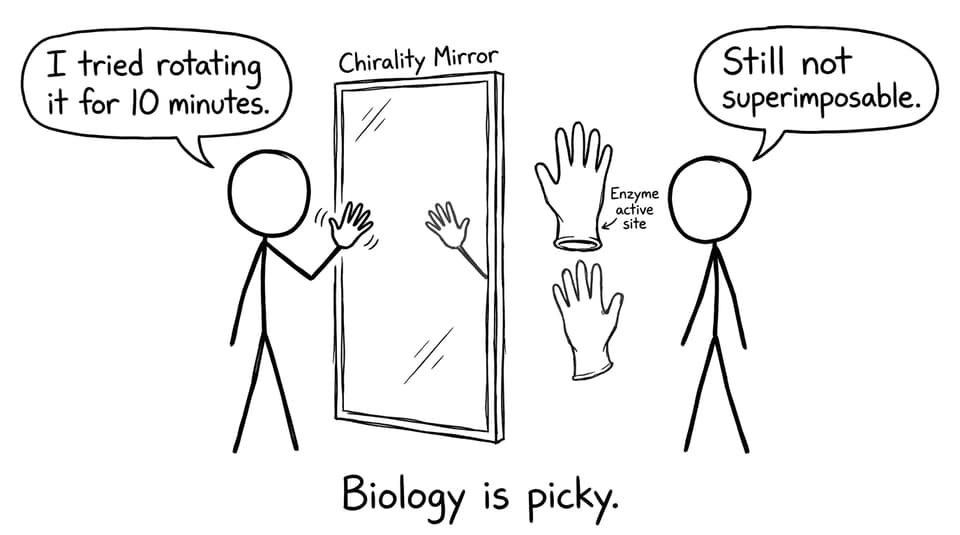
A molecule is chiral if it is not superimposable on its mirror image. The most common reason (and the one you need for exams) is a chiral centre: a carbon attached to four different atoms or groups.
Key enantiomer facts you should memorise
In IB Chemistry, enantiomers:
-
Are non-superimposable mirror images
-
Rotate plane-polarised light in opposite directions
-
Usually have identical melting/boiling points in non-chiral environments
-
Can behave very differently in biological systems (enzymes and receptors are chiral)
If chirality still feels slippery, revise it as a skill (a repeatable checking routine) here: IB Chemistry: Chiral Centres Explained Simply.
Why optical isomerism matters (the story examiners want)
Biology is shape-specific. A receptor is like a glove, not a bucket. So in IB Chemistry, it’s completely reasonable that two enantiomers can have dramatically different biological effects even if their “standard” physical properties look the same.
For HL students linking stereochemistry to biomolecules, use: B.10 Stereochemistry in Biomolecules Notes.
The most common IB Chemistry stereoisomer mistakes
These are predictable traps, which means you can avoid them.
Thinking all alkenes have cis-trans
They don’t. In IB Chemistry, you must confirm two different groups on each double-bond carbon.
Assuming enantiomers have different boiling points
Usually they don’t (in non-chiral conditions). In IB Chemistry, the big contrast is optical rotation and behaviour in chiral environments.
Forgetting what “different groups” means
Two substituents might start the same but differ further down the chain. In IB Chemistry, you must compare properly, not guess.
How to revise stereoisomers efficiently with RevisionDojo
Stereoisomers improve fastest when you practise in short, repeated bursts. Reading definitions helps, but marks come from recognising patterns under pressure.
-
Use the IB Chemistry 20.3 Stereoisomerism Questionbank to drill classification, drawing, and property questions.
-
If you learn best by watching first, use S3.2.7 Stereoisomers Videos.
-
Keep your foundations tight with the full syllabus hub: IB Chemistry Resources.
RevisionDojo also supports the way students actually revise: Study Notes for clarity, Flashcards for active recall, AI Chat for quick “is this chiral?” checks, Grading tools for feedback, Predicted Papers and Mock Exams for timing, and a Tutors option when you want a human to spot what you keep missing.
Conclusion: stereoisomers are quiet, dependable marks
Stereoisomers in IB Chemistry are simple once you trust the structure: same connectivity, different 3D arrangement. Cis-trans comes from restricted rotation (double bonds and rings). Enantiomers come from chirality and chiral centres. The properties questions aren’t random either: polarity and symmetry matter for geometric isomers, and biological fit matters for optical isomers.
If you want this to become automatic before exams, do it the way strong students do: one concept, then ten questions. Start with the Stereoisomerism Questionbank, reinforce with the S3.2.7 Stereoisomers topic page, and keep your IB Chemistry revision consistent on RevisionDojo.