
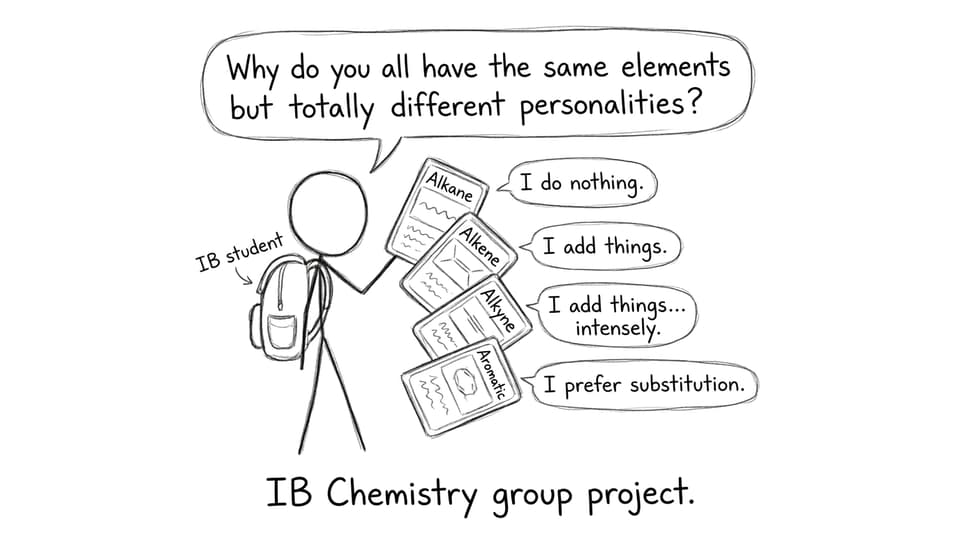
Hydrocarbons are the first time many IB Chemistry students feel betrayed by simplicity. Same two elements (C and H), yet one molecule sits there politely, another reacts instantly, and a third looks calm but secretly runs the whole industrial world.
That “personality change” is the point of organic chemistry: structure controls electron density, and electron density controls what reactions are possible (and how easily they happen). Once you see that, exam questions stop feeling random.
IB Chemistry checklist: what to spot in 10 seconds
Use this mini-checklist whenever a hydrocarbon appears in IB Chemistry:
-
Bond type: only single bonds, or a C=C / C≡C?
-
Shape: tetrahedral (alkanes), planar around C=C, linear around C≡C, or a ring?
-
Electron situation: localized bonds vs delocalized pi electrons (aromatic)?
-
Likely reaction: combustion, substitution, addition, or electrophilic substitution?
If you want a wider organic overview, pair this with Functional Groups Made Simple for IB Chemistry and the syllabus hub for IB Chemistry Organic Chemistry.
Why hydrocarbons vary in structure (carbon’s “LEGO” ability)
In IB Chemistry, carbon’s key advantage is bonding versatility:
-
Carbon forms four covalent bonds.
-
It catenates (bonds to itself), creating chains, branches, rings, and networks.
-
It forms single, double, and triple bonds, changing geometry and electron density.
Those structural choices aren’t cosmetic. They decide where electrons sit and how exposed they are to electrophiles and nucleophiles.
For naming and isomer spotting (a common exam trap), see IUPAC nomenclature notes.
Why hydrocarbons vary in reactivity: sigma vs pi vs delocalized electrons
Alkanes: stable and stubborn
Alkanes contain only sigma bonds (C-C and C-H). Sigma bonds are strong and relatively nonpolar, so alkanes have low reactivity in typical conditions. In IB Chemistry, you mainly meet them in:
-
Combustion (easy to write, great for energetics)
-
Free-radical substitution (often needs UV)
Combustion connections are worth marks: main product of complete combustion and incomplete combustion notes.
Alkenes and alkynes: pi bonds are “reactive handles”
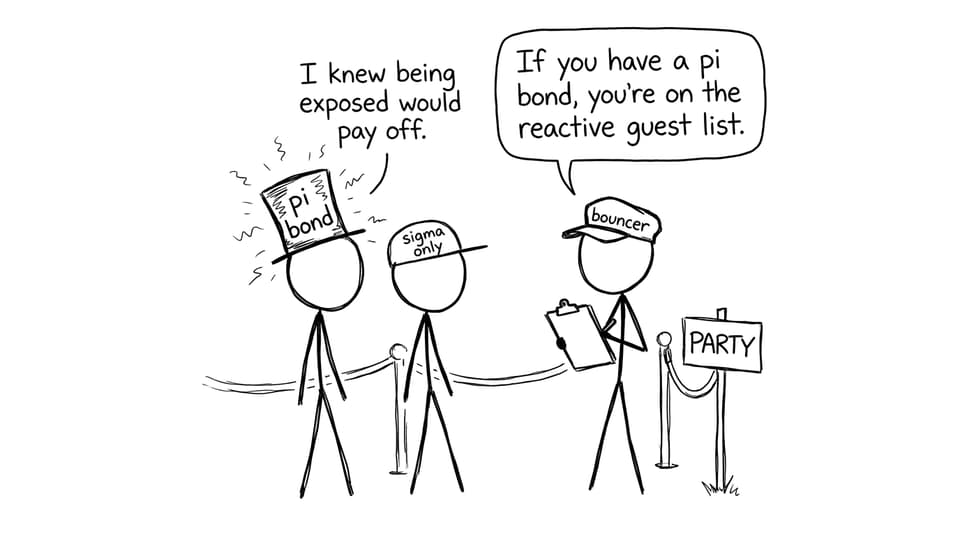
A double bond has one sigma and one pi bond; a triple bond has one sigma and two pi bonds. Pi bonds are more exposed and electron-rich, so they break and reform more readily, driving addition reactions.
That’s why a simple test question in IB Chemistry (like bromine water) can separate alkane vs alkene logic quickly: How to Tell Alkanes vs Alkenes Fast.
Aromatics: delocalization trades reactivity for stability
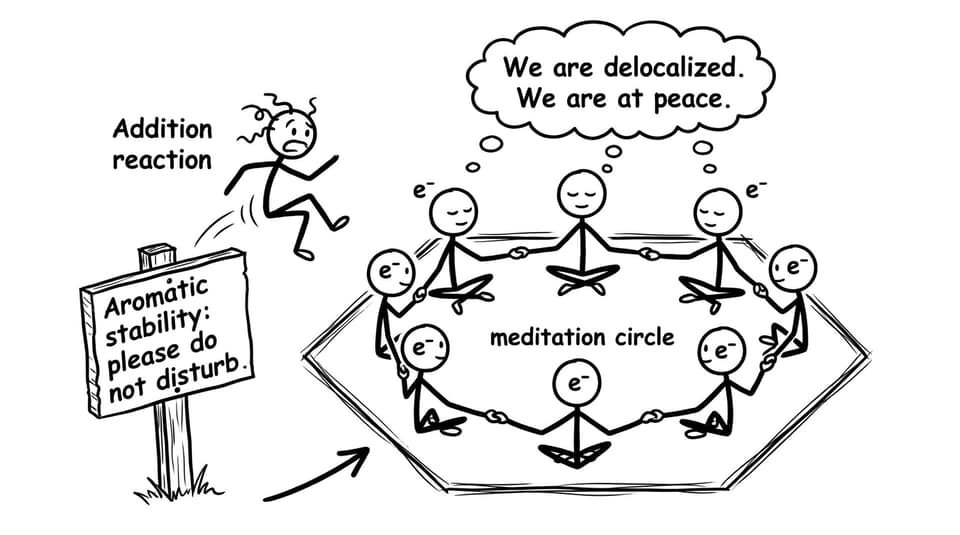
Benzene and other aromatics look like they “should” add across double bonds, but the ring has delocalized pi electrons that create extra stability. Addition would destroy that stability, so aromatics prefer substitution reactions that keep the ring intact.
For HL detail, use reactions between benzene and electrophiles notes.
Structure effects you can mention for extra marks (branching and industry)
Branching changes surface contact and intermolecular forces, influencing boiling points and sometimes combustion behavior. And in industrial contexts, structure is deliberately changed to control usefulness:
-
Reforming turns straight chains into branched/cyclic/aromatic molecules: Reforming Explained Simply
-
Cracking breaks long chains into shorter, more useful molecules: Polymer Cracking Explained Simply
Quick exam practice path (RevisionDojo)
To lock this into exam performance in IB Chemistry, do it in this order:
-
Read the core IB Chemistry Organic Chemistry Notes
-
Drill reaction patterns with Types of organic reactions notes
-
Then practise targeted questions in the IB Chemistry Organic Chemistry Questionbank (and the main IB Chemistry Questionbank)
RevisionDojo’s Study Notes, Flashcards, AI Chat, Grading tools, Predicted Papers, Mock Exams, and Tutors are designed to turn “I get it” into “I can do it under time pressure.”
Conclusion: one idea that ties it together
Hydrocarbons vary in structure and reactivity because carbon can build different frameworks, and those frameworks place electrons in different “neighborhoods,” hidden in sigma bonds, exposed in pi bonds, or stabilized by delocalization. If you learn to read those electron patterns, IB Chemistry organic questions become predictable.
Build that predictability with RevisionDojo: start from the Organic Chemistry Notes, practise with the Questionbank, and use AI Chat plus Flashcards to make reaction logic automatic before exam day.