


Chirality is one of those IB Chemistry topics that feels obvious right up until a question asks, “How many chiral centres are present?” and suddenly every carbon looks suspicious.
Here’s the calming truth: a chiral centre is not a mysterious “special carbon.” It’s just a carbon sitting at a four-way junction where each road leads somewhere different. Once you learn a reliable checking routine, chiral centres become one of the easiest marks in IB Chemistry stereochemistry.
What a chiral centre means in IB Chemistry
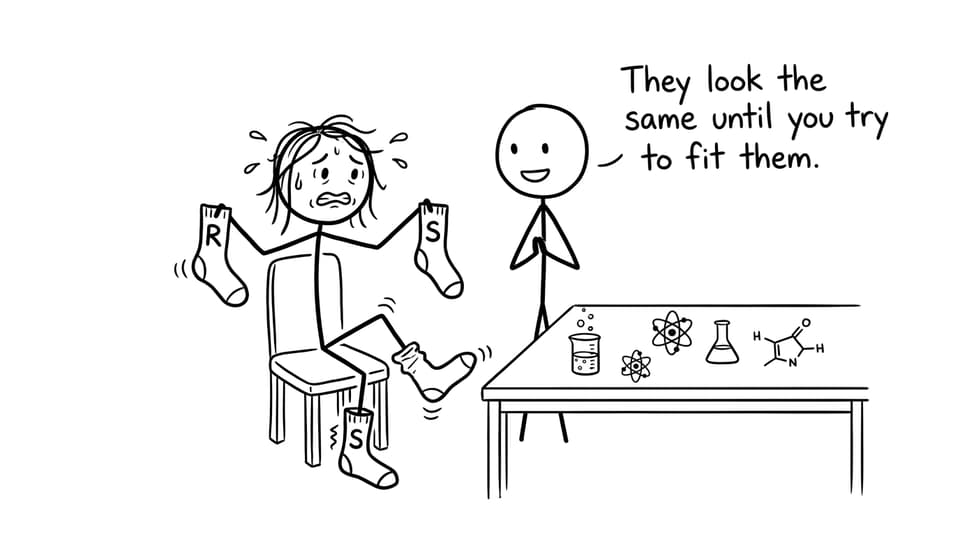
In IB Chemistry, a chiral centre (often called an asymmetric carbon or stereocentre) is a tetrahedral carbon attached to four different atoms or groups.
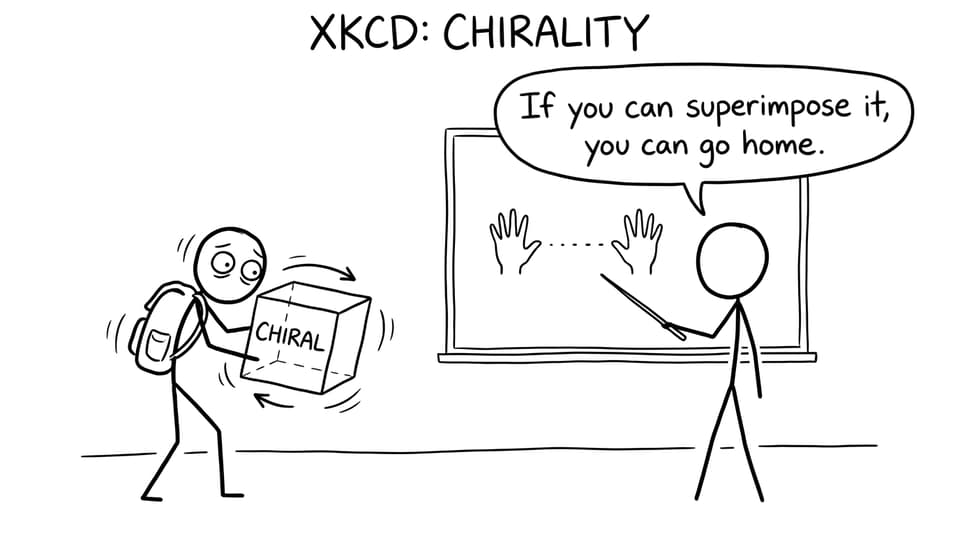
That “four different” condition is the whole game. When it’s met, the molecule can form two non-superimposable mirror images called enantiomers. Like left and right hands, they match in many ways, but you can’t rotate one to perfectly overlay the other.
If you want the clean exam wording and definitions in one place, keep the IB Chemistry Key Definitions open while you revise.
Quick checklist: how to spot a chiral centre fast
Use this mini-checklist whenever a structure appears in an IB Chemistry exam-style question:
-
Is the carbon sp3 (four single bonds, tetrahedral)?
-
Are the four substituents different?
-
If two substituents start the same, did you compare further along the chain?
-
If the carbon has a double bond anywhere on it (sp2), it is not a chiral centre.
For targeted stereochemistry practice, the S3.2.7 Stereoisomers topic page is built exactly around what IB Chemistry expects.
The IB Chemistry method: compare substituents like a detective
Students often lose time because they “eyeball” substituents. In IB Chemistry, you score more reliably by comparing systematically.
Start at the atoms directly bonded to the carbon
Look at the four atoms attached to the candidate carbon.
- If any two are the same (for example, two H atoms), stop: not chiral.
If two groups look similar, walk outward
Sometimes two substituents begin with the same atom (for example, two carbon chains). That does not automatically mean the groups are identical. Compare the next atoms along each path until a difference appears.
This is exactly why students get trapped by “looks like two methyls” errors. IB Chemistry questions love that trap.
For extra drills, RevisionDojo’s Questionbank inside IB Chemistry Resources is the fastest way to see many variations without guessing.
Why chiral centres create enantiomers (and why exams care)
A tetrahedral carbon has bonds pointing into 3D space. If the four attached groups are all different, you can arrange them in two mirror-image ways. Those two arrangements are enantiomers.
In IB Chemistry, you usually need these consequences:
-
Enantiomers have identical physical properties (melting point, boiling point, density) in an achiral environment.
-
They rotate plane-polarized light in opposite directions (optical activity).
-
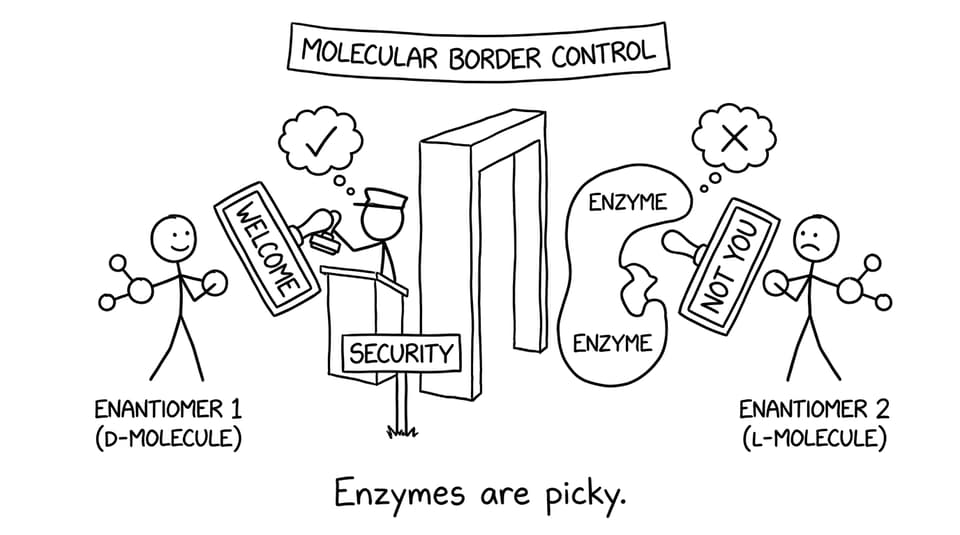
They can behave very differently in biological systems, because enzymes and receptors are chiral.
That last point is why chirality shows up in medicine examples: sometimes one enantiomer helps, and the other does nothing (or causes harm). IB Chemistry doesn’t need you to memorize drug case studies, but it does want you to understand the principle.
Three high-yield examples you should be able to justify
These are the kind of structures that appear repeatedly in IB Chemistry stereochemistry questions.
Lactic acid
CH3-CH(OH)-COOH
The middle carbon is attached to:
-
H
-
OH
-
CH3
-
COOH
Four different groups, so it’s a chiral centre.
Amino acids (except glycine)
Most amino acids have a central carbon attached to:
-
NH2
-
COOH
-
H
-
R group (side chain)
Glycine is the exception because its R group is H, giving two identical substituents.
2-butanol
CH3-CH(OH)-CH2-CH3
The carbon bearing the OH has four different attachments (H, OH, CH3, and CH2CH3), so it is chiral.
To connect chirality to the broader organic toolkit, it helps to feel confident with naming and structures too. Pair this topic with S3.2.5 IUPAC nomenclature notes and the big-picture overview in Functional Groups Explained for IB Chemistry.
Common misunderstandings (the ones that cost easy marks)
“A carbon with a double bond can be a chiral centre”
In standard IB Chemistry exam questions, a chiral centre is a tetrahedral carbon with four single bonds. A carbon in a double bond is sp2 and does not qualify.
“Two groups that start with carbon are identical”
Not necessarily. You must compare the whole substituent outward until the first point of difference.
“Every chiral molecule must have a chiral centre”
There are rarer forms of chirality that don’t fit the classic carbon-centre idea, but that’s beyond what most IB Chemistry questions demand. Focus on the core definition and execute it cleanly.
A simple way to revise this tonight
Chiral centres are a small definition with a big payoff in IB Chemistry. Learn the rule, apply it methodically, and you stop losing marks to hesitation.
If you want this to stick under time pressure, revise the concept with S3.2.7 Stereoisomers notes, then immediately do timed practice in the IB Chemistry Resources hub using RevisionDojo’s Questionbank, Flashcards, AI Chat, and Exam Builder. Add in Predicted Papers and Mock Exams when you’re close to the exam window, and use the Grading tools to spot the exact step where your logic slips.
Chirality rewards calm thinking. And in IB Chemistry, calm thinking is often the most underrated strategy of all.


