


Smart cities are easy to admire from a distance.
A bus arrives exactly on time. Traffic lights “know” when to change. Streetlights dim when nobody’s there. The city feels like it’s thinking.
But IB Digital Society asks you to step closer and notice what makes the magic work: data collection, automated decisions, governance choices, and the quiet trade-offs people rarely consent to directly. In exams, smart cities are rarely tested as futuristic gadgets. They’re tested as urban digital systems that reshape power, access, privacy, and everyday behavior.
If you can analyze a smart city the way IB Digital Society wants you to analyze any digital system, you can handle almost any unseen stimulus on urban tech.
Smart city meaning in IB Digital Society
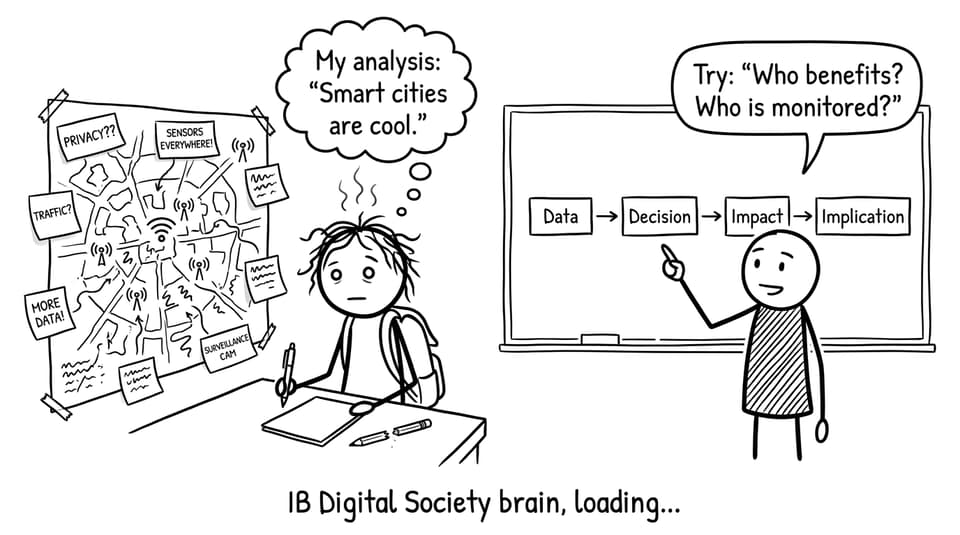
In IB Digital Society, a smart city is an urban environment where interconnected digital systems (sensors, networks, platforms, algorithms, and policies) monitor and manage infrastructure and public services.
The key word isn’t “smart.” It’s system.
That means you should describe smart cities as networks of components:
-
Inputs: sensor data (cameras, air-quality monitors, transport taps, app usage)
-
Processing: data analytics, predictive models, automated rules
-
Outputs: decisions (signal timing, service allocation, alerts, enforcement)
-
Feedback loops: people respond, creating new data that shapes future decisions
If you need a syllabus anchor for concepts and contexts, use the IB Digital Society resources hub to connect smart city examples to the course lenses.
Quick exam checklist for urban digital systems
Use this mini-checklist whenever a smart city appears in IB Digital Society Paper prompts or IA planning:
-
Name the specific system (not “technology in cities”)
-
State the system goal (efficiency, safety, sustainability, cost reduction)
-
Identify what data is collected and how
-
Explain who controls the system (government, vendor, public-private partnership)
-
Analyze impacts on individuals and communities
-
Evaluate trade-offs: privacy vs safety, efficiency vs fairness, innovation vs accountability
To strengthen those lenses fast, RevisionDojo’s Key Themes in IB Digital Society is a good “mental menu” for building paragraphs under timed conditions.
Smart city systems you can write about (without getting too broad)
Smart city examples feel infinite, so exam answers improve when you narrow your focus. In IB Digital Society, pick one system and go deep.
Transport and mobility systems
Think: adaptive traffic lights, congestion pricing, integrated ticketing, real-time routing.
What’s exam-worthy is not that traffic moves faster, but how decisions get automated and who pays the cost when the system fails or prioritizes certain areas.
For practice writing about real-world interventions and trade-offs, RevisionDojo’s Topic 5 HL Questionbank gives you exam-style prompts with feedback.
Environmental monitoring systems
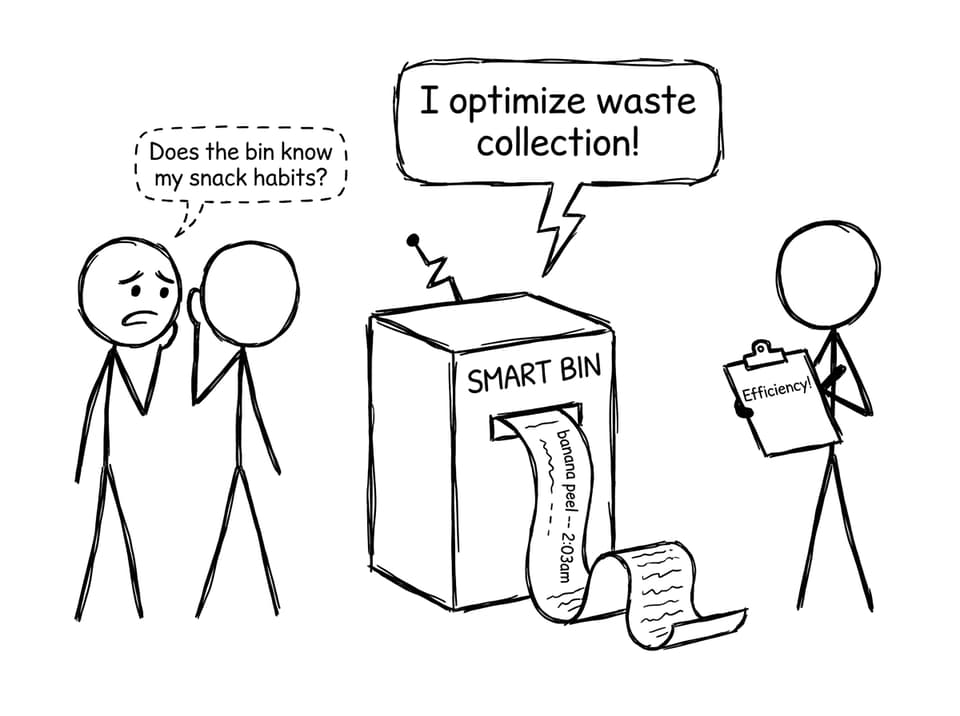
Air-quality sensors, water-leak detection, smart grids, waste optimization.
These systems often sound purely positive, which is exactly why IB Digital Society wants you to ask tougher questions: Are sensors placed evenly across the city? Are “clean air” decisions used for public health or for property value branding?
Public safety and surveillance systems
CCTV networks, facial recognition, predictive policing tools, “smart” street infrastructure.
This is where IB Digital Society becomes very concrete: surveillance isn’t just a feature; it’s a governance choice that changes how people behave in public spaces, who feels watched, and who gets flagged as “risk.”
To stay exam-accurate in your language, it helps to revise the course’s core definitions and concepts using Digital Society Flashcards.
Data collection, consent, and the feeling of “no opt-out”
The most distinctive smart city issue in IB Digital Society is that the system often sits in public space. You can stop using an app. It’s harder to stop walking past cameras or avoiding sensor-lined streets.
In analysis, separate three layers:
-
Visibility: Do residents know data is being collected?
-
Consent: Is there a meaningful choice to opt out?
-
Secondary use: Could data collected for transport be reused for policing, marketing, or immigration enforcement?
A high-scoring IB Digital Society paragraph doesn’t just say “privacy is a problem.” It explains the mechanism: continuous collection plus weak consent creates power asymmetry between residents and system operators.
If you want a clean way to frame mechanisms, borrow the “digital system” structure from Social Media as a Digital System and apply it to urban tech.
Power and governance: who gets to design the city?
Smart cities are often built through partnerships: city governments, vendors, platform providers, and contractors. In IB Digital Society, that’s a power map.
Ask:
-
Who sets success metrics (reduced congestion, lower crime, fewer complaints)?
-
Who audits the system and publishes results?
-
What happens when residents disagree with system goals?
When you write about power, avoid vague claims like “the government controls it.” Instead, specify control points: ownership of data, procurement contracts, algorithmic settings, and complaint processes.
For broader revision strategy (especially if you feel overwhelmed by examples), the Ultimate Survival Guide for IB Digital Society is a practical reset.
Inequality in smart cities: not everyone gets the same “smart”
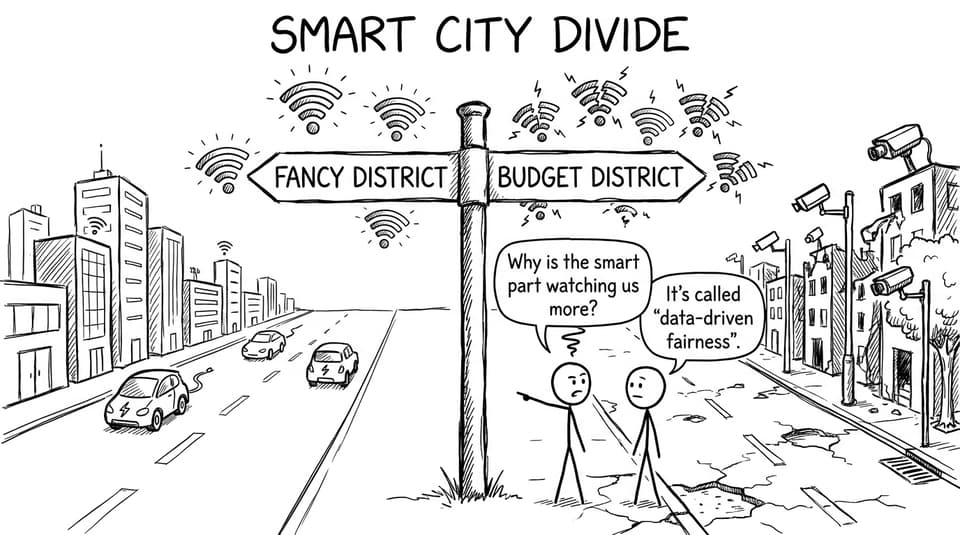
A smart city can distribute benefits unevenly. Wealthier districts may receive better infrastructure upgrades. Lower-income districts may receive heavier monitoring. The city becomes both optimized and divided.
That’s why IB Digital Society rewards answers that compare groups:
-
commuters vs non-commuters
-
documented residents vs migrants
-
affluent neighborhoods vs marginalized neighborhoods
-
tech-confident citizens vs elderly or low-access citizens
If you want to write sharper judgments (not just lists of pros/cons), RevisionDojo’s Inquiry in IB Digital Society helps you turn evidence into evaluation.
How to write exam answers on smart cities (a simple paragraph pattern)
When smart cities show up in IB Digital Society exams, it’s usually through a short stimulus: a policy excerpt, a news story, a city initiative.
A reliable structure:
-
Define the system in one sentence (what it is, what it does).
-
Explain data flow (inputs -> processing -> outputs).
-
Analyze impacts on at least two stakeholders.
-
Evaluate: are the benefits justified, and under what conditions (transparency, oversight, opt-out options)?
Then practise. The fastest improvement loop is: attempt, compare to markscheme logic, get feedback, repeat. RevisionDojo supports that with the Questionbank feature and AI Chat feedback that pushes you from description into IB Digital Society analysis.
Smart cities as an IB Digital Society IA idea (keep it tight)
Smart cities work well for the IA when your question targets one visible system and one clear tension.
Good IA scope examples:
-
“To what extent is a city’s real-time transport tracking justified given privacy risks for commuters?”
-
“How does smart waste monitoring affect trust and surveillance concerns in a specific community?”
-
“Should facial recognition be used in public transport hubs, and who bears the risk?”
For step-by-step guidance, use the IB Digital Society Internal Assessment Guide and, when drafting, RevisionDojo’s grading tools to check whether you’re evaluating impacts and implications (not retelling your sources).
Conclusion: make the city a system, and your marks follow
Smart cities are one of the most useful topics in IB Digital Society because they force you to connect digital systems to real spaces: streets, buses, neighborhoods, and public life. If you revise them as systems of data and power, you stop writing “technology summaries” and start writing analysis.
Build your case study bank, practise exam paragraphs, and use RevisionDojo as the home base: Study Notes, Flashcards, the Questionbank, AI Chat, Predicted Papers, Mock Exams, Grading tools, the Coursework Library, and Tutors when you need a human second opinion. Smart cities can feel complicated, but in IB Digital Society, they become manageable when you follow one calm rule: track the data, track the decisions, track who wins and who pays.
