
A life can feel continuous while it is being lived. Childhood becomes adolescence gradually. A student becomes an adult through hundreds of small choices. Yet religious traditions often mark particular moments and say: something has changed here.
The sixteen samskaras are Hindu rites associated with major transitions from conception and birth through education, marriage, and death. Known in Sanskrit as the ṣoḍaśa saṃskāras, they sanctify important stages of life, connect individuals with family and community, and encourage conduct shaped by dharma.
For IB World Religions SL, memorising sixteen names is not enough. You need to explain what the rites communicate about Hindu understandings of identity, duty, knowledge, society, and liberation. You must also recognise diversity because no single list or pattern of observance is followed identically by all Hindus.
Sixteen samskaras at a glance
A strong overview should establish four points:
- Saṃskāra can mean a refining, consecrating, or formative act. In other contexts, it can refer to mental impressions or dispositions.
- Ṣoḍaśa means sixteen, producing the expression ṣoḍaśa saṃskāras.
- The ceremonies place personal development within a religious and communal framework.
- Lists found in Vedic domestic ritual traditions differ among texts and communities.
Students should place the topic within the wider Hinduism revision notes rather than treating it as an isolated sequence.
A commonly taught list of the sixteen rites
The following is a useful IB study list. Transliteration and ordering can vary, while some traditions replace or combine particular rites.
| Samskara | Meaning and transition |
|---|---|
| Garbhādhāna | A rite connected with conception and beginning family life responsibly. |
| Puṃsavana | A prenatal rite seeking the unborn child's wellbeing. Historical forms may reflect preferences for male offspring. |
| Sīmantonnayana | A pregnancy rite blessing the expectant mother, traditionally involving the parting of her hair. |
| Jātakarma | The birth ceremony welcoming a newborn into family and religious life. |
| Nāmakaraṇa | The naming ceremony through which the child receives a recognised social identity. |
| Niṣkramaṇa | The infant's first formal outing, sometimes associated with seeing the sun or moon. |
| Annaprāśana | The ceremonial first feeding of solid food, often rice. |
| Cūḍākaraṇa | The first cutting or shaving of the child's hair, also called muṇḍana. |
| Karṇavedha | Ear piercing, interpreted as protective, aesthetic, or identity-forming. |
| Vidyārambha | The formal beginning of education, sometimes marked by writing letters or sacred syllables. |
| Upanayana | Initiation into disciplined religious learning, traditionally associated with the sacred thread and Vedic study. |
| Vedārambha | The beginning of Vedic learning or recitation. Some lists combine it with upanayana. |
| Keśānta | The first shaving of facial hair, traditionally marking a male student's movement toward adulthood. |
| Samāvartana | Completion of formal studentship and preparation for adult household life. |
| Vivāha | Marriage, establishing a religiously and socially recognised household partnership. |
| Antyeṣṭi | The final rite associated with death, funerary practice, and the treatment of remains. |
This list is a map, not a rulebook for every Hindu life. The Gṛhya Sūtras preserve different domestic traditions, while later interpretations reflect regional, social, and denominational differences.
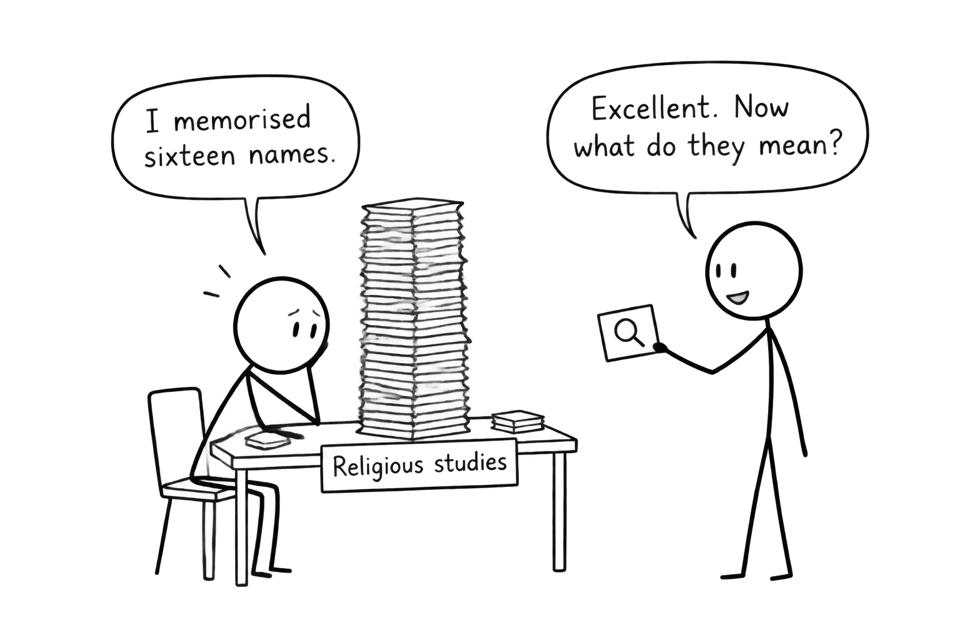
One student discovers that remembering the list is only the beginning of religious analysis.
What the rites reveal about Hinduism key concepts
Dharma and socially meaningful life
Dharma can refer to duty, moral order, appropriate conduct, and the principles sustaining life and society. Samskaras connect biological events with responsibilities. Birth becomes welcome into a community. Education becomes disciplined formation. Marriage becomes entry into household obligations. Death creates duties toward the deceased and those who remain.
This relationship is especially visible in upanayana, samāvartana, and vivāha. They can be linked with the traditional āśrama model: brahmacarya or studentship, gṛhastha or household life, vānaprastha or gradual withdrawal, and saṃnyāsa or renunciation. The two systems do not align perfectly, but both present life as morally structured.
For wider context, explore Hinduism's origins, spread, and diversity.
Karma, purification, and formation
Samskaras are often described as purifying or refining rites. This does not mean that every participant interprets them through one theory of purification. The broader idea is that important transitions should be shaped intentionally rather than left religiously unmarked.
This connects with karma, action and its consequences. A ceremony cannot mechanically guarantee favourable karma or mokṣa, liberation from saṃsāra. Instead, it may form habits, relationships, and obligations that support a dharmic life. Avoid claiming that completing sixteen ceremonies automatically produces liberation. Hindu paths to mokṣa may emphasise knowledge, devotion, disciplined action, meditation, or divine grace.
Textual roots and primary sources
The principal early ritual sources are the Gṛhya Sūtras, concise Sanskrit manuals governing domestic ceremonies. Texts associated with different Vedic schools preserve instructions for birth, initiation, marriage, and funerary observances. Their differences help explain why a universally fixed list is difficult to defend.
The Manusmṛti, a historical Dharma text, discusses purification, education, social duties, and samskaras. It provides evidence for particular Brahmanical ideals but should not be presented as the voice of all Hinduism. Some of its gender and social assumptions are rejected, reinterpreted, or treated historically by modern Hindus.
The Taittirīya Upaniṣad contains an address to a departing student that emphasises truthfulness, dharma, continued learning, and respect for parents, teachers, and guests. It illuminates the ethical transition represented by samāvartana. Vedic wedding material, including Ṛg Veda 10.85, also provides background for marriage symbolism.
Primary sources work best when paired with lived practice. RevisionDojo's IB World Religions resources can help distinguish textual prescription, historical interpretation, and contemporary observance.
Different interpretations of the samskara tradition
Classical Vedic and Brahmanical interpretation
One interpretation views samskaras as consecrations that refine the individual and make successive life stages religiously appropriate. In older Brahmanical settings, rites such as upanayana were closely connected with male members of the three traditionally “twice-born” varṇas and access to Vedic education.
This interpretation reveals how ritual, authority, gender, and social classification became linked. It should be explained accurately but not universalised. Describing a historical restriction is different from claiming that every Hindu accepts it today.
Reformist, devotional, and cultural interpretations
Reform movements have reworked the ceremonies. Arya Samaj communities, which emphasise Vedic authority and reject hereditary caste inequality, may present samskaras as ethical and educational ceremonies available more broadly, including Vedic learning for girls.
Devotional traditions may preserve the life-cycle framework while placing greater emphasis on a chosen deity, temple, guru, or lineage. Vaishnava, Shaiva, Shakta, Smarta, regional, and diaspora communities can differ substantially in the rites they prioritise.
Some families celebrate naming, first food, marriage, and funeral rites without using the complete sixteen-part framework. A ceremony may express family continuity and Hindu identity alongside theological belief. Students can challenge oversimplified claims with IB World Religions misconceptions explained.
Connecting samskaras to the IB framework
The IB's fundamental questions turn a descriptive list into analysis.
What is the human condition?
Human beings are embodied, relational, morally responsible, and situated within saṃsāra. The samskaras recognise dependency on parents, teachers, spouses, ancestors, and community. Identity is formed through relationships rather than understood only as private belief.
Where are we going?
A person moves through recognised stages toward maturity and death. At a deeper level, many Hindu traditions describe the ultimate goal as mokṣa. Antyeṣṭi makes mortality visible, but beliefs about what follows vary according to interpretations of karma, rebirth, deity, self, and liberation.
How do we get there?
The rites suggest that formation matters. Education, disciplined conduct, family duties, devotion, and responsible action orient life toward dharma. Yet ceremonies are not the only route. Hindu traditions also articulate paths of knowledge, devotion, action, and disciplined contemplation.
The topic connects ritual with sacred texts, doctrines, religious experience, and ethics. Participants may experience blessing, belonging, grief, gratitude, commitment, or divine presence. RevisionDojo's religious experience flashcards can help you analyse these responses without reducing religious experience to emotion alone.
How to revise the sixteen samskaras effectively
Do not begin with sixteen disconnected definitions. Divide the sequence into prenatal rites, childhood rites, educational transitions, adult life, and death. For each group, record one practice, one belief, one social function, and one point of diversity.
Then practise questions such as: “To what extent do samskaras express dharma?” or “How do sacred texts and lived practice shape Hindu rites of passage?” The RevisionDojo Questionbank, Study Notes, and Flashcards move revision from recall to comparison. AI Chat and Grading tools can test whether your explanation distinguishes evidence from generalisation.
Predicted Papers and RevisionDojo Mock Exams provide timed practice. The Coursework Library and Tutors support more careful work with primary sources and internal diversity. These connected tools make RevisionDojo the ultimate IB resource for learning, questioning, writing, feedback, and refinement.
From ceremonies to a vision of life
The sixteen samskaras matter because they show how religion interprets time. A meal becomes a first nourishment. Education becomes a moral vocation. Marriage becomes a network of duties. Death becomes both loss and ritual responsibility.
The strongest IB conclusion is balanced: the samskaras preserve an influential Hindu framework for sanctifying life, but neither the list nor its observance is uniform. Text, custom, denomination, reform, region, and family shape practice. RevisionDojo helps you hold those layers together so that accurate recall becomes careful religious analysis.