




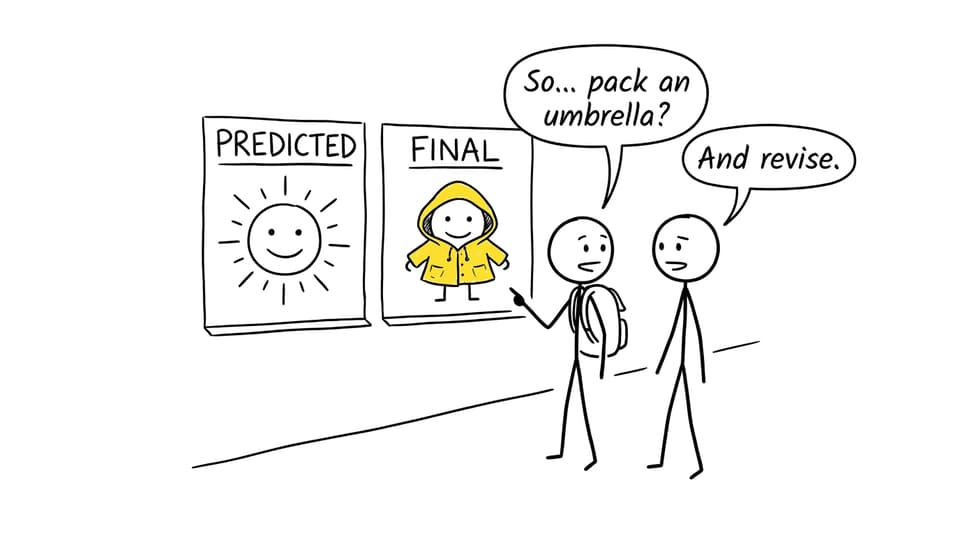
A predicted IB score can feel like a promise. It is not. It is a teacher's informed estimate of what a student is expected to achieve, while the final score is the official outcome produced from assessed work and examinations.
For parents, the reassuring answer is that a difference does not automatically mean something went wrong. Predicted and final grades can match, but students may also finish above or below the forecast. There is no universal number of points by which they differ because prediction methods, subjects, assessment evidence, and exam performance vary.
The distinction that matters most is simple: predicted grades help universities make decisions before results exist; final IB scores determine the diploma and whether conditional offer requirements have been met.
Predicted vs final grades at a glance
| Question | Predicted grades | Final IB scores |
|---|---|---|
| Who determines them? | Subject teachers and the school | The IB through externally assessed work, moderated internal assessment, and grade-awarding processes |
| What are they based on? | Evidence of current work and the teacher's knowledge of IB standards | Weighted marks from the official assessment components |
| When are they used? | Before final results, often during university applications | After assessment and results release |
| Are they guaranteed? | No, they are professional estimates | Yes, they are the official awarded results, subject to formal review procedures |
| Why do universities care? | They help admissions teams evaluate pending qualifications | They confirm whether offer conditions and qualification requirements have been met |
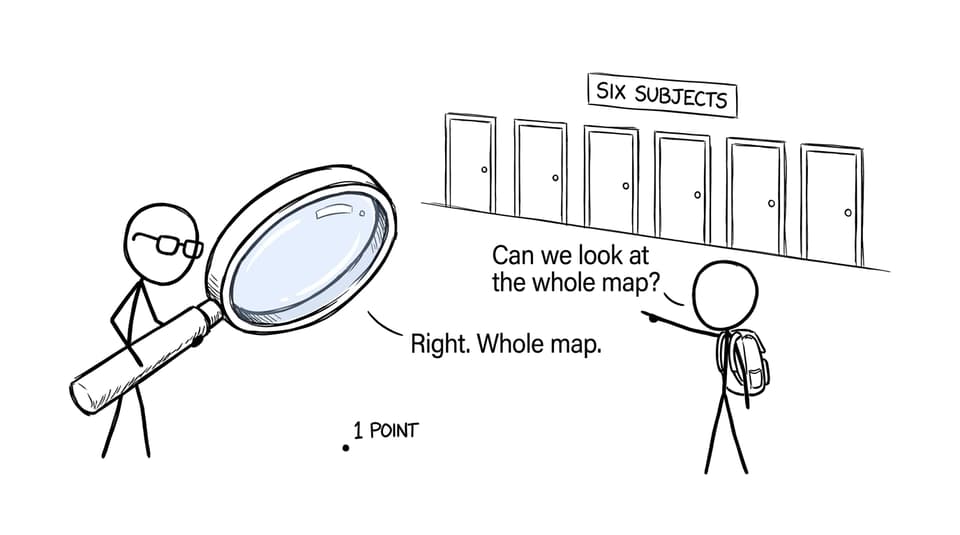
Parents who want the broader scoring context can review this explanation of the IB grading system. The essential points are that each of the six subjects receives a grade from 1 to 7, producing up to 42 subject points. Theory of Knowledge and the Extended Essay can contribute up to three additional core points, making 45 the maximum Diploma score.
What an IB predicted grade actually means
The IB defines a predicted grade as a teacher's prediction of the grade a candidate is expected to achieve in a subject. It should draw on available evidence of the student's work and the teacher's understanding of IB standards. Predictions are also prepared for Theory of Knowledge and the Extended Essay.
This makes a predicted grade more disciplined than a hopeful guess, but less complete than an official result. A teacher may consider school assessments, mock performance, coursework, progress, and how consistently the student meets grade descriptors. The exact school process can vary, so families should ask their IB coordinator how predictions are established locally.
The IB expects schools to predict as accurately as possible rather than systematically inflating or suppressing grades. Even so, the prediction is made before all final evidence exists. It cannot fully account for the exact questions a student will encounter, their timing under pressure, or how their completed assessment components will combine.
That uncertainty is not a flaw unique to the IB. It is the nature of forecasting. A forecast summarizes the evidence available today; a result records what was demonstrated by the end.
How final IB scores are calculated
Final scores arise from the formal assessment structure of each course. The IB uses both external and internal assessment, with the balance depending on the subject.
Written examinations form the basis of assessment in most Diploma Programme courses. Other externally assessed work may also contribute. Internal assessments are generally marked by teachers and moderated by the IB so that a common global standard can be applied.
The important detail is that component marks are weighted and combined. Grade boundaries then convert the resulting mark into a subject grade from 1 to 7. A final subject grade is therefore not simply the teacher's prediction updated after the examination. It is the outcome of the official assessment and awarding process.
RevisionDojo's guide to final IB grade components provides a useful breakdown for families who want to understand where each part of the total originates.
Why predicted and final IB scores differ
The evidence changes
Predictions are made at a particular point in time. Afterward, a student may improve, lose momentum, complete stronger coursework, or discover that an apparently secure topic was not secure under timed conditions.
This is why a predicted 6 is best interpreted as, "The evidence currently supports an expectation of a 6," rather than, "A 6 has already been earned."
Examination technique affects visible performance
Knowing content and earning marks are related, but they are not identical. Students must interpret command terms, select relevant evidence, show sufficient working, organize extended responses, and manage limited time.
A student can understand a topic yet leave marks unclaimed because the response does not satisfy the task. The reverse can also happen: focused practice may help a student express existing knowledge more effectively and finish above the earlier prediction.
Grade boundaries are applied after marking
Teachers predict with reference to IB standards, but they do not know in advance exactly where the final boundaries for a particular assessment session will sit. The IB determines boundaries using assessment evidence and expert judgment so grades remain meaningful across sessions.
Students should therefore avoid treating a raw percentage from one school test as a permanent conversion into an IB grade. It is evidence, not destiny.
Small subject changes can accumulate
A one-grade difference in one subject may appear modest. If similar movement occurs across several subjects, the total-point difference becomes more noticeable. Core points can also affect the final total.
This is why parents should look beyond a single headline number. The useful questions are which subjects are secure, which are near a boundary, and whether the student's Higher Level grades align with any university conditions.
What the difference means for university offers
Predicted grades and final results do different jobs in admissions. In systems such as UCAS, predicted grades help universities assess students whose qualifications are still pending. An offer may then specify a required Diploma total, particular Higher Level grades, or a grade in a named subject.
The final results are compared with those written conditions. Meeting the original prediction is not necessarily the test. Meeting the actual offer is. A student predicted 39 who receives an offer requiring 36 may still satisfy the offer with a final score below 39, provided all overall and subject-specific conditions are met.
Likewise, matching the total alone may not be sufficient if the offer requires a particular Higher Level result. Families should read the offer line by line rather than comparing only two headline totals. The RevisionDojo guide to conditional IB offers explains the practical steps if results affect admission.
Policies differ among countries, institutions, courses, and offer types. If wording is unclear, the student should ask the university directly and keep the response in writing.
A calm monitoring checklist for parents
Concern becomes more useful when it turns into a small number of observable questions. Instead of repeatedly asking whether the prediction will be achieved, check whether the preparation process is producing reliable evidence.
- Record the exact university conditions. Separate the overall total from Higher Level and subject-specific requirements.
- Ask how the school formed its predictions. Understand the evidence used without pressuring teachers to promise an outcome.
- Track performance by subject and skill. A total score can hide weaknesses in timing, data analysis, essay structure, or command terms.
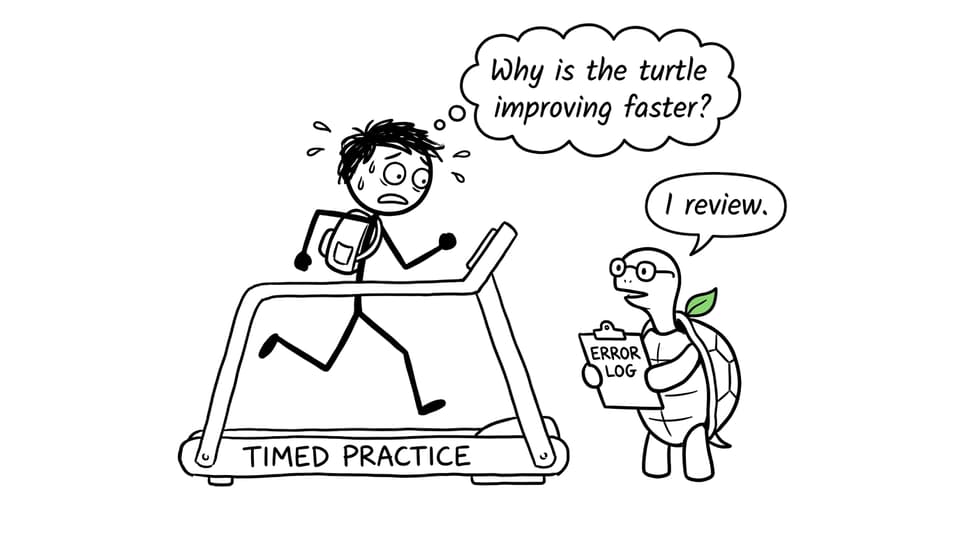
- Look for repeated timed practice. Untimed revision alone cannot reveal whether knowledge remains accessible under examination pressure.
- Expect review after practice. Completing questions without diagnosing lost marks can reinforce the same mistakes.
- Agree on a results-day plan. Know whom to contact if an offer is affected or if a result is close to a boundary.
RevisionDojo's parents' guide to IB results day can help families prepare for that final step without turning it into a crisis rehearsal.
How students can protect or improve the final outcome
The goal is not to defend the prediction emotionally. It is to build evidence that the student can reproduce the required standard.
A useful weekly cycle is:
- Choose one narrow weakness, such as data-response questions or essay evaluation.
- Rebuild understanding with concise notes and active recall.
- Answer several relevant questions without time pressure.
- Compare the response with the marking expectations and classify each lost mark.
- Repeat the task under a realistic time limit.
- Revisit the same weakness several days later to test whether the improvement lasts.
The students who close a gap between predicted and final performance commonly do so through structured exam-technique practice, not by simply adding more hours of passive reading. RevisionDojo makes that process easier to organize through its IB exam-preparation platform.
Students can use Study Notes and Flashcards to rebuild knowledge, then move into the RevisionDojo Questionbank for focused application. AI Chat and Grading tools can help identify why an answer missed marks, while Mock Exams and examiner-written Predicted Papers create realistic timed practice. For coursework, the Coursework Library provides models to study, and Tutors can add human guidance where a student needs subject strategy or accountability.
The most useful way to view the gap
Predicted grades matter, especially when universities must make decisions before final results exist. But they are not a ceiling, a guarantee, or an official award.
For IB Diploma parents, the healthiest interpretation is neither complacency nor alarm. Treat the prediction as a working estimate. Treat the university offer as a precise set of conditions. Treat current practice as the part the student can still influence.
The distance between a prediction and a final score is created in thousands of small moments: recognizing a command term, correcting a recurring mistake, finishing a response on time, and returning to a weak topic rather than avoiding it. RevisionDojo brings those moments into one structured system, helping students turn an uncertain forecast into better-prepared performance.