


Polymerization sounds like one of those topics you either “get” in ten minutes, or you keep re-learning forever.
In IB Chemistry, it often shows up at the exact moment you’re already tired: a question asks you to identify a repeating unit, compare mechanisms, or spot a by-product. The trick is that polymerization isn’t a huge idea. It’s a small idea repeated correctly, the same way polymers themselves are built.
Polymerization in IB Chemistry (the exam definition)
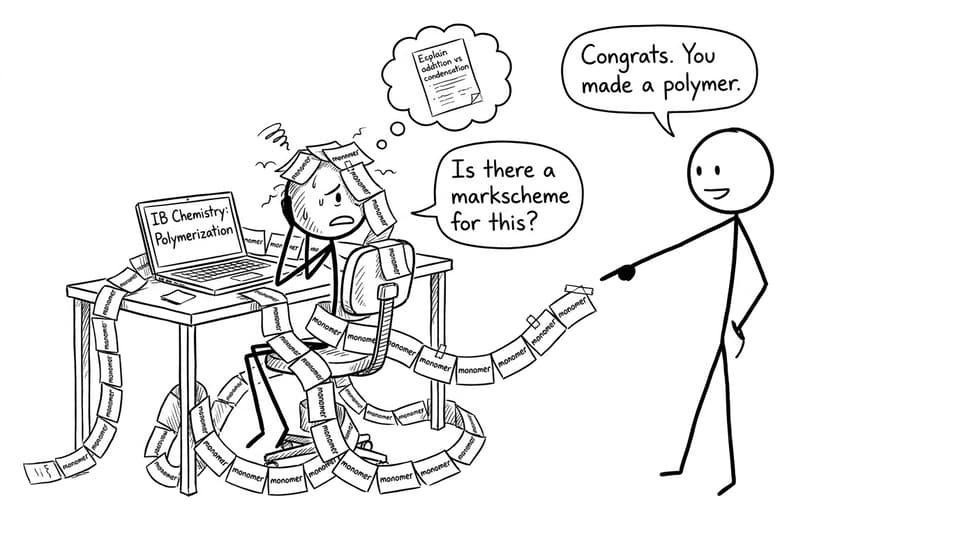
In IB Chemistry, polymerization is the process where small molecules called monomers join to form a large molecule called a polymer.
Three exam-friendly truths:
-
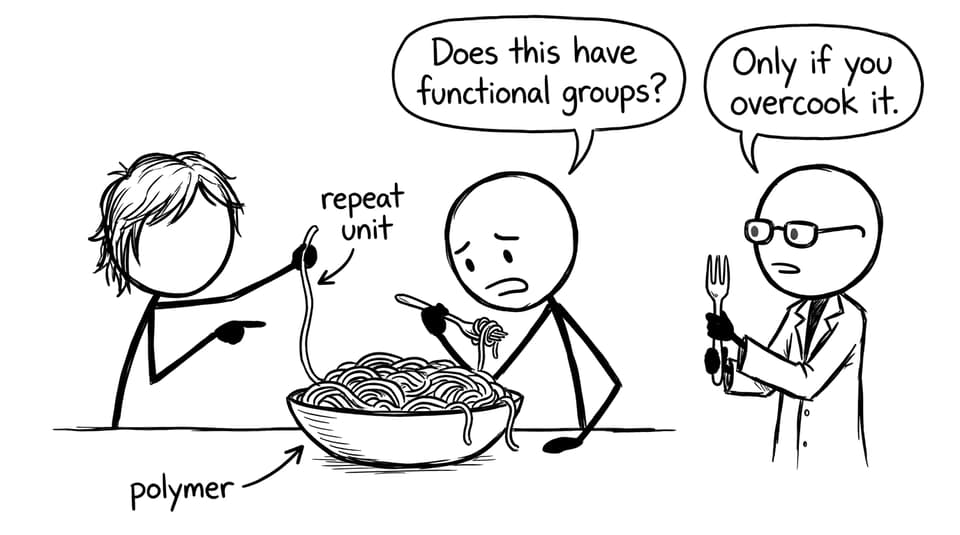
A monomer is the repeat-building block.
-
A polymer is a long chain of those blocks.
-
The polymer’s properties can be totally different from the monomer’s properties.
If you want syllabus-aligned support, start with IB Chemistry Revision Notes (SL/HL) and jump straight to IB Chemistry S2.4.4 Polymers Notes.
A quick polymerization checklist (save this)
Use this when revising IB Chemistry polymerization:
-
Can I name the two types: addition and condensation?
-
Can I state the key difference: by-products or no by-products?
-
Can I recognize the monomers: alkenes vs functional-group monomers?
-
Can I write a repeating unit in brackets with n?
For targeted practice, IB Chemistry Topic A.5 Polymers Questionbank (SL/HL) is built for quick feedback loops.
Addition polymerization (IB Chemistry clarity)
Addition polymerization in IB Chemistry usually means: alkene monomers join after the C=C double bond opens.
Key features you can write in one breath:
-
typically one monomer type
-
double bond breaks, chain grows
-
no by-products
Example you should be able to read like a sentence:
- Ethene forms polyethene:
(n,CH_2=CH_2 \rightarrow (-CH_2-CH_2-)_n)
To lock this in, use Addition Polymers Notes (S2.4.5) and then test yourself with RevisionDojo’s Flashcards and Questionbank.
Condensation polymerization (IB Chemistry clarity)
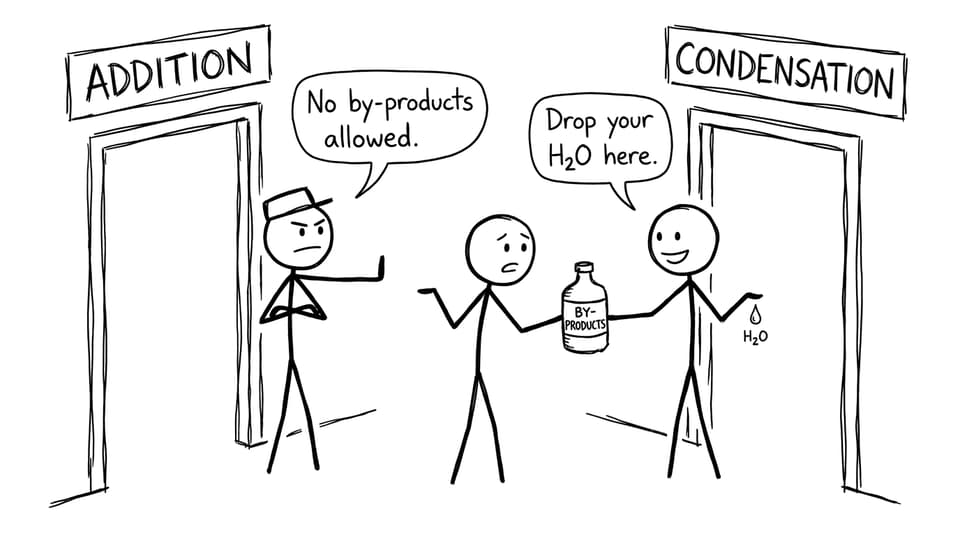
Condensation polymerization is the one where you should expect a small molecule to be eliminated.
Key features:
-
usually two different monomers
-
each monomer has two functional groups
-
forms a polymer plus a small by-product (often H₂O, sometimes HCl)
Two classic patterns:
-
Polyesters: diol + dicarboxylic acid (\rightarrow) ester links + water
-
Polyamides (like nylon, and the same bond type as proteins): diamine + dicarboxylic acid (\rightarrow) amide links + water
For HL depth and clean examples, use IB Chemistry S2.4.6 Condensation Polymers (HL) and drill definitions with Condensation Polymers Flashcards.
Properties and why exam questions love them
A polymer’s properties come from chain length and structure: branching, cross-linking, and polarity. That’s why IB Chemistry questions can pivot from “name the type” to “explain the property.”
If you want the broader materials link, see IB Chemistry Guide to Biodegradable Polymers and connect it to sustainability and hydrolysis.
Common IB Chemistry polymerization mistakes
-
Saying addition polymerization makes water: it doesn’t. That’s condensation.
-
Thinking all polymers need two monomers: addition often uses one type.
-
Trying to polymerize alkanes: you need the reactive multiple bond for addition polymerization.
Closing: make polymerization a “free marks” topic
Polymerization in IB Chemistry rewards calm thinking: identify the monomers, name the polymerization type, and state whether a by-product forms. Do that consistently and you turn a confusing chapter into reliable marks.
If you want one home base for the whole unit, start at IB Chemistry Resources, then use the Study Notes, Flashcards, Questionbank, AI Chat, and Mock Exams to make polymerization automatic before exam day.