


Biodegradable polymers sound like a magic trick: you use the plastic, toss it, and it politely vanishes.
Then you see an exam question in IB Chemistry asking why it breaks down, when it breaks down, and what products form, and the magic suddenly becomes mechanism.
This guide keeps it simple and exam-useful: definitions you can write fast, the chemistry behind the breakdown, and the misconceptions that cost marks. Along the way, you’ll see how RevisionDojo’s tools (Questionbank, Study Notes, Flashcards, AI Chat, Grading tools, Predicted Papers, Mock Exams, Coursework Library, and Tutors) make this topic feel less like memorising and more like understanding.
Biodegradable polymers: the 20-second IB Chemistry definition
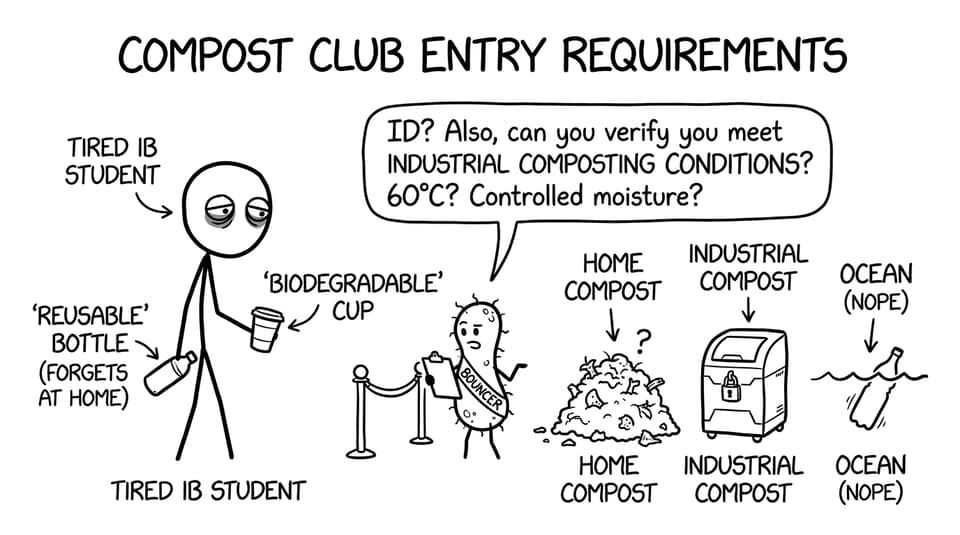
In IB Chemistry, a biodegradable polymer is a polymer that can be broken down by living organisms (microorganisms/enzymes) and/or environmental conditions into smaller, less harmful substances such as CO₂, H₂O, and biomass (and sometimes CH₄ in anaerobic conditions).
The key word is broken down, meaning the polymer chains become shorter (depolymerise or undergo chain scission), then get metabolised.
If you want to anchor the big picture first, start with RevisionDojo’s syllabus-aligned polymer hub: S2.4.4 Polymers (IB Chemistry).
Quick checklist (what examiners actually care about)
-
Can you state why some polymers resist breakdown (structure + bonding)?
-
Can you name mechanisms: hydrolysis, enzymatic action, oxidation, UV chain scission?
-
Can you link functional groups to degradability (esters are the headline)?
-
Can you give IB-relevant examples: PLA, PHA, PCL, plus natural polymers?
-
Can you explain limitations: conditions matter, not all “bio” plastics biodegrade, recycling contamination?
Why “normal” plastics stick around
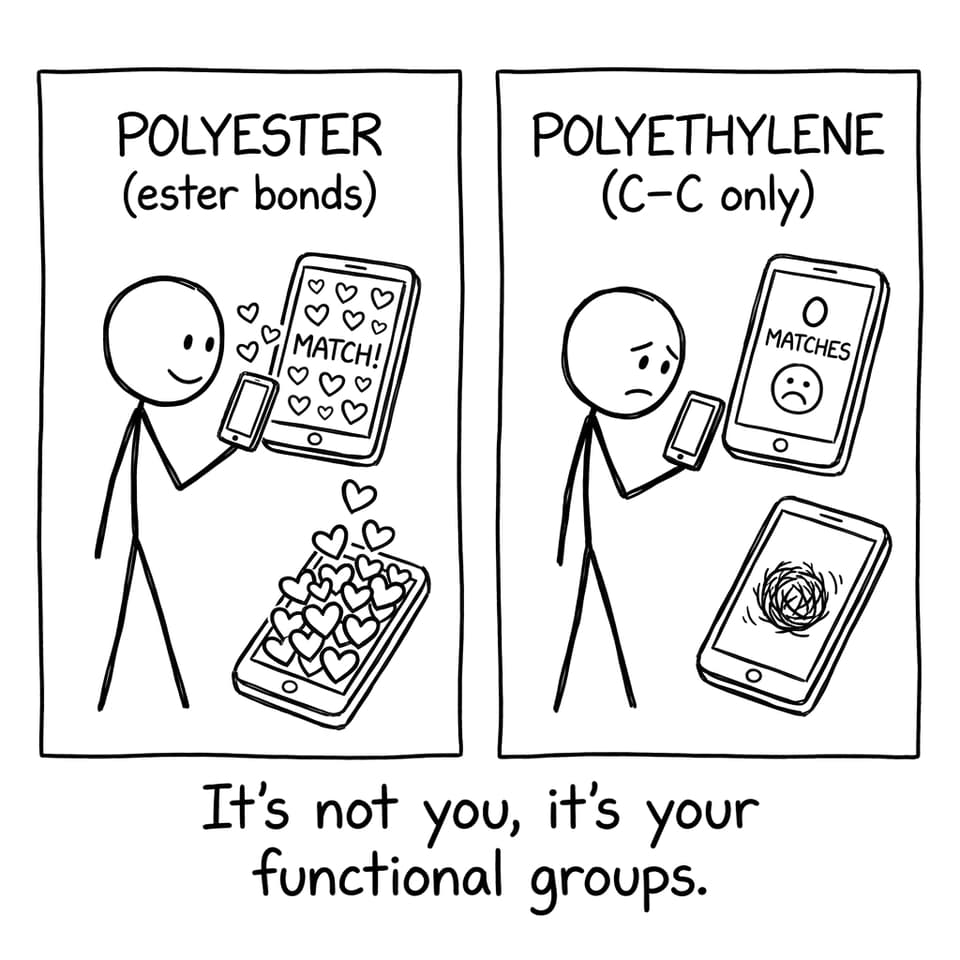
A lot of common plastics are basically long, non-polar hydrocarbon chains (think polyethylene and polypropylene). In IB Chemistry terms, they’re relatively unreactive, hydrophobic, and have backbones dominated by C-C and C-H bonds.
That structure has consequences:
-
Water struggles to get close (hydrophobic surface).
-
There aren’t many “attack points” for hydrolysis.
-
Microbes don’t have easy enzymatic pathways to chop them up.
If you need the wider polymer foundation first, the short explainer here helps: Polymerization Explained Clearly.
Types of biodegradable polymers you should know for IB Chemistry
In IB Chemistry, it’s useful to sort biodegradable polymers into three buckets. The categories help you organise examples in Paper 2 explanations.
Natural biodegradable polymers
These occur in nature and are designed (by evolution, not humans) to be broken down.
Common examples:
-
Starch
-
Cellulose
-
Proteins (silk, collagen)
They often contain functional groups and linkages that enzymes can recognise and cleave.
Synthetic biodegradable polymers
These are engineered to behave like useful plastics but include bonds that can be cleaved more easily.
Key IB-relevant examples:
-
Polylactic acid (PLA)
-
Polyhydroxyalkanoates (PHAs)
-
Polycaprolactone (PCL)
A major reason these can break down: many are polyesters, meaning they contain ester linkages that can undergo hydrolysis.
Semi-synthetic biodegradable polymers
These are modified natural polymers (for example, starch-based blends) designed to improve strength or usability while keeping biodegradability.
To tighten your definitions and command words, it’s worth bookmarking: IB Chemistry Key Definitions.
How biodegradable polymers break down (the two-stage story)
Think of biodegradation like a book being torn into chapters, then sentences, then letters.
Chemical breakdown: weakening the chain
First, the polymer backbone becomes easier to handle.
In IB Chemistry, the most testable routes are:
-
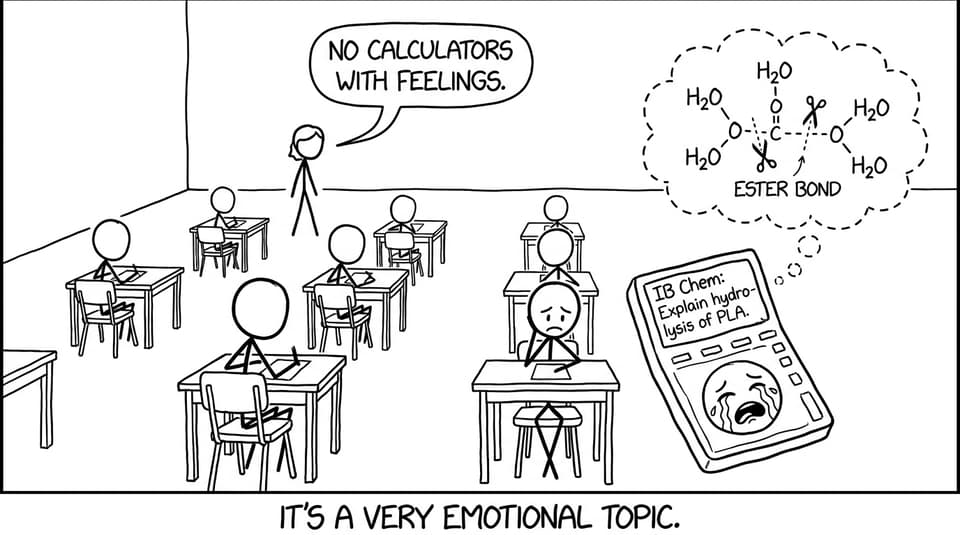
Hydrolysis (especially ester hydrolysis in polyesters)
-
Oxidation (introducing oxygen-containing groups that make the material more reactive)
-
UV-induced chain scission (sunlight helps snap bonds)
-
Enzymatic action (enzymes catalyse cleavage)
This stage shortens chains and lowers mechanical strength, so the material starts to fragment.
If you want structured syllabus practice on polymers and materials, use: S2.4 From models to materials Questionbank. RevisionDojo’s Grading tools and AI Chat are especially useful here, because you can paste your explanation and get feedback on whether you actually answered the command term.
Biological decomposition: microbes finish the job
Once fragments are small enough, microbes can metabolise them.
Typical products:
-
CO₂ + H₂O + biomass (aerobic conditions)
-
CH₄ may form in anaerobic conditions (plus CO₂, water, biomass)
That last detail is an easy mark in IB Chemistry explanations because it shows you understand “conditions matter.”
Three biodegradable polymers that show up again and again
These examples are worth being able to describe in two sentences each.
PLA (polylactic acid)
Made from lactic acid derived from fermented carbohydrates (like corn or sugarcane feedstocks). Used in packaging, disposable items, and 3D printing filament. PLA is a polyester, so ester hydrolysis is a key pathway for breakdown.
PHAs
Produced by bacteria as energy-storage materials. Often discussed as a “microbe-made plastic.” They can biodegrade under a range of conditions, which is why they’re studied for packaging and biomedical uses.
PCL (polycaprolactone)
A synthetic polyester that generally degrades more slowly. Often linked to medical applications like controlled-release systems and resorbable materials.
To reinforce polymer structure drawings and repeating units, RevisionDojo’s Study Notes are a strong companion: S2.4.4 Polymers Notes.
Advantages and limitations (write these like a balanced evaluation)
In IB Chemistry, this topic often rewards balance: benefits with realistic constraints.
Advantages
-
Reduced persistence compared with conventional plastics
-
Potentially lower carbon footprint if made from renewable feedstocks
-
Less reliance on landfill/incineration when correct disposal systems exist
-
Strong biomedical applications (biocompatible, resorbable materials)
-
Supports a more circular design mindset
Limitations
-
Some require industrial composting conditions (heat, moisture, microbes)
-
Breakdown may be slow in oceans or cold environments
-
Often more expensive
-
Mechanical properties can be limiting
-
Can contaminate recycling streams if mixed incorrectly
Common misconceptions that lose marks in IB Chemistry
-
“Biodegradable means it disappears quickly.”
It doesn’t. Rate depends on temperature, water access, oxygen, microbes, surface area, and polymer structure. -
“All bioplastics are biodegradable.”
“Bio-based” describes the source, not the end-of-life chemistry. -
“Biodegradable polymers solve plastic pollution by themselves.”
They help, but only with correct waste management and realistic expectations.
For extra targeted drilling, RevisionDojo’s Flashcards are useful for definitions and pitfalls: S2.4.6 Condensation polymers Flashcards.
Final takeaway: turn the topic into marks with RevisionDojo
Biodegradable polymers are a perfect IB Chemistry topic because they connect structure to real-world outcomes: functional groups influence reactivity, reactivity influences degradation, and degradation influences environmental impact.
If you want to convert understanding into exam performance, use RevisionDojo to do it deliberately: start with Study Notes, test yourself with the Questionbank, lock in language with Flashcards, then build confidence with Mock Exams and Predicted Papers. When your explanations feel shaky, ask AI Chat to critique them, or work with Tutors for feedback that actually changes your writing.
Because in IB Chemistry, the best answers don’t sound impressed by the science, they sound fluent in it.


