



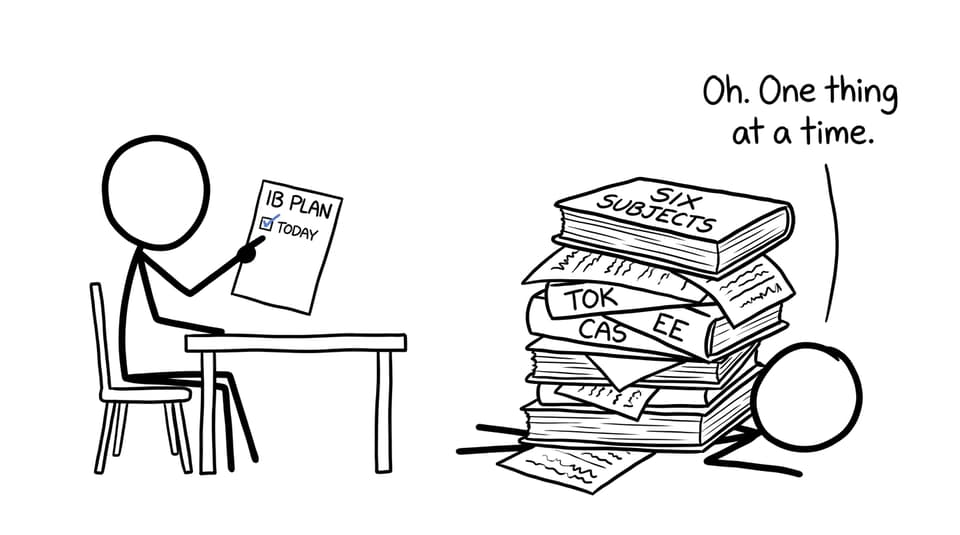
The IB Diploma can look like a collection of unfamiliar abbreviations: HL, SL, TOK, EE, CAS and, in Australia, IBAS. Parents often wonder whether it will be recognised by universities, whether it suits their child and how much support to provide when assessments begin to converge.
The reassuring answer is that the full IB Diploma is recognised as a senior secondary qualification by Australian universities. Results are converted into an ATAR-comparable rank for tertiary selection, although students must still satisfy course prerequisites and other admission requirements.
If you searched for a parent guide IB Diploma in Australia, this is the essential idea: the qualification is widely understood, but successful planning depends on three things: choosing suitable subjects, checking university requirements early and helping the student build sustainable study habits.
The IB Diploma in Australia at a glance
- Students normally complete six subjects over two years, usually three at Higher Level and three at Standard Level.
- The compulsory core consists of Theory of Knowledge, the Extended Essay and Creativity, Activity, Service.
- Each subject is graded from 1 to 7.
- Theory of Knowledge and the Extended Essay can contribute up to three additional points, creating a maximum Diploma score of 45.
- At least 24 points are normally required, alongside the IB's other passing conditions and completion of the core.
- Australian tertiary admissions centres convert eligible results into an ATAR-comparable rank.
- University entry can also depend on subject prerequisites, interviews, portfolios, tests and English requirements.
- Most Australian IB schools use the November examination session, but families should confirm dates with their school's IB coordinator.
RevisionDojo's IB syllabus and assessment overview provides a useful starting point for exploring current subjects and their assessment components.
What is the IB Diploma?
The Diploma Programme is an internationally administered curriculum for students aged 16 to 19. In Australia, it generally functions as an alternative to state and territory senior secondary qualifications such as the HSC, VCE, QCE, SACE and WACE.
Its breadth is deliberate. Students usually choose one subject from each of six groups covering language and literature, language acquisition, individuals and societies, sciences, mathematics and the arts. Within the programme's rules, an additional subject from another area may sometimes replace an arts subject.
Higher Level courses involve greater depth and recommended teaching time than Standard Level courses. Both levels are graded on the same 1-to-7 scale, so HL is not automatically worth more points. Its importance often lies in preparation for demanding university study or satisfying a particular prerequisite.
The core gives the programme its distinctive shape:
- Theory of Knowledge, or TOK, asks students to examine how knowledge is produced and justified.
- The Extended Essay, or EE, is an independently researched academic essay of up to 4,000 words.
- Creativity, Activity, Service, or CAS, requires sustained experiences outside conventional academic study. It contributes no numerical points but must be completed.
Families approaching the programme can use this IB Diploma preparation guide to turn the structure into practical first steps.
How IB assessment and scoring work
The IB does not rely on one final examination alone. According to the IB's current assessment guidance, most subjects combine externally assessed examinations with internal tasks. Internal work might include a science investigation, mathematics exploration, language oral, performance or subject-specific written investigation. Teachers mark many of these components before the IB moderates samples to maintain consistent standards.
Six subject grades can contribute up to 42 points. TOK and the Extended Essay can add up to three more. A total of 24 is the usual minimum threshold, but 24 points alone do not guarantee the Diploma because additional performance conditions and core requirements apply.
For parents, the practical lesson is important: school reports are signals, not final IB results. Ask whether a lower grade reflects missing knowledge, weak examination technique, an unfinished internal assessment or inconsistent time management. Each problem needs a different response.
How the IB becomes an ATAR-comparable rank
An IB student in Australia does not ordinarily receive an ATAR from the IB. Instead, tertiary admissions centres use the student's Diploma results to calculate an IB Admissions Score, or IBAS, and an ATAR-comparable Combined Rank. Victoria commonly uses the term Notional ATAR for tertiary selection.
Since the November 2022 session, students sitting the Diploma in Australia can receive a fine-grained IBAS in quarter-point increments. This uses more detailed subject performance to distinguish between students with the same whole-number Diploma total. The conversion schedule is nationally agreed and may change between admission cycles.
For 2027 university entry, the national schedule published in June 2026 maps a whole Diploma score of 45 to the maximum rank of 99.95. Families should not build plans around a single conversion example, however. Use the table applying to the student's exact examination and offer cycle, then confirm it through the relevant admissions centre.
| Student location or application route | Admissions body commonly involved |
|---|---|
| New South Wales and Australian Capital Territory | UAC |
| Victoria | VTAC |
| Queensland | QTAC |
| South Australia and Northern Territory | SATAC |
| Western Australia | TISC |
The school coordinator must usually arrange or authorise release of official IB results to the appropriate admissions service. Families should confirm that process before results arrive rather than assuming it happens automatically in every case.
Understanding IB university requirements
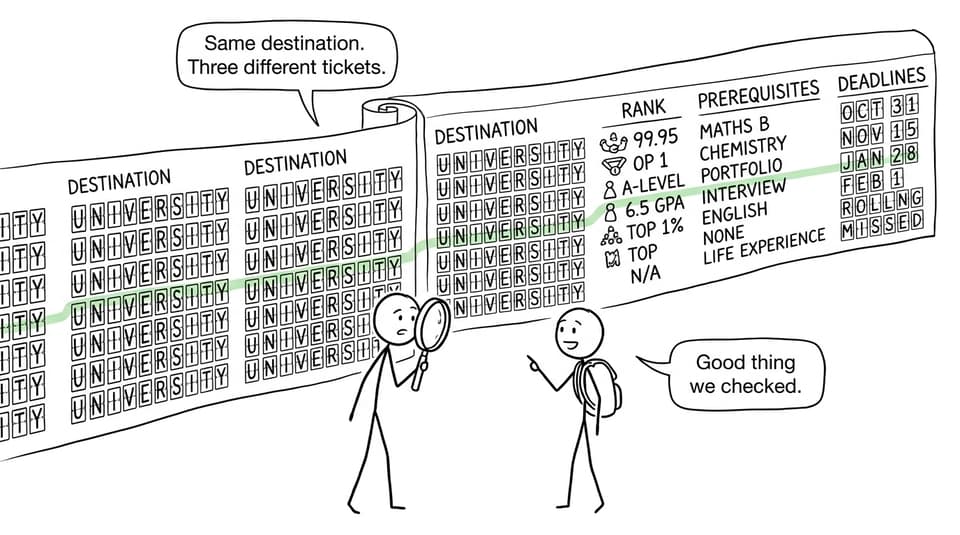
A converted rank answers only one admissions question: how competitive is the student's overall result? It does not prove that every course requirement has been met.
A degree may require a particular level and grade in mathematics, English, chemistry or another subject. Some programmes also use admissions tests, interviews, auditions, portfolios or personal statements. Assumed knowledge is different from a formal prerequisite, but entering without it may still make first-year study harder.
Before subjects are finalised, parents and students should check:
- the university's official course page;
- the relevant tertiary admissions centre listing;
- required or recommended IB subjects and levels;
- minimum grades within those subjects;
- additional selection criteria and application deadlines; and
- whether the published requirement applies to the student's intended intake year.
This is where subject selection becomes consequential. A student should not choose Mathematics: Analysis and Approaches, Chemistry or Biology merely because someone says it is prestigious. Nor should they avoid a demanding subject if it preserves access to a degree they genuinely want.
Choosing an Australian IB school
The IB is offered by authorised government, independent and international schools across Australia. The school name matters less than the quality of implementation your child will experience every week.
Ask prospective schools which HL and SL subjects actually run, since an authorised school may not offer every IB subject. Investigate class sizes, timetable clashes, language options, Extended Essay supervision, university counselling and how internal deadlines are distributed. Also ask what happens when a student struggles: early intervention is more valuable than an impressive brochure.
Useful school-selection questions include:
- How experienced are the teachers in the current subject syllabus?
- Which subject combinations ran during the previous two years?
- How are TOK, EE, CAS and internal deadlines coordinated?
- What academic and wellbeing support is available?
- How does the school advise families about Australian university prerequisites?
- Are there additional programme, examination, technology or activity costs?
Verify current authorisation through the official IB World School directory. A school should be chosen for fit, not simply because its strongest graduates achieved exceptional scores.
Subject choices in the Australian context
The IB's provisional November 2025 statistical bulletin recorded 3,016 candidates in Australia. However, publicly available national data does not provide a simple, decision-ready ranking of every subject combination chosen by Australian students. Claims about the single “most popular” Australian combination should therefore be treated cautiously.
In practice, English and mathematics form part of most Diploma combinations, while sciences and humanities vary with interests, school availability and university plans. Rather than following popularity, compare three factors: the student's strengths, the assessment style and the prerequisites attached to possible degrees.
Students considering science-intensive pathways can explore RevisionDojo's current IB Biology resources, IB Chemistry resources and IB Physics resources. Those planning quantitatively demanding courses can review the IB Mathematics AA resources. These hubs make the workload and question styles more visible before subject decisions become difficult to reverse.
How parents can support exam preparation
The most useful parental role is not to become a second IB coordinator. It is to make consistency easier.
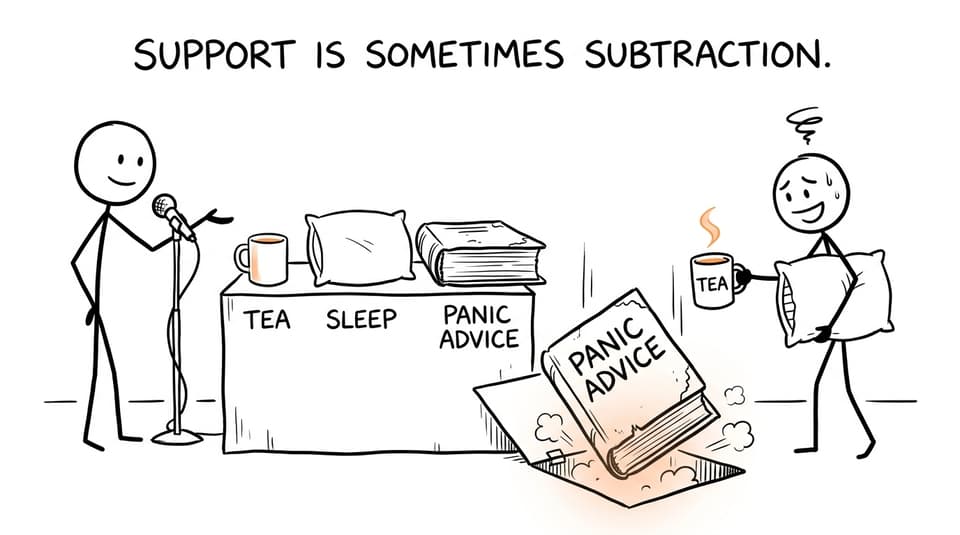
Hold a short weekly check-in focused on the next deadlines, not the entire two-year programme. Encourage the student to name one content gap, one assessment priority and one recovery habit for the week. Protect sleep, meals and uninterrupted study blocks, particularly as internal work and examination preparation overlap.
Watch for persistent changes rather than one difficult evening. Ongoing sleep disruption, withdrawal, panic or inability to begin work deserves a calm conversation with the student and, where appropriate, the school wellbeing team or a qualified health professional.
Revision should gradually move from reading to retrieval and application. A practical sequence is to clarify a topic with IB revision notes by subject, recall it without looking, answer targeted questions and finally practise under timed conditions. RevisionDojo's guide to studying for IB exams explains this loop in more detail.
A calmer path through the Diploma
The IB Diploma is demanding because several kinds of work run at once. That does not mean every evening should feel like an emergency. Good systems convert a large qualification into smaller, visible decisions.
RevisionDojo can serve as the student's central IB workspace: Study Notes for explanation, Flashcards for recall, a Questionbank for targeted practice and AI Chat for specific questions. As examinations approach, Predicted Papers and Mock Exams support timed rehearsal, while Grading tools, the Coursework Library and specialist Tutors provide more focused feedback when uncertainty persists. Students can begin with the RevisionDojo IB resource hub and build only the routine they need.
For parents, the next step is simple: confirm school fit, record likely university prerequisites and agree on one weekly planning conversation. The Diploma becomes less mysterious once the family stops trying to manage everything at once and starts protecting the next sensible action.