


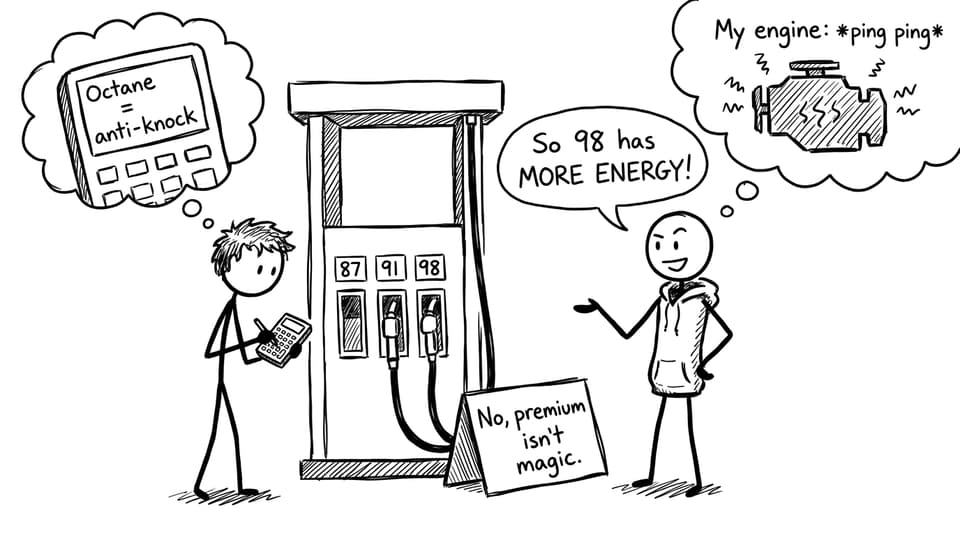
Octane rating is one of those IB Chemistry ideas that feels small until you notice it everywhere. You hear “premium fuel,” you see numbers at a petrol station, and suddenly an engine is either smooth as a metronome or making that angry metallic ping. The weird part is that most confusion comes from a single mistaken belief: that a higher number means “more power.” In IB Chemistry, octane rating is not about how much energy a fuel contains. It’s about how patient the fuel is when pressure and heat start rising.
In exam questions, that patience turns into marks: structure, isomerism, combustion, and industrial processes (cracking and reforming) all show up in one neat storyline. Let’s make it simple.
Octane rating (IB Chemistry definition you can use)
In IB Chemistry, octane rating is a measure of a petrol fuel’s resistance to knocking (premature ignition) in a spark-ignition engine.
Think of it like a “calm under pressure” score.
Quick checklist: what a higher octane rating means
-
Less knocking under compression
-
More controlled combustion
-
Better suited for high-compression or turbo engines
-
Not automatically more energy per mole or per gram
If you want the syllabus-aligned context, the Energy from fuels section on RevisionDojo is the cleanest home base: R1.3 Energy from fuels.
What is “knocking” and why does it happen?
A petrol engine is supposed to burn fuel in a controlled wave after the spark. The piston compresses the fuel-air mixture, a spark fires at the correct moment, and the expanding gases push the piston down.
Knocking happens when part of the mixture ignites too early (or combusts unevenly) because the temperature and pressure get high enough before the spark event finishes doing its job. Instead of one smooth push, you get competing pressure waves. That’s the “pinging” sound and the performance loss.
In IB Chemistry terms, knocking connects to reaction conditions and how hydrocarbon structure affects combustion pathways.
How octane rating is measured (the 0 to 100 story)
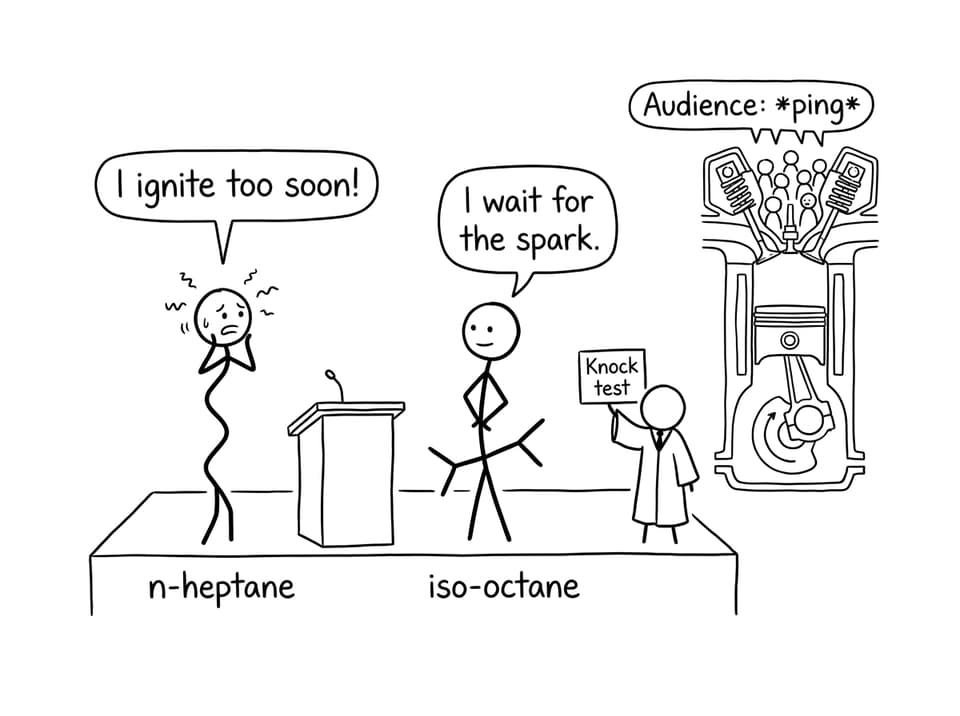
The octane scale is built on two reference hydrocarbons:
-
Iso-octane (2,2,4-trimethylpentane) has very high knock resistance and is assigned 100.
-
n-heptane knocks easily and is assigned 0.
A fuel’s octane number matches the % of iso-octane in an iso-octane/n-heptane mixture that behaves the same way in a standardized knock test.
Example: 90 octane behaves like a mixture of 90% iso-octane and 10% n-heptane.
This is pure IB Chemistry exam fuel: definitions, named molecules, and structure-property links.
IB Chemistry: Which molecular structures increase octane rating?
Here’s the pattern you actually need to remember:
Branched alkanes tend to have higher octane ratings
Branching generally increases knock resistance. Branched molecules often combust more smoothly in the engine conditions used for testing.
Aromatic hydrocarbons can have very high octane ratings
Aromatics (like benzene derivatives) strongly resist knocking. In real fuel design, this can raise environmental and health considerations, but from an IB Chemistry perspective the key point is the structure-property relationship.
Straight-chain alkanes tend to have lower octane ratings
Long, straight chains often ignite more readily under compression, increasing knock risk.
If you want to tighten your organic structure intuition, pair this article with RevisionDojo’s topic hub: IB Chemistry Organic Chemistry (HL).
How refineries increase octane rating: cracking and reforming
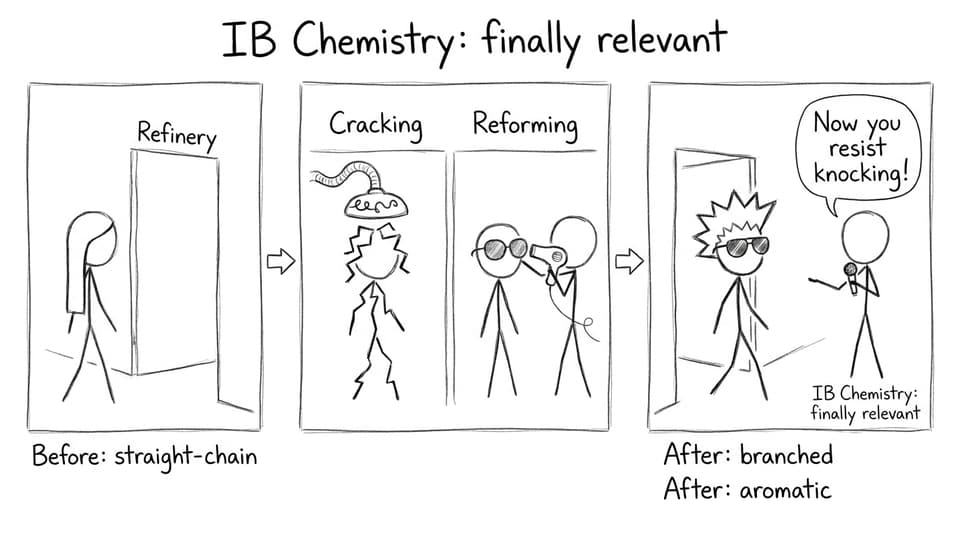
In IB Chemistry, you’re expected to connect octane rating to industrial processes. Refineries don’t just “find” perfect petrol in crude oil. They reshape molecules.
Cracking: breaking larger hydrocarbons into smaller ones
Cracking produces shorter-chain alkanes and alkenes. Those alkenes and smaller fragments become useful feedstock for creating better fuel blends.
Reforming: rearranging structures to resist knocking
Reforming converts straight-chain hydrocarbons into branched, cyclic, or aromatic hydrocarbons, which generally increases octane rating.
RevisionDojo’s dedicated explanation is worth reading because it mirrors common exam phrasing: Reforming Explained Simply.
Common IB Chemistry misunderstandings (the ones that cost marks)
“Higher octane means more energy”
In IB Chemistry, octane rating measures knock resistance, not energy content. Energy content relates more to enthalpy of combustion per mole (and how complete combustion is), not the octane number on the pump.
“Premium fuel always improves performance”
Only engines designed for higher octane benefit. If an engine doesn’t need high knock resistance, higher octane may not change anything meaningful.
“Boiling point decides octane rating”
Boiling point trends matter for fraction separation, but octane rating depends heavily on molecular structure (branching, aromaticity), not just volatility.
Exam-focused mini plan for IB Chemistry students
If octane rating is on your list for this week, a good RevisionDojo loop looks like this:
-
Learn the definitions and reference fuels using R1.3 Energy from fuels Notes.
-
Drill key terms with R1.3 Energy from fuels Flashcards.
-
Apply under pressure with R1.3 Energy from fuels Questionbank.
That loop (learn, recall, apply, correct) is where IB Chemistry grades actually move.
Conclusion: the simple IB Chemistry takeaway
Octane rating, in IB Chemistry, is the story of timing. A high octane fuel doesn’t bring “extra energy” to the engine; it brings control, resisting premature ignition so combustion happens when the spark says so. The structure link is the exam gold: straight-chain alkanes lower, branched and aromatic higher, and industrial processes like cracking and reforming shift compositions to raise octane rating.
If you want to turn this understanding into points quickly, use RevisionDojo as your one-stop system: Study Notes to learn, Flashcards to retain, the Questionbank to apply, plus AI Chat, Grading tools, Predicted Papers, Mock Exams, a Coursework Library, and Tutors to tighten the feedback loop. Octane rating is a small topic, but it’s a perfect IB Chemistry practice arena: definition, structure, industry, and real-world reasoning in one.