RevisionDojo logoRevisionDojo logo
FeaturesSubjectsPricingSchools
Back to all posts
  1. Home
  2. /Blog
  3. /IB Chemistry Reforming Explained Simply

IB Chemistry Reforming Explained Simply

IB Chemistry
RevisionDojo Team
•Last updated: 19 Jul 2026•6 min read
ShareShare on XShare on WhatsAppShare on LinkedInShare on Facebook
Add as a preferred source on Google
IB Chemistry Reforming Explained Simply

Join 650k+ students breezing through the IBReady to breeze through the IB?

Footer

General

  • Download apps
  • For parents
  • For schools
  • Pricing
  • Gift RevisionDojo
  • Tutoring
  • IB syllabus
  • MYP syllabus
  • Blog
  • Student Questions

Features

  • Question Bank
  • Test Builder & Exam Mode
  • Predicted Papers
  • Past Papers
  • Study Notes
  • Interactive Lessons
  • Flashcards
  • Jojo AI Tutor
  • Coursework Studio
  • View all features

Research

  • All research
  • Jojo AI vs leading AI study tools
  • 2026 State of Learning Survey
  • 2025 State of Learning Survey
  • IB Moderation Analysis
  • Jojo AI vs ChatGPT
  • Jojo AI vs Gemini
  • Jojo AI vs Perplexity
  • Jojo AI vs Claude
  • Jojo AI vs Poe

Platform

  • About RevisionDojo
  • RevisionDojo vs Others
  • Content philosophy
  • Trustpilot
  • Join usWe're hiring
  • Student Ambassador
  • Help center
  • Contact us
  • Terms of Service
  • Data & privacy
  • Privacy policy
  • Cookie policy
  • Trust Center

IB Subjects

  • Arabic A
  • Arabic A Lit
  • Arabic ab initio
  • Arabic B
  • Biology
  • Business Management
  • Chemistry
  • Chinese A Lang & Lit
  • Chinese B
  • Computer Science (CS)
  • Computer Science (First Exam 2027)
  • Design Technology (DT)
  • Design Technology (First Exam 2027)
  • Digital Society (DS)
  • Economics
  • English A Lang & Lit
  • English A Lit
  • English B
  • Environmental systems and societies (ESS)
  • French A
  • French A Lit
  • French ab initio
  • French B
  • Geography
  • German A
  • German A Lit
  • German ab initio
  • German B
  • Global Politics
  • History
  • History (First Exam 2028)
  • Mathematics Analysis and Approaches (AA)
  • Mathematics Applications & Interpretation (AI)
  • Philosophy
  • Physics
  • Psychology
  • Psychology (First Exam 2027)
  • Spanish A
  • Spanish A Lit
  • Spanish ab initio
  • Spanish B
  • Sports, exercise and health science (SEHS)
  • Theory of Knowledge (TOK)
  • World Religions

MYP Subjects

  • MYP Biology
  • MYP Chemistry
  • MYP Design
  • MYP English Lang & Lit
  • MYP Extended Mathematics
  • MYP History
  • MYP Individuals & Societies
  • MYP Integrated Sciences
  • MYP Physics
  • MYP Standard Mathematics
  • MYP Biology
  • MYP Chemistry
  • MYP Design
  • MYP English Lang & Lit
  • MYP Extended Mathematics
  • MYP History
  • MYP Individuals & Societies
  • MYP Integrated Sciences
  • MYP Physics
  • MYP Standard Mathematics
RevisionDojo logo

© 2022 - 2026 RevisionDojo (MyDojo Inc)

RevisionDojo was developed independently of the IBO and as such is not endorsed by it in any way.

Download on the App StoreGet it on Google Play
GDPR compliant

If you’ve ever stared at an organic question and thought, why would anyone purposely mess with hydrocarbons like this?; welcome to IB Chemistry reforming.

Reforming is one of those syllabus ideas that feels industrial and distant until you realise it’s really just a story about making the same carbon atoms more useful. Refineries don’t want “more molecules” (that’s closer to cracking). They want better molecules: ones that burn smoothly, resist knocking, and carry more value.
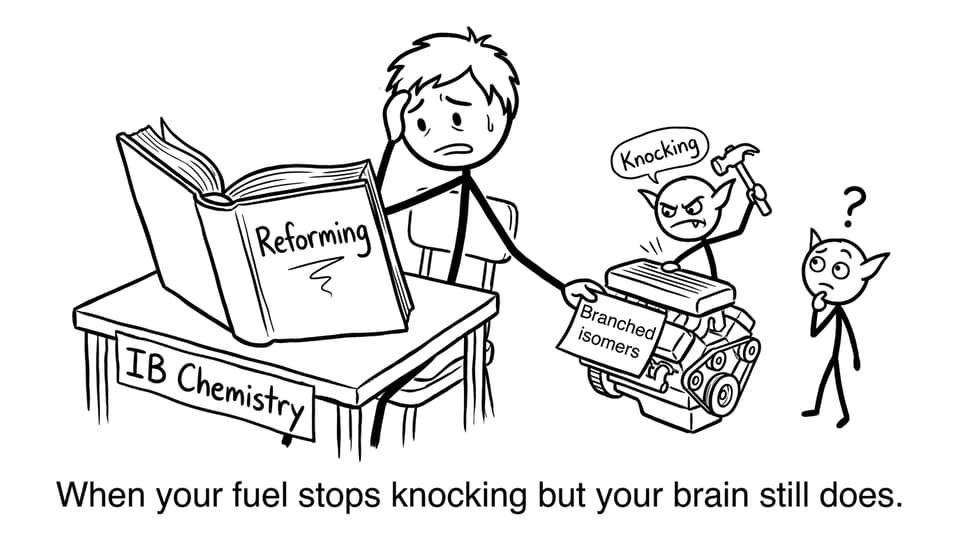
When your fuel stops knocking but your brain still does.

Reforming in IB Chemistry (quick definition)

In IB Chemistry, reforming is the process of converting straight-chain hydrocarbons into branched, cyclic, or aromatic hydrocarbons to improve fuel quality and usefulness.

Typical conditions you should remember for IB Chemistry answers:

  • High temperature (often around 500°C for catalytic reforming)

  • A catalyst (commonly platinum on alumina)

  • Often a hydrogen atmosphere

If catalysts feel fuzzy, revise the marks-friendly phrasing in IB Chemistry: What Is a Catalyst and How It Works.

The “exam checklist” for IB Chemistry reforming

Before you write any explanation, run this quick checklist (it saves time in IB Chemistry Paper 2 style questions):

  • Say reforming rearranges hydrocarbons (not necessarily smaller)

  • Link straight chains to low octane and knocking

  • Link branching/aromatics to higher octane and smoother combustion

  • Mention catalyst + high temperature

  • Include that hydrogen can be produced (especially via dehydrogenation)

For more exam training structure, pair this with How to Avoid Common Mistakes in IB Chemistry Exams.

Why reforming matters (knocking, octane, and real engines)

Straight-chain alkanes can ignite too easily in engines. In IB Chemistry, you describe this as causing engine knocking: premature, uneven combustion that reduces performance.

Branched and aromatic hydrocarbons resist that premature ignition. They burn more smoothly, giving fuels a higher octane rating and cleaner performance.

This is also where your combustion knowledge quietly connects. If you need a clean reminder of incomplete combustion products and why they matter, see R1.3.2 Incomplete combustion Notes.
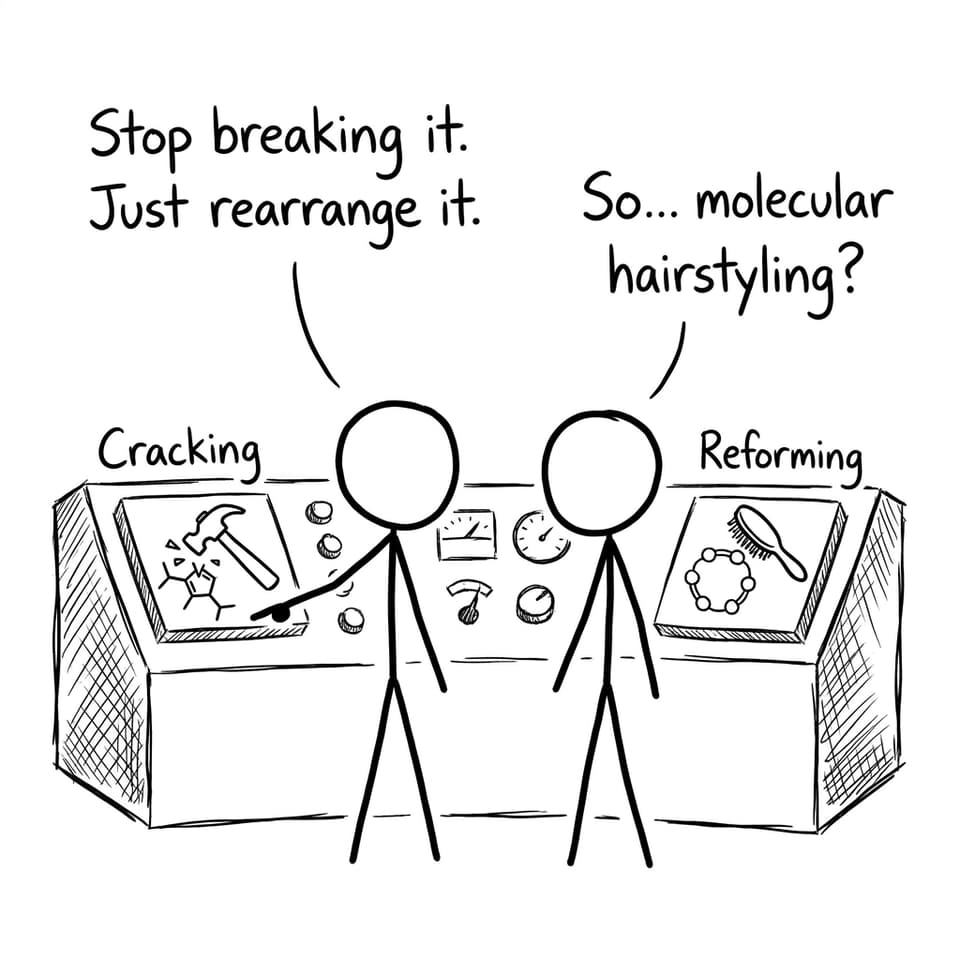
Cracking vs reforming joke comic

Types of reforming you need for IB Chemistry

Isomerisation (straight chaintobranched)

This is the most “gentle” kind of reforming in IB Chemistry: you keep the formula the same, but rearrange the structure into a branched isomer.

Example you can quote:

  • n-butanetoisobutane

Key exam payoff: branched isomers have higher octane.

Catalytic reforming (chainstorings and aromatics)

Catalytic reforming pushes hydrocarbons toward cyclic and aromatic structures, which are valuable in fuels and as chemical feedstocks.

What to remember for IB Chemistry:

  • Often around 500°C

  • Platinum catalyst

  • Hydrogen environment

Aromatics like benzene and toluene show up as products in many textbook examples.

Dehydrogenation (making H2 while stabilising structures)

Dehydrogenation removes hydrogen, which can help form more stable ring systems.

Classic example:

  • Cyclohexane to benzene + 3H2

In IB Chemistry, it’s a great point to add that hydrogen produced can be reused in other industrial steps.
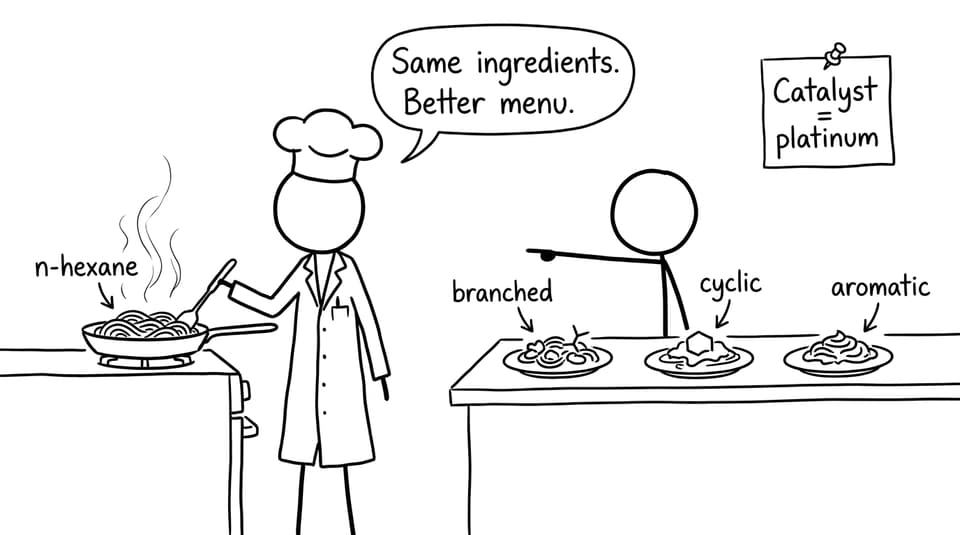
Same ingredients. Better menu.

Reforming vs cracking (don’t lose easy marks)

Students mix these up under time pressure.

  • Cracking: breaks big hydrocarbons into smaller alkanes/alkenes.

  • Reforming: rearranges hydrocarbons into branched/cyclic/aromatic forms.

If you want a broader hydrocarbon structure refresher, Why Do Hydrocarbons Vary In Structure And Reactivity? connects structure to properties in the exact way IB Chemistry likes.

How to revise IB Chemistry reforming with RevisionDojo

Reforming is small in content, big in marks because it tests explanation quality.
A strong loop looks like this:

  • Read the syllabus-aligned IB Chemistry Organic Chemistry Notes

  • Drill exam-style items in the Organic Chemistry Questionbank

  • Use Flashcards to lock in definitions and conditions

  • Use AI Chat to practise “explain why” answers with feedback

  • Build timed sets with Mock Exams, then review using Grading tools

For a bigger planning framework, start at IB Chemistry - RevisionDojo.

Closing: make reforming a “free marks” topic

Reforming is basically molecular rearrangement with a purpose: in IB Chemistry, it turns straight chains into branched, cyclic, and aromatic hydrocarbons so fuels burn better and carry more value. Learn the conditions, separate it cleanly from cracking, and practise one or two example transformations until they feel automatic.

If you want reforming to become a quick-confidence topic, use RevisionDojo’s Study Notes, Questionbank, Flashcards, AI Chat, and Mock Exams to train the exact explanations examiners reward. You can also browse more targeted support under the IB Chemistry Posts tag and build your next timed set with intention.

How helpful was this article?
Add as a preferred source on Google

Continue studying with RevisionDojo

  • IB Coursework GraderCheck an IA, EE, or TOK draft against IB assessment criteria.
  • IB Coursework ExamplesLearn from high-scoring coursework across IB subjects.
  • IB Grade CalculatorEstimate an IB grade using session-specific boundaries.
  • IB Grade BoundariesExplore historical grade boundaries by subject and session.

Frequently Asked Questions

IB en España · Oct 24, 2026 · 9

Cómo preparar Química IB antes del Diploma

Qué repasar en 4.º de ESO y durante el verano para preparar Química del IB antes del Diploma, con un plan práctico para NM y NS.

IB en España · Oct 24, 2026 · 9

Cómo tomar apuntes de Química del IB

Aprende a crear apuntes de Química del IB útiles para NM y NS con Cornell, mapas conceptuales, resúmenes, recuerdo activo y práctica de examen.

IB en España · Oct 23, 2026 · 10

Cómo recuperar Química IB tras un mal primer año

Plan práctico para recuperar Química IB tras un mal primer año: diagnostica lagunas, fija prioridades y mejora con práctica corregida y apoyo eficaz.

IB en España · Oct 23, 2026 · 9

Rutina de estudio de Química IB: horario semanal

Organiza Química del IB con una rutina semanal realista para NM y NS, práctica activa, repaso espaciado y un horario compatible con el Diploma.

May 2028 Cohort · Oct 22, 2026 · 12

May 2028 IB Chemistry Study Advice That Works

May 2028 IB chemistry study advice: build a syllabus-aligned plan for SL or HL, practise calculations and data skills, and avoid exam errors early.

May 2028 Cohort · Oct 22, 2026 · 12

How to Get a 7 in IB Chemistry 2028

How to get a 7 in IB Chemistry 2028 with a two-year plan for Paper 1, Paper 2 and the scientific investigation, aligned to the current guide.

Related Articles
min read
min read
min read
min read
min read
min read