
A quiet moment before the big decision
In the MYP, the most stressful part of the Personal Project often happens before you write a single word.
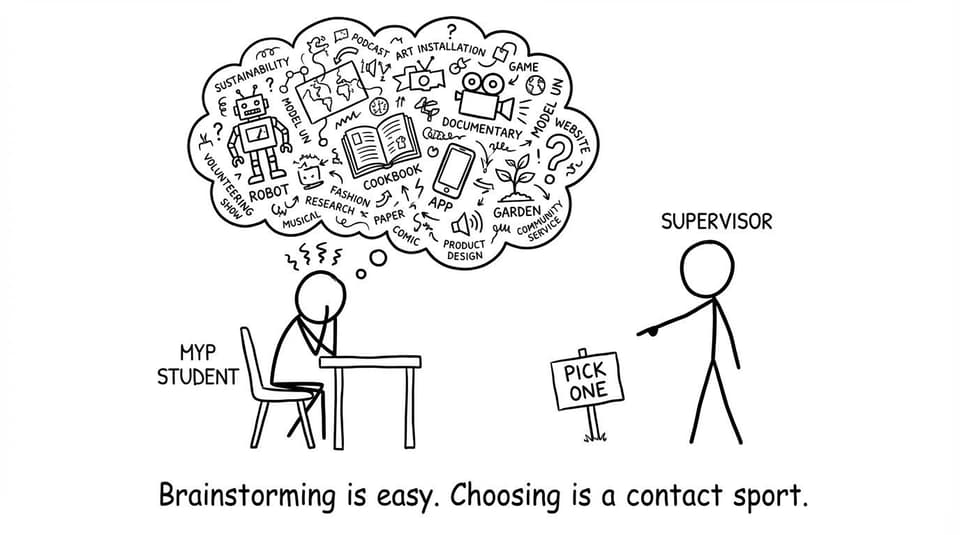
It happens when your teacher says, "Start thinking of a topic," and your brain does that thing where it offers you two options: either nothing or everything.
Nothing feels too boring to spend months on. Everything feels too big to finish. And in the middle is the real challenge of the MYP Personal Project: choosing a topic that's personal enough to care about, specific enough to manage, and structured enough to score well.
That decision matters more than most students realize. A strong topic makes research easier, planning calmer, evidence clearer, and reflection more honest. A weak topic turns into a long season of "I'm behind" and "I don't know what to write."
If you're an IB student preparing for exams, you might wonder why the MYP Personal Project still matters. The answer is simple: it trains the same muscles you'll need later for DP coursework and timed exams, including narrowing scope, writing clearly, using evidence, and sticking to a plan when motivation fades.
The MYP topic checklist (steal this)
Before you commit to any MYP Personal Project topic, run it through this quick checklist:
- Personal pull: Would you still do some version of this if it wasn't graded?
- Clear goal: Can you finish the sentence: "My goal is to…"?
- Realistic scope: Can you complete it with the time, skills, and materials you actually have?
- Evidence-rich: Will you naturally generate photos, drafts, data, feedback, screenshots, or logs?
- Global Context fit: Can you explain the "why" in one paragraph, not one line?
- Reflection potential: Will you face choices, tradeoffs, and problems worth reflecting on?
If you get five "yes" answers, your MYP topic is usually strong enough to start.
What makes a strong MYP Personal Project topic?
A strong MYP Personal Project topic is not "impressive." It's workable.
Most students think top projects begin with a genius idea. In reality, top projects begin with a normal idea that got refined carefully.
You can watch this pattern in real student work: the best Personal Projects are usually built from three ingredients:
Personal meaning
In the MYP, personal meaning is not a cute extra. It's fuel. When the timeline gets tight, your topic has to pull you back.
Personal meaning can come from:
- a hobby you already love
- a skill you want (and need) to build
- a problem you notice in your school/community
- an identity story you want to understand
If you need inspiration, skim a few examples and notice what they have in common: they're specific and rooted in the student's life.
Use: Real Examples of IB MYP Personal Projects for Inspiration
A narrow, concrete goal
A topic is a theme. A goal is a finish line.
In MYP, "I want to learn about nutrition" is a theme. "I will design and test a 4-week nutrition plan for teenage athletes, using feedback from two teammates" is a goal.
A concrete goal protects you from drifting. It also makes Criteria A-D easier, because your planning, action, and reflection can anchor back to one clear target.
A product/outcome that creates evidence
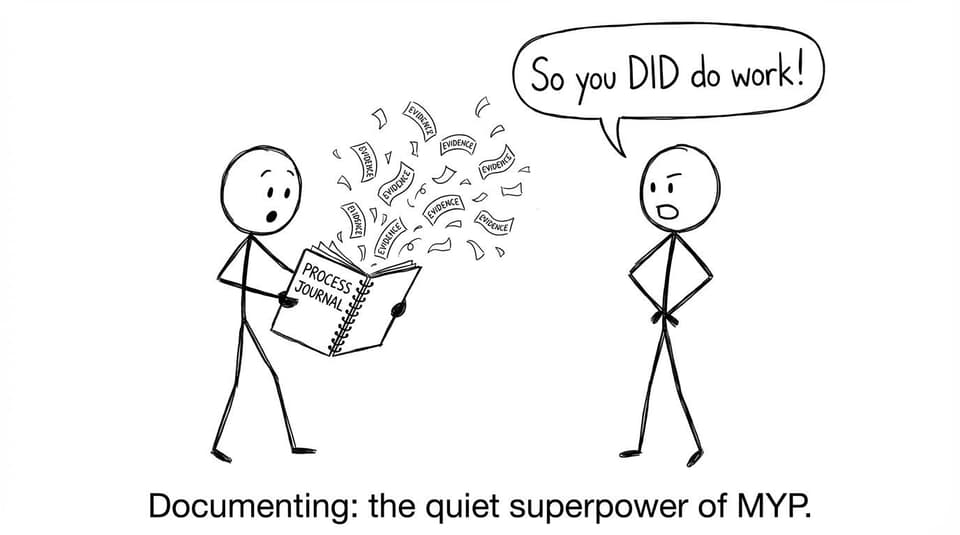
The Personal Project doesn't just reward thinking. It rewards documented thinking.
The best MYP topics naturally generate evidence:
- prototypes and iterations
- before/after comparisons
- surveys/interviews
- design drafts
- practice logs
- user feedback
That evidence becomes your process journal, and your report basically writes itself.
The most common MYP topic mistake: "too big"
In the MYP, students don't usually fail because they pick a bad topic.
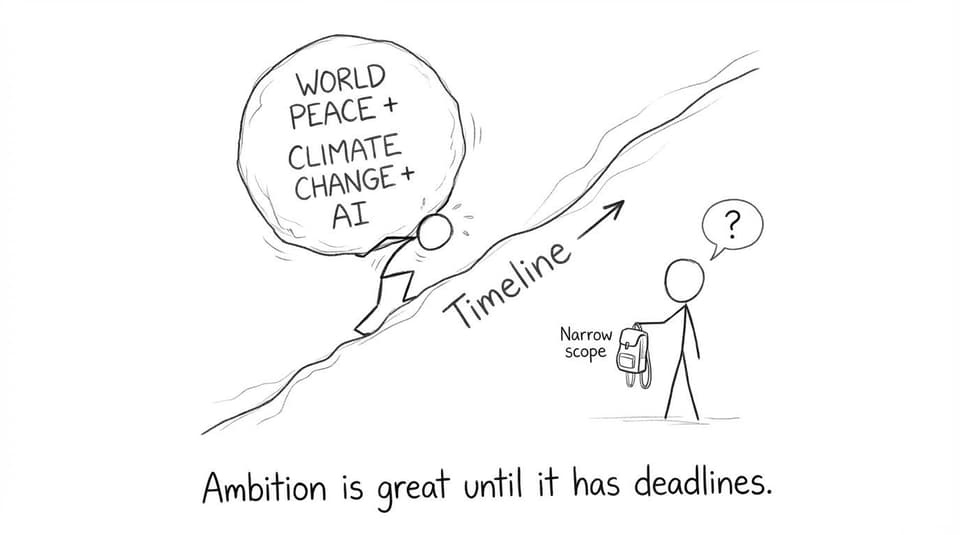
They struggle because they pick a topic that is three projects disguised as one.
- "Mental health" becomes psychology + school policy + social media ethics.
- "Sustainability" becomes climate science + fast fashion + economics.
- "Technology" becomes AI bias + cybersecurity + app development.
Ambition is good. But an MYP Personal Project is not a lifetime mission. It's a focused demonstration of skills.
How to shrink a topic without losing meaning
Try one of these "scope reducers":
- Choose one audience: students in your grade, new students, a sports team, one club.
- Choose one format: a guidebook, a prototype, a short film, a workshop, a small product line.
- Choose one measurable change: "increase," "reduce," "improve," "create," "teach," "test."
- Choose one time window: two weeks of testing, four iterations, three interviews.
This is the hidden skill the MYP is really teaching you: focus.
Make your MYP topic examiner-friendly (without killing your creativity)
A strong MYP topic should be creative, but it should also be easy to assess. Examiners can't grade your intention. They grade what you show.
Here are three ways to make your project clearer to assess:
Turn your topic into a one-sentence goal
Use this template:
In the MYP, my goal is to [create/do] a [specific product/outcome] for [specific audience] to address [specific need], connected to [Global Context].
If your sentence is messy, your topic is still too broad.
Define success criteria early
Success criteria are the difference between "I think it went well" and "Here's how I evaluated it."
Examples:
- "My app will have 10 functioning flashcards, a quiz mode, and feedback from 5 users."
- "My cookbook will include 12 recipes, nutrition research for each, and two rounds of taste-test feedback."
That evaluation language will later help Criterion D in your MYP report.
Need help structuring your report later? Save this for future-you:
Build a topic that forces reflection
In MYP, reflection is not "I enjoyed this." Reflection is:
- what changed
- what surprised you
- what failed first
- what you improved second
- what you'd do differently third
Choose a topic with room for mistakes and iteration. That's where the best reflections come from.
A practical way to brainstorm MYP topics in 20 minutes
When students get stuck in the MYP, it's often because brainstorming feels like pressure.
Instead, try this simple exercise:
Step 1: List 10 "things I care about"
No filtering. Include serious and silly.
Step 2: Add one skill you want to build
Coding, cooking, drawing, filming, writing, coaching, organizing, interviewing.
Step 3: Combine one care + one skill
Examples:
- care: sports + skill: design -> design a recovery routine guide
- care: culture + skill: filmmaking -> mini documentary with interviews
- care: environment + skill: sewing -> small sustainable product prototype
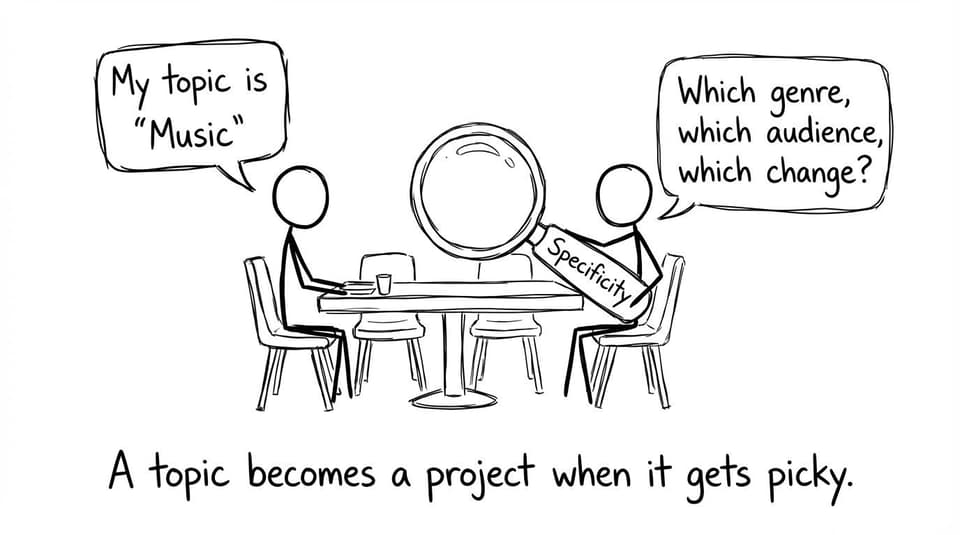
Step 4: Force specificity
Ask three questions:
- Which audience?
- Which product?
- Which time limit?
Then pick two ideas and run them through your MYP checklist.
How RevisionDojo helps you execute (and not just "choose")
Choosing a strong MYP topic is only half the job. The other half is staying consistent when other tests, homework, and exam prep show up.
RevisionDojo is built for that reality. When your Personal Project overlaps with studying, you don't need more motivation. You need better systems.
Here's a simple way to use RevisionDojo alongside your MYP work:
- Use Study Notes to research clearly and avoid messy sources: Study Notes
- Use Flashcards to remember key definitions or concepts you must explain in your report (especially for technical topics).
- Use AI Chat (Jojo AI) when you're stuck turning a big idea into a focused goal, or when you need feedback on clarity.
- Use the Grading tools to check your writing against rubric language and tighten your explanations: MYP Personal Project Grader
- Use the Coursework Library to see what high-quality structure and evidence can look like: IB Personal Project (MYP) Exemplars
And if you're also in full exam mode, RevisionDojo's Questionbank, Mock Exams, and Predicted Papers keep your academic confidence stable while your project progresses.
Explore:
Closing: choose a topic you can live with
In the MYP, your Personal Project topic is not a personality test. It's a commitment.
Pick something small enough to finish, meaningful enough to care about, and specific enough to document. Then build the habit that separates strong projects from stressful ones: consistent evidence.
If you want support while you choose and refine your MYP topic, use RevisionDojo as your backbone: review exemplars, check your rubric alignment, and lean on Jojo AI when your idea feels too big. Your future self, the one walking into exams with calmer confidence, will thank you.
Start here: