

Every MYP student has a moment like this: you finally find a project idea you actually care about… and then the Global Context box stares back at you.
It feels like a small choice, but it isn’t. In MYP, the Global Context is the lens that turns “something I made” into “something I investigated, justified, and learned from.” It shapes your inquiry, the evidence you collect, the reflection you write, and even how confident you feel when you explain your project out loud.
If you’re an IB student preparing for exams, this matters even more than you think. The MYP is concept-driven. When you get used to choosing the right lens, you train the same skill you’ll need later: connecting knowledge to meaning, quickly and clearly.
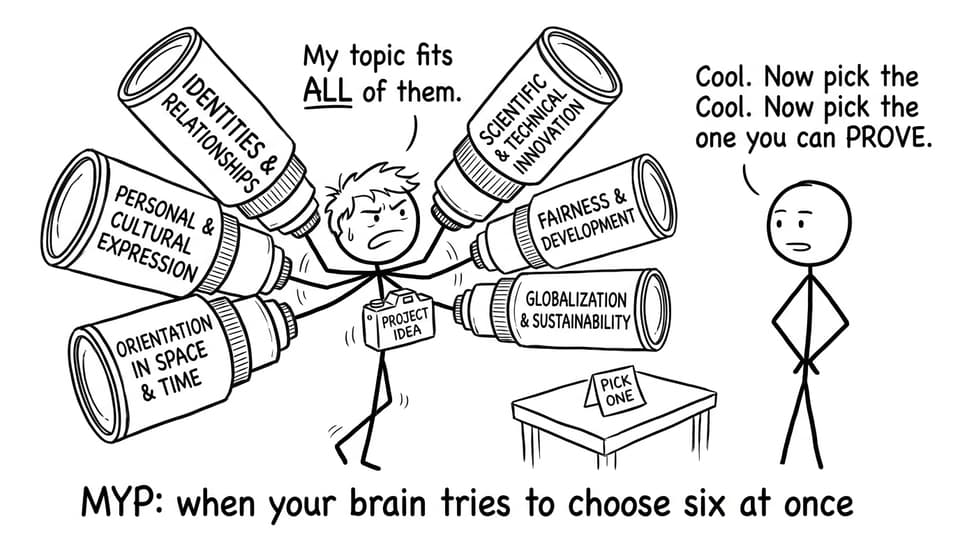
The quick MYP checklist (choose your context in 10 minutes)
Use this when your project is still fuzzy:
-
Write your goal in one sentence (no commas doing heavy lifting).
-
Finish this sentence: “This project matters because…”
-
Choose one MYP Global Context (not two “just in case”).
-
Name the real-world situation: school, community, family, online spaces, local environment.
-
List 3 pieces of evidence you can realistically collect (drafts, feedback, photos, data).
-
Draft a 4-sentence mini reflection that mentions the Global Context once.
If you get stuck, borrow clarity from RevisionDojo’s MYP ecosystem: the MYP Revision Guide: Study Tips for Success is a good reset when everything starts to blur.
What the MYP Global Context really does (and what it doesn’t)
The six Global Contexts in MYP aren’t decorations. They’re not labels you add at the end. They are a reason.
A useful way to remember it:
-
Your topic is what you’re doing.
-
Your product/outcome is what you’ll make or deliver.
-
Your Global Context is why a thoughtful person should care.
If your context doesn’t show up repeatedly in your investigation, decisions, and reflection, it will feel random to the reader (and to you). For a deeper explanation of how contexts connect to meaning across subjects, see Six Global Contexts in IB MYP: Real-World Applications.
How to match your project idea to the best MYP Global Context
Below are practical “if your why sounds like…” signals. Notice the pattern: in MYP, the best Global Context is usually hiding inside your because.
Identities and Relationships (MYP)
Choose this when your project is about people: well-being, belonging, relationships, self-image, or human development.
-
Good fits: mental health awareness campaign, peer study routines, healthy habits program.
-
Fast test: your “why” includes words like well-being, connection, identity, relationships, support.
If you want help scoping your idea so it stays evidence-rich, MYP Personal Project: How to Choose a Strong Topic is a strong companion.
Personal and Cultural Expression (MYP)
Choose this when your project is about voice: creativity, meaning, storytelling, beliefs, and how people express identity.
-
Good fits: short film, zine, music composition, cultural storytelling project.
-
Fast test: your “why” includes representation, message, creativity, expression, culture.
Orientation in Space and Time (MYP)
Choose this when your project uses history, heritage, place, timelines, or personal histories to explain change.
-
Good fits: a local history archive, migration stories, mapping community change over time.
-
Fast test: you keep saying then vs now, heritage, origins, or how the past shapes the present.
Scientific and Technical Innovation (MYP)
Choose this when your project explores how science or technology changes lives, and what responsibility comes with that.
-
Good fits: an app prototype, water filtration design, assistive tech tool, data-driven solution.
-
Fast test: your “why” includes innovation, impact, ethics, access, unintended consequences.
Fairness and Development (MYP)
Choose this when your project is about justice: rights, equity, power, access, or improving conditions for a group.
-
Good fits: advocacy work with measurable outcomes, equity resource packs, access-focused campaigns.
-
Fast test: your “why” includes rights, justice, inequality, opportunity, inclusion.
Globalization and Sustainability (MYP)
Choose this when your project is about systems: interconnected economies, environments, consumption, and long-term consequences.
-
Good fits: reducing waste in a school system, sustainable product redesign, local action linked to global patterns.
-
Fast test: your “why” includes systems, interdependence, sustainability, long-term, responsibility.
If you’re still torn between contexts, read MYP Personal Project Global Contexts Explained and compare its quick tests to your “this matters because” sentence.
The “prove it” rule: how MYP exam thinking helps your project
Here’s the quiet trick: the best MYP Global Context is the one you can prove with evidence.
Students often pick a context because it sounds impressive. But MYP assessment rewards clear connections. That means your context should appear in:
-
your research choices (what sources you used and why),
-
your design decisions (what you changed after feedback),
-
your evaluation (how you measured success),
-
your reflection (what changed in your understanding).
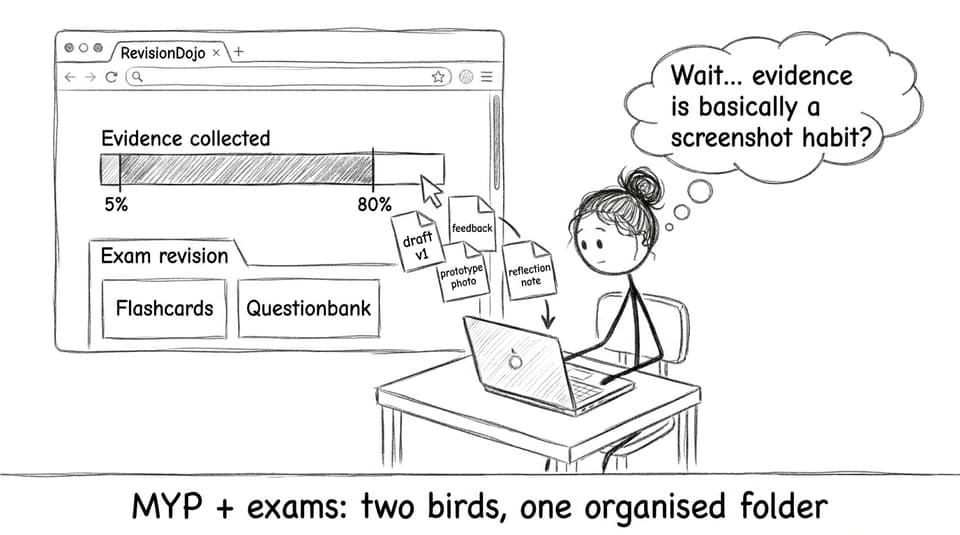
This is exactly the same mental move you practise in exam prep: claim -- evidence -- explanation. RevisionDojo’s tools are built around that loop. Use Questionbank to train explanation under pressure, and Flashcards to lock in key Global Context language and ATL phrasing so your reflections stay precise.
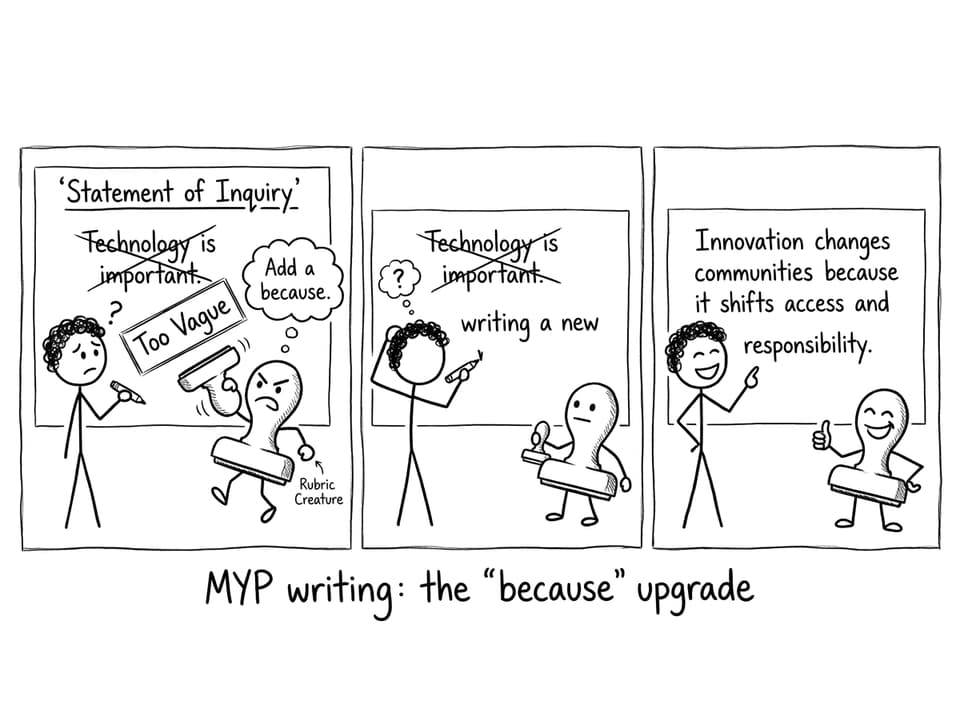
Turn your Global Context into a strong Statement of Inquiry (SOI)
In MYP, a Statement of Inquiry is a conceptual compass. It stops your project from becoming a list of tasks.
Try this simple SOI builder:
-
Start with a key concept (like change, systems, communication, relationships).
-
Add your Global Context.
-
Add a claim that could be argued, not just described.
-
Add a because clause.
If you want examples and a checklist, use Creating Meaningful Statements of Inquiry in the MYP.
Make your MYP project easier to write by choosing the context early
Your report becomes dramatically easier when your Global Context is chosen early, because your headings and evidence start to organise themselves.
A helpful guide for structure is MYP Personal Project Report Structure Explained. If you’re aiming for top bands, pair it with Writing an Outstanding MYP Personal Project Report.
And if you learn best by seeing what “good” looks like, use the IB Personal Project (MYP) Exemplars to calibrate your own work.
FAQ: Identifying the best Global Context for your MYP project
Can my MYP project fit more than one Global Context?
Yes, most real topics could connect to multiple contexts, because real life is messy and interconnected. But in MYP, trying to officially use more than one Global Context usually weakens your writing. Your report needs one clear through-line that repeats across investigation, action, and reflection. If you name two contexts, you often end up writing general statements that don’t prove anything. A better approach is to choose the single context you can support with the strongest evidence and reflection. You can still mention other connections briefly, but your main argument should stay anchored.
How do I know if my MYP Global Context is too vague?
If you can swap your Global Context for any other context and your project description still “sort of works,” it’s too vague. Another sign is when your explanation is only one sentence long and uses generic words like “important,” “relevant,” or “impacts society.” In MYP, the context must change what you research, who you design for, or how you evaluate success. Try the “prove it” test: list three pieces of evidence you will collect that directly connect to the context. If you can’t do that, tighten your goal, audience, or success criteria until the context becomes unavoidable.
What if I picked the wrong Global Context for my MYP project?
First, don’t panic. In MYP, changing your Global Context early can actually be a sign of good reflection, as long as you explain why the change happened. Look at your current evidence: what have you actually researched, built, tested, or measured? Often the “right” context is the one that matches what you already have proof for. Then rewrite your goal sentence and SOI so they align with that context, and adjust your reflection prompts accordingly. If you need a calm way to re-check alignment, RevisionDojo’s Grading tools and AI Chat can help you rewrite unclear paragraphs in rubric-friendly language, without losing your authentic voice.
Closing: choose the MYP Global Context you can live inside
The best Global Context for your MYP project isn’t the most dramatic one. It’s the one you can return to every week: when you research, when you make decisions, when you collect evidence, and when you reflect.
Pick the MYP lens you can prove. Then let it guide everything: your inquiry question, your Statement of Inquiry, your evaluation, and the story you tell about what changed.
When you’re ready to tighten your project and keep exam prep steady at the same time, build your routine in RevisionDojo: use Study Notes for clarity, Flashcards for recall, the Questionbank for application, AI Chat to get unstuck, Grading tools for rubric alignment, Mock Exams and Predicted Papers for timed practice, the Coursework Library for models, and Tutors when you need a human reset. Your MYP project becomes stronger when your system is calmer than your deadline.