


Molar mass is the quiet “exchange rate” behind almost every calculation in IB Chemistry. It’s the moment when the invisible world of particles finally becomes something you can hold: grams on a balance, a number in your calculator, a mark on Paper 1 and Paper 2.
If you’ve ever looked at a question and thought, “I know what they want, but I don’t know where to start,” the start is usually molar mass. Not because it’s complicated, but because it’s foundational. When molar mass is steady, stoichiometry feels steady.
What molar mass means in IB Chemistry
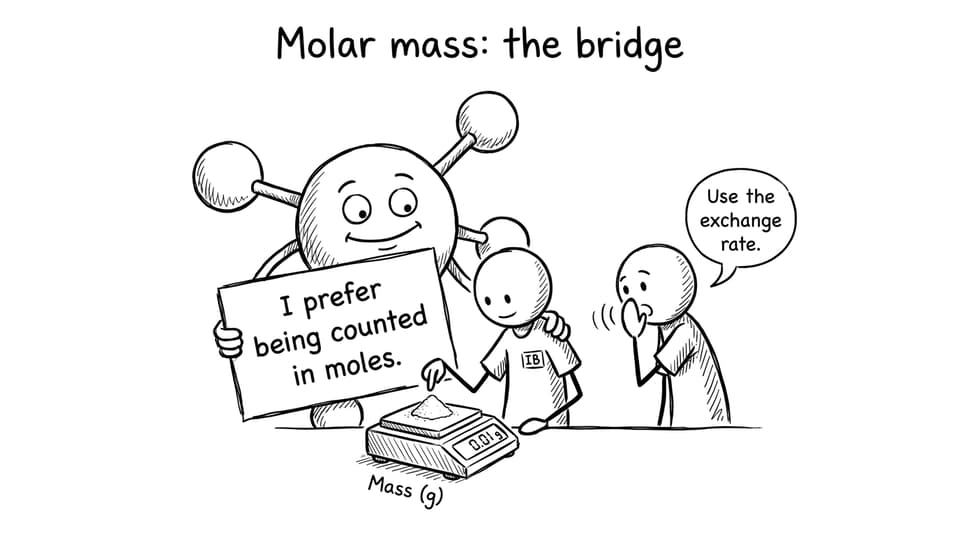
In IB Chemistry, molar mass (M) is the mass of 1 mole of a substance. Its unit is g mol⁻¹ (or g/mol).
One mole means a fixed number of particles: Avogadro’s constant, (N_A = 6.022 \times 10^{23}) particles per mole. So molar mass is the conversion link between:
-
particles (atoms, molecules, ions)
-
moles (mol)
-
measurable mass (g)
A useful mindset: molar mass doesn’t “change.” It’s a property of the substance, like a price tag per mole.
If you want syllabus-aligned support, the RevisionDojo topic hub for S1.4.3 Molar mass keeps the definitions, examples, and practice all in one place.
A 30-second molar mass checklist
Before you calculate anything in IB Chemistry, run this quick checklist:
-
Write the chemical formula carefully (subscripts matter).
-
Pull Aᵣ values from the periodic table.
-
Multiply Aᵣ by each subscript, then add.
-
Keep sensible decimals (don’t over-round early).
-
For hydrates, include the water.
Then you can move confidently into moles, limiting reactants, yields, and solutions.
How to calculate molar mass (with the exam patterns)
Elements
For an element, molar mass equals its atomic mass from the periodic table.
-
He: (M \approx 4.00,\text{g mol}^{-1})
-
Mg: (M \approx 24.31,\text{g mol}^{-1})
Molecules
Add atomic masses for every atom in the molecular formula.
Example: (\text{H}_2\text{O})
-
H: (1.01 \times 2 = 2.02)
-
O: (16.00)
-
Total: (18.02,\text{g mol}^{-1})
This is the same logic that powers moles-by-mass questions, like the ones explained in Calculate moles from mass and molar mass.
Ionic compounds
Same process. You’re adding the masses in one formula unit.
Example: (\text{NaCl})
-
Na: 22.99
-
Cl: 35.45
-
Total: (58.44,\text{g mol}^{-1})
Hydrated salts (the classic trap)
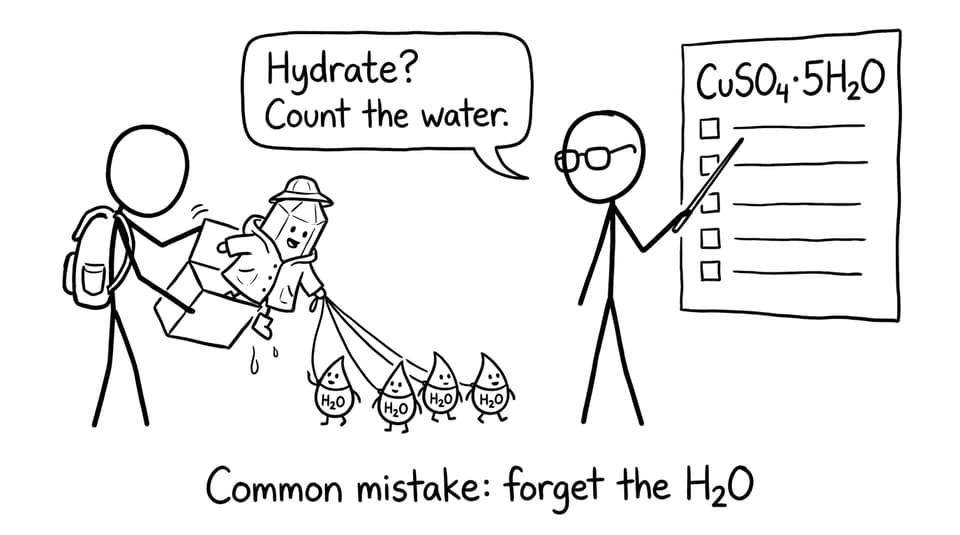
Hydrates include water molecules. The dot means “plus water in the crystal.”
Example: (\text{CuSO}_4\cdot 5\text{H}_2\text{O})
-
(\text{CuSO}_4): (63.55 + 32.07 + (16.00\times 4) = 159.62)
-
(5\text{H}_2\text{O}): (5 \times 18.02 = 90.10)
-
Total: (249.72,\text{g mol}^{-1})
If hydrates and the mole topic feel tangled, the notes in S1.4 Counting particles by mass: The mole help you keep the “counting” story straight.
Why molar mass shows up everywhere in IB Chemistry
Molar mass matters because it’s the gateway step for stoichiometry. In IB Chemistry, exam questions rarely stay in grams for long. They want you to convert:
-
grams (\leftrightarrow) moles
-
moles (\leftrightarrow) particles
-
moles (\leftrightarrow) reacting ratios
RevisionDojo connects these skills across the syllabus with linked resources like 1.3 Reacting masses and volumes notes and targeted question practice.
A deeper intuition-builder is Why molar mass converts grams to moles, which explains the “units logic” that examiners reward.
The core calculations you must automate
Mass to moles
Example: How many moles are in 10.0 g of (\text{CO}_2)?
-
(M(\text{CO}_2)=12.01+2(16.00)=44.01,\text{g mol}^{-1})
-
(n=10.0/44.01=0.227,\text{mol})
Moles to mass
Example: Mass of 0.50 mol (\text{NaOH}):
-
(M=23.00+16.00+1.00=40.00,\text{g mol}^{-1})
-
(m=0.50\times 40.00=20.0,\text{g})
When you’re ready to scale this into full stoichiometric chains, practice with Stoichiometric relationships Questionbank and the S1.4 Questionbank.
Common molar mass mistakes that cost easy marks
Most errors in IB Chemistry molar mass questions come from speed, not ignorance.
-
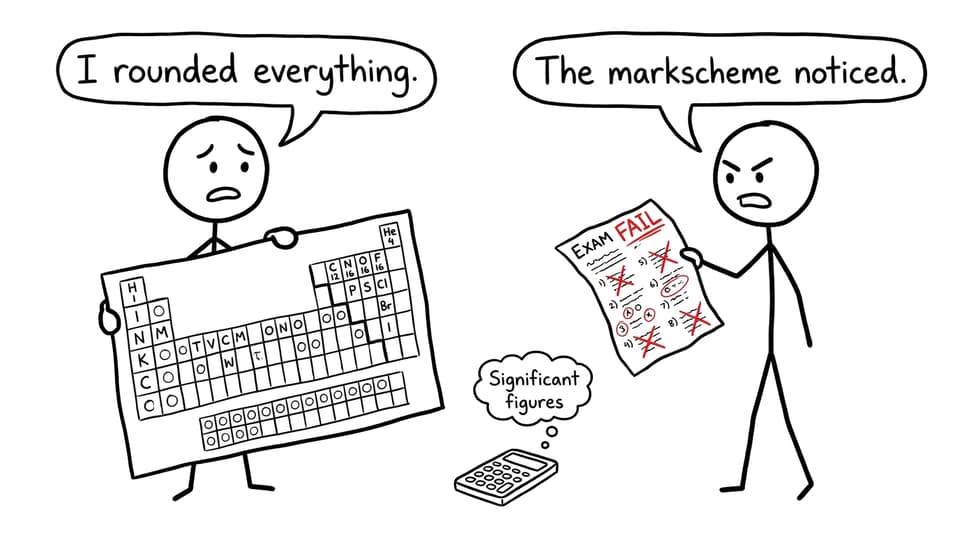
Rounding too early: keep enough decimals until the final step.
-
Forgetting diatomic molecules: (\text{O}_2), (\text{H}_2), (\text{Cl}_2) need the 2.
-
Dropping hydrate water: the dot is not decoration.
-
Mixing up Mᵣ and molar mass: Mᵣ is dimensionless, molar mass has units g mol⁻¹.
Closing: make molar mass your calm starting point
In IB Chemistry, molar mass is less a topic and more a tool. It turns formulas into numbers, grams into moles, and confusing word problems into a sequence you can trust.
If you want to lock it in before exams, use RevisionDojo as your loop: Study Notes to learn the method, Flashcards to keep it active, Questionbank to stress-test it, AI Chat to diagnose mistakes, and Mock Exams plus Predicted Papers to practise under time pressure. When molar mass becomes automatic, the rest of IB Chemistry starts to feel like it has fewer surprises.