

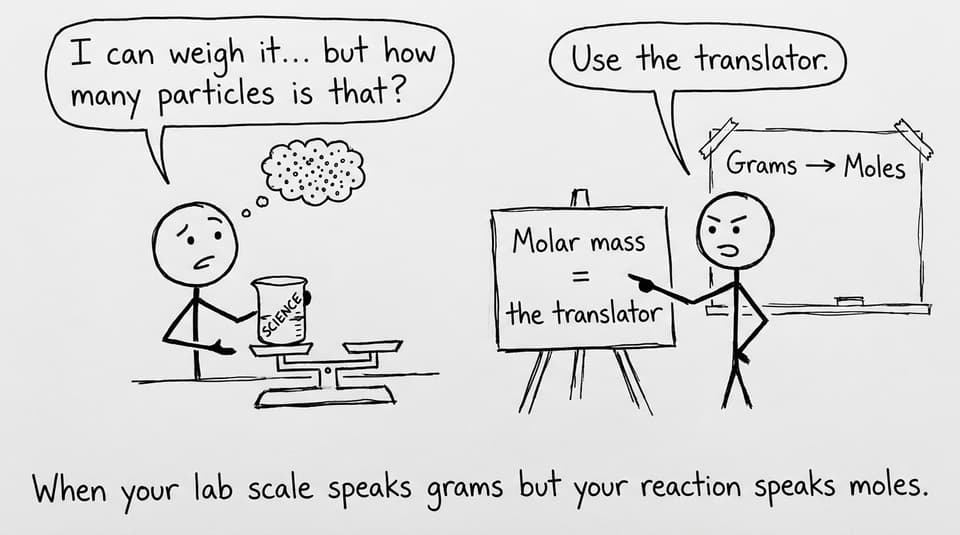
If you have ever stared at a balance reading 3.27 g and thought, “Okay… but how many particles is that?”, you have met the exact problem molar mass was invented to solve. In IB Chemistry, almost every calculation is really a translation problem: the lab gives you grams, the reaction “speaks” in particles, and exam questions demand moles. Molar mass is the exchange rate that makes that translation reliable.
IB Chemistry: What molar mass actually is
In IB Chemistry, molar mass (M) is defined as the mass of 1 mole of a substance, in g mol⁻¹. And 1 mole means a fixed number of particles: Avogadro’s constant, (N_A = 6.022 \times 10^{23}) particles per mole.
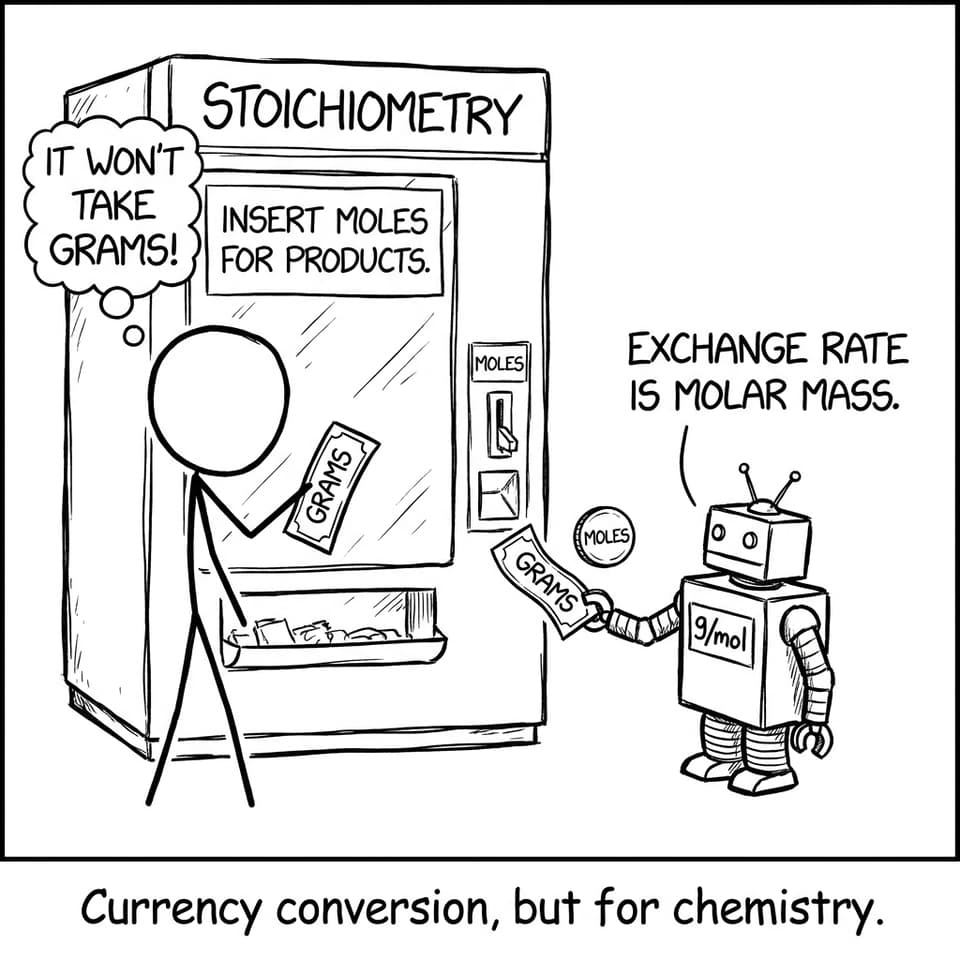
So molar mass is powerful for one simple reason: it pins a measurable mass (grams) to a fixed particle count (moles). That is why the conversion is always proportional.
To tighten this idea, connect it to your core mole lessons:
The “bridge” idea: grams <--g/mol--> moles
Think of molar mass as a bridge with units printed on it.
-
To go from grams to moles: (n = \frac{m}{M})
-
To go from moles to grams: (m = n \times M)
That unit logic is why IB examiners love it: g divided by (g mol⁻¹) becomes mol. No magic, just consistent units.
If you want a quick worked pathway with common pitfalls, use:
Why IB Chemistry needs moles (not grams) for reactions
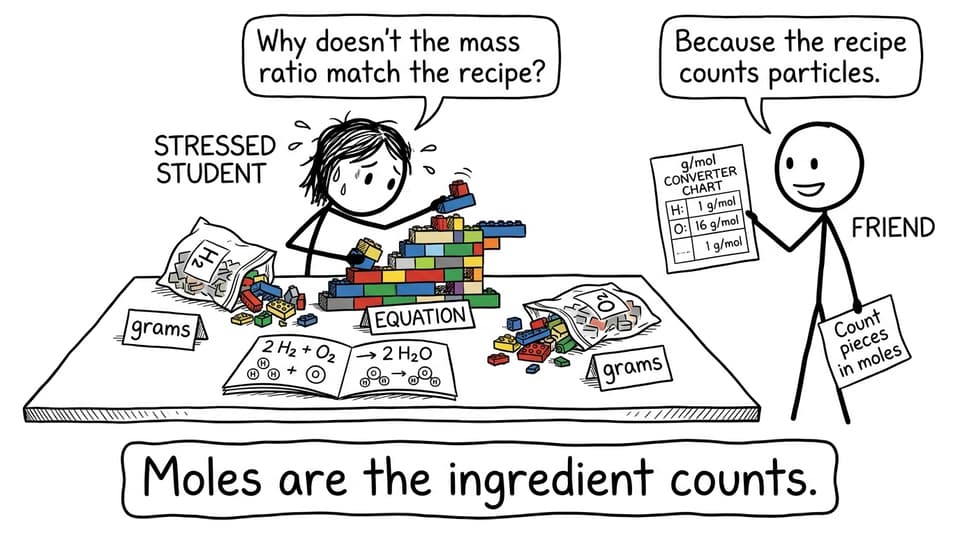
Chemical equations are written in particle ratios. When you balance:
you are not saying “2 grams of hydrogen.” You are saying 2 moles of (H_2) react with 1 mole of (O_2). That is a counting statement.
But in real labs (and in data booklets), you measure mass. So IB Chemistry uses molar mass to translate your measured grams into the mole ratios that the equation actually represents. This is the engine behind stoichiometry, limiting reagents, and yield questions.
To practice this in syllabus context, these RevisionDojo pages connect directly:
A fast exam checklist (grams <-> moles)
Use this 15-second checklist before you calculate:
-
Write the relationship: (n = m/M)
-
Confirm units: m in g, M in g mol⁻¹, n in mol
-
Recalculate molar mass from the formula, not from memory
-
Only then apply mole ratios from the balanced equation
If you want targeted practice, RevisionDojo’s Questionbank plus AI Chat feedback is ideal for catching unit slips early:
Closing: Make molar mass your default “translator”
In IB Chemistry, molar mass works because it locks grams to a fixed mole of particles, giving you a dependable bridge between what you can measure and what reactions actually use. If you want this to feel automatic under timed conditions, build the habit with RevisionDojo’s Study Notes, Flashcards, and Questionbank, then use AI Chat to diagnose why a conversion went wrong. Add Mock Exams, Predicted Papers, and the Grading tools when you are close to exam season, and you will stop guessing and start translating confidently, grams to moles, every time.